
Vale's Weakening Investment Appeal: Market Shifts and Diminishing Valuation Advantages
Vale SA (VALE) has long been a cornerstone of the global mining sector, but its investment appeal is showing signs of strain as shifting market dynamics and valuation pressures converge. Despite a 47% stock price surge in 2025-outpacing the S&P 500 and its peers-the company faces mounting challenges in iron ore markets, energy transition metals, and competitive positioning. This analysis examines the forces eroding Vale's once-robust investment case and questions whether its valuation advantages are sustainable.
Iron Ore: Oversupply and Weak Demand Undermine Profitability
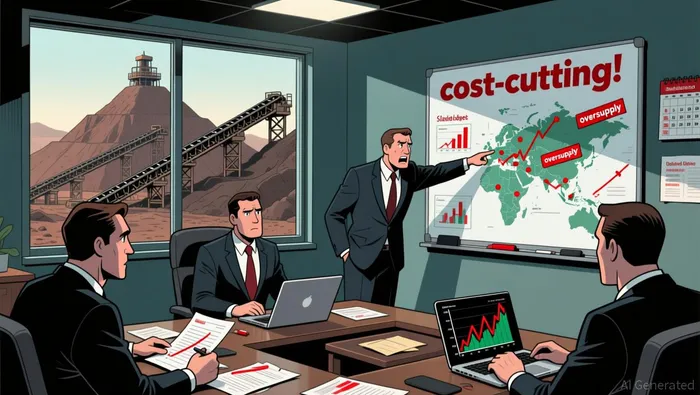
Iron ore, Vale's core asset, has become a drag on its performance. The average realized price for iron ore fines in Q1 2025 fell to $90.8/t, a 10% year-over-year decline driven by oversupply and weak demand from Chinese steel mills. This has compressed Vale's EBITDA, which dropped 8% year-over-year to $3.2 billion in Q1 2025. While ValeVALE-- has mitigated some pressure through cost-cutting- reducing C1 cash costs to $21.0/t, down 11% year-over-year-it remains vulnerable to further price declines.
The oversupply issue is structural. Chinese steel demand, which accounts for over 50% of global consumption, has plateaued due to economic slowdowns and regulatory curbs on overcapacity. Meanwhile, global iron ore production has surged, with rivals like Rio Tinto and BHP Group maintaining high output levels. Vale's strategic pivot to energy transition metals, while promising, cannot offset near-term iron ore headwinds.
Energy Transition Metals: Nickel Oversupply and Copper Uncertainty
Vale's pivot to copper and nickel, critical for electric vehicles and renewable energy, has hit roadblocks. The nickel market, in particular, is oversupplied, with Indonesia's rapid production expansion suppressing prices and squeezing Vale's margins. Vale's nickel division reported single-digit EBITDA margins in early 2025, a stark contrast to its iron ore operations. The company is now exploring asset sales and partnerships to reduce exposure to volatile nickel markets.
Copper, while in higher demand, is not immune to volatility. Vale aims to boost copper production to 700 kt by 2035, but this depends on market rebalancing and sustained demand growth- both of which remain uncertain. Environmental and social risks further complicate Vale's energy transition strategy. A recent report highlights ongoing scrutiny of Vale's operations in Brazil, including past environmental disasters and ties to extractive finance linked to deforestation and labor rights violations. These issues threaten Vale's reputation and could attract regulatory or activist investor pressure.
Valuation Metrics: Attractive But Diminishing
Vale's valuation appears compelling at first glance. Its forward P/E ratio of 6.26x and enterprise value to EBITDA ratio of 3.17x for 2025 are among the lowest in the Metals & Mining industry. However, this undervaluation reflects underlying risks rather than a sustainable competitive advantage. Vale's P/E ratio has risen from 4.16 in early 2025 to 9.44 by November 2025, driven largely by its 47% stock price gain. Yet, this growth may not be justified by fundamentals.
Comparative analysis with peers reveals a narrowing valuation gap. Rio Tinto trades at an EBITDA multiple of 5.89x, while Fortescue's multiple stands at 7.4x according to multiples data. Vale's forward P/E of 6.34x is lower than the industry median of 20.35x, but this could erode as investors rotate toward companies with stronger growth profiles. Vale's debt levels, though manageable with a Debt/Equity ratio of 0.44), are not a differentiator in an industry where leverage is common.
Risks and the Path Forward
Vale's challenges are multifaceted. Iron ore demand is unlikely to rebound without a global economic upturn, while energy transition metals face structural oversupply and regulatory headwinds. The company's Altman-Z score of 1.98 places it in a "grey zone" for bankruptcy risk, and its Debt to Free Cash Flow ratio of 6.13 suggests it would take over six years to pay off debt using FCF.
To regain its investment appeal, Vale must accelerate its pivot to energy transition metals while addressing operational and reputational risks. Strategic partnerships in nickel and copper, coupled with cost discipline, could stabilize its margins. However, the window for such measures is narrowing. As the market increasingly prioritizes companies with clear growth trajectories and sustainable practices, Vale's current valuation advantages may prove temporary.





Comentarios
Aún no hay comentarios