
Vale (VALE): Undervalued Commodity Giant Poised for Energy Transition Growth
Financial Resilience Amid Commodity Volatility
Vale's Q3 2025 results underscore its operational resilience. Net operating revenue rose to $10.42 billion, a 9% year-over-year increase, driven by higher iron ore and copper sales. According to the financial report, while operating income dipped to $2.79 billion from $3.68 billion in 2024, net income attributable to shareholders climbed to $2.69 billion, reflecting improved cost management. Notably, Vale's all-in costs for iron ore fell 4% year-over-year to $52.9/ton, and copper costs plummeted 65% to $994/ton. These efficiencies, coupled with a 5% year-over-year rise in iron ore sales and a 11% quarter-over-quarter increase in realized prices, demonstrate Vale's ability to navigate cyclical headwinds.
Analysts have taken notice. Barclays and JPMorgan upgraded their price targets to $14.50 and $14, respectively, citing Vale's cost discipline and production growth. Meanwhile, Vale's trailing P/E of 9.87 and forward P/E of 6.56 suggest the market is underappreciating its earnings potential. For context, the mining sector's average P/E hovers around 12x, implying Vale is trading at a significant discount to its peers.
Strategic Positioning in the Energy Transition
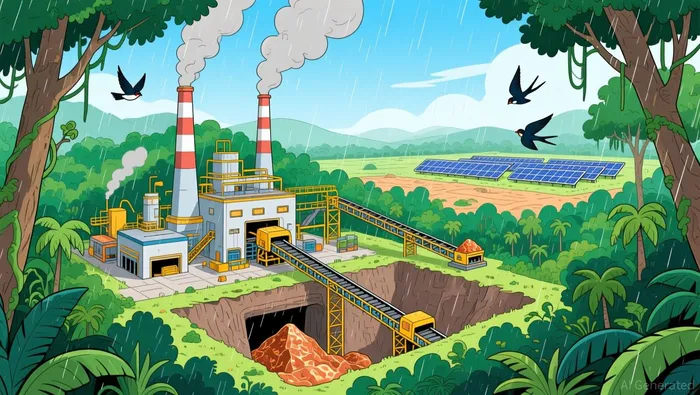 The energy transition is reshaping global commodity demand, and Vale is pivoting to capitalize on this shift. Copper demand is projected to grow by 30% by 2040. Vale's strategy to double copper output to 700,000 tonnes by 2035-leveraging its Carajás region infrastructure and the Bacaba project-positions it to benefit from this surge. The Bacaba project alone, expected to produce 50,000 metric tons of copper concentrate annually by 2028, could bolster Vale's market share.
Unlike peers prioritizing rapid expansion, Vale is emphasizing sustainable, cost-efficient growth. It plans to invest 70 billion reais ($13 billion) in the Amazon region through 2030, focusing on internal project development rather than acquisitions. This approach aligns with broader industry trends, where sustainability and automation are becoming central to competitive advantage. Vale's commitment to decarbonization-84% of its electricity now comes from renewables, with a target of 100% by 2030-further strengthens its long-term appeal.
Contrarian Case: Undervaluation Amid Industry Shifts
Vale's current valuation appears disconnected from its strategic and operational strengths. While top copper producers like Codelco and Freeport-McMoRan are expected to produce 700,000 to 1.7 million tonnes annually in 2025, Vale's 2025 output of 340,000–370,000 tonnes is modest. However, its focus on gradual, sustainable growth-rather than aggressive scale-may be underappreciated by a market fixated on short-term volume metrics.
Moreover, Vale's earnings trajectory suggests untapped potential. Analysts project EPS to rise to $1.85 in 2025 and $2.11 in 2026, reflecting a 14% growth rate. At a forward P/E of 6.56, this implies significant upside if the market begins to price in these expectations. The recent EPS beat of $0.63 (versus a consensus of $0.49) further highlights management's ability to exceed forecasts.
Risks and Considerations
No investment is without risk. Commodity prices remain volatile, and Vale's exposure to iron ore-a commodity with slowing demand growth-could weigh on long-term prospects. Additionally, regulatory and environmental hurdles in the Amazon region pose operational risks for projects like Bacaba. However, Vale's cost discipline and renewable energy initiatives mitigate some of these concerns, while its copper-focused strategy aligns with secular trends.
Conclusion: A Contrarian Bet on Long-Term Value
Vale's low valuation, combined with its strategic pivot toward copper and sustainability, makes it an attractive contrarian play. While the market may currently undervalue its energy transition positioning and cost advantages, the growing demand for copper-driven by electrification and decarbonization-could catalyze a re-rating. For value investors willing to look beyond near-term volatility, Vale offers a rare combination of discounted pricing and long-term growth potential.





Comentarios
Aún no hay comentarios