
VALE S.A. (VALE) Outperformance in 2025: Operational Resilience and Cost Efficiency in a Volatile Commodity Cycle
Operational Resilience: A Pillar of Stability
VALE's ability to maintain profitability during volatile conditions is underscored by its cost management and automation initiatives. In Q2 2025, the company reduced iron ore C1 cash costs by 11% to $22.2 per ton, a significant achievement in a sector where margin compression is common during price swings, as shown in Vale's stock price history. This reduction reflects Vale's focus on automation, such as autonomous haul trucks and predictive maintenance systems, which have streamlined operations and reduced labor and fuel expenses, according to Vale's Q2 2025 report.
The company's strategic pivot to energy transition metals further strengthens its resilience. Copper and nickel production surged by 17% and 21%, respectively, in Q2 2025, driven by growing demand for electric vehicles and renewable energy infrastructure, which diversifies Vale's revenue away from iron ore and aligns with long-term decarbonization trends.
Cost Efficiency and Capital Discipline
Vale's capital discipline has been another key differentiator. Free cash flow generation improved in Q2 2025, supported by reduced capital expenditures and higher production volumes, as shown in Vale's stock price history. The company's focus on optimizing working capital and minimizing debt has positioned it to fund dividends and strategic acquisitions without overleveraging. For instance, Vale's full acquisition of the Agua Limpa mine in Brazil-completed in early 2025 for $23.4 million-eliminated joint venture complexities and consolidated control over a critical iron ore asset, as reported in Vale secures full control. This move is expected to enhance operational flexibility and reduce administrative overhead, according to Mining.com.
Stock Performance: Mixed Results in a Challenging Sector
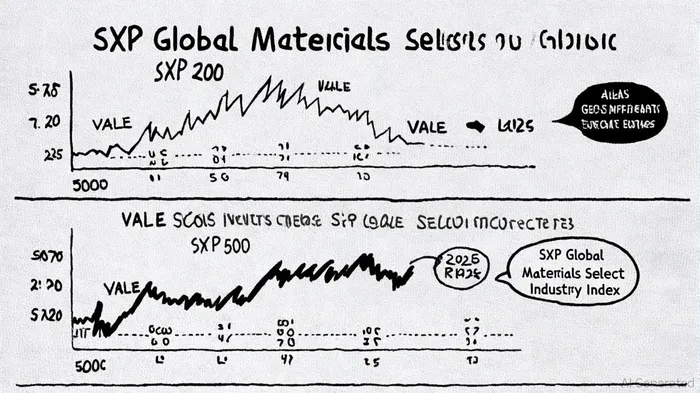
Despite these operational strengths, VALE's stock has underperformed the S&P 500, which gained 17.1% year-to-date, while VALE returned just 5.31%, according to Vale's stock price history. This gap reflects broader challenges in the mining sector, including weak iron ore prices and operational disruptions like heavy rainfall in Brazil during Q1 2025, as noted in a Mining.com article. However, recent short-term performance tells a different story. In late 2025, VALE outpaced both the S&P 500 and the Basic Materials sector, with a daily gain of 2.42% compared to the sector's -2.84% decline, per Vale's Q2 2025 report. This suggests that Vale's cost efficiency and strategic investments are beginning to resonate with investors.
Analysts remain cautiously optimistic. A "Moderate Buy" consensus rating is supported by an average 12-month price target of $11.71, implying a potential 12.54% upside from current levels, according to the VietnamSteel piece. This optimism is tied to Vale's ability to balance short-term cost controls with long-term growth in energy transition metals.
Strategic Positioning for the Future
Vale's 2025 production guidance of 325–335 million tons of iron ore, coupled with its aggressive cost-cutting measures, positions it to outperform peers in a low-growth environment, as discussed in the VietnamSteel piece. The company's full ownership of the Agua Limpa mine and its focus on copper and nickel also align with decarbonization megatrends, which are expected to drive demand for these metals over the next decade, according to Vale's Q2 2025 report.
While Vale's stock has lagged the S&P 500, its operational discipline and strategic agility suggest a narrowing of this gap as energy transition metals gain market share. Investors may find value in Vale's ability to balance cost efficiency with long-term growth, even in a volatile commodity cycle.





Comentarios
Aún no hay comentarios