
Vale vs. Cleveland-Cliffs: Which Stock is a Better Buy Now?
Vale S.A VALE and Cleveland-Cliffs Inc. CLF are major players in the global iron ore and steel supply chain. ValeVALE-- is a leading iron ore producer and Cleveland-CliffsCLF-- is a top U.S. steelmaker and iron ore pellet supplier. Both companies are closely linked to steel demand, infrastructure spending and broader industrial trends.
Headquartered in Brazil, Vale S.A is one of the world’s largest iron ore producers, the key steelmaking ingredient. It also produces nickel, copper and cobalt, as well as by-products, such as gold, silver, platinum group metals, and other precious metals.
Cleveland-Cliffs is a leading North America-based steel producer with a focus on value-added sheet products, particularly for the automotive industry. The company transitioned from an iron ore miner to a fully integrated steelmaker following its 2020 acquisitions of AK Steel and ArcelorMittal USA. CLFCLF-- has a vertically integrated portfolio, spanning mining to manufacturing steel products, including stamping, tooling and tubing. It has the unique advantage as a steel producer of being fully or partially self-sufficient with its production of raw materials for steel manufacturing, which includes iron ore pellets, HBI, scrap, coking coal and coke.
The steel industry has faced significant challenges due to overcapacity and excess production of steel. Nevertheless, long-term growth in global steel demand is expected to be supported by urbanization and infrastructure development.
The Case for Vale
Vale reported revenues of $38 billion in 2025, 1% higher year over year. Higher sales volumes for copper, nickel and iron ore and increased copper prices were offset by lower iron ore and nickel prices. Adjusted earnings per share were $1.82, up 15% supported by ongoing cost discipline.
Vale continued to lower all-in costs by 3% in its iron business, 77% in the copper business and 27% in the nickel business in 2025, marking the second consecutive year of cost reduction.
Operationally, Vale delivered strong output in 2025, with iron ore production of around 336 Mt, copper output of about 382 kt and nickel production of roughly 177 kt, all exceeding expectations. Iron ore and copper output reached the highest levels since 2018, while nickel production was the strongest since 2022.
Vale targets iron ore production capacity at 335-345 Mt in 2026 and plans to take it up to 360 Mt by 2030. The Vargem Grande 1 (VGR1) project and the Capanema Maximization project are anticipated to play a key role in attaining these targets, each expected to add about 15 Mtpy of capacity. Additional initiatives, including Compact Crushing at S11D and Serra Sul, are also set to boost capacity from the second half of 2026.
Vale is also investing heavily in the base metals business to benefit from the global energy transition. In 2026, Vale's copper production is expected to be between 350 kt and 380 kt. Copper production is expected to reach 420-500 kt as of 2030 and 700 kt by 2035. With these projections, the company projects a 7% CAGR over 2024-2035 compared with the 4% average for peers.
Projects such as Bacaba will extend the life of the Sossego Mining Complex, contributing an average annual copper output of 50 ktpy over an eight-year mine life. Production is expected to start in the first half of 2028. Other projects, such as Salobo Coarse Particle Flotation (CPF), Alemão and Cristalino, will increase Vale’s copper production capacity.
Vale recently signed an agreement with Glencore Canada (Glencore) to jointly evaluate a potential brownfield copper development project at their adjacent properties in the Sudbury Basin, with an expected start-up in 2030. Vale plans to hit 700 kt levels by 2035, primarily through the accelerated development of assets in the North and South hubs in the Carajás region.
For 2026, Vale expects its nickel production to be between 175 kt and 200 kt, reflecting replenishment projects in Canada, exposure to Pomalaa and Morowali, and the start-up of the second furnace at Onça Puma. For 2030, nickel production is anticipated at 210-250 kt, with input from projects such as Thompson Ultramafics, Sorowako HPAL, partnership projects and offtake.
The Case for Cleveland-Cliffs
CLF reported revenues of $18.6 billion, down 3%. The company posted an adjusted loss of $2.48 per share, wider than the adjusted loss of 74 cents per share in 2024, reflecting weak demand in the automotive sector and lower steel prices.
Management expects some improvement in 2026, guiding for steel shipment volumes of approximately 16.5–17.0 million net tons compared with 16.2 million net tons in 2025.
Cleveland-Cliffs’ largest end market is the North American automotive sector, which makes light vehicle production a key driver of demand. Light vehicle production in 2025 remained below the five-year pre-COVID level of approximately 17 million units. North American light vehicle output was 15.3 million units, down from 15.4 million units in 2024.
The average age of light vehicles in the United States is currently at an all-time high of 12.8 years, which is expected to boost replacement demand. Also, 25% tariff on imports of automobiles and certain automobile parts is expected to lead to higher demand for domestically produced vehicles that consume domestically made steel. Lower interest rates could boost demand for vehicles. As a leading supplier of automotive-grade steel in the United States, Cleveland-Cliffs will benefit from healthier domestic vehicle production over the coming years.
The company has continued cost-cutting efforts that were initiated in 2023. It has managed to reduce year-over-year cost per ton as it worked through higher cost inventory. CLF expects to maintain a strong focus on cost discipline for the long term. It has also optimized its asset footprint, exited non-core operations and secured multi-year contracts with key automotive customers.
Beyond steel, Cleveland-Cliffs has begun exploring rare-earth potential at its ore bodies and tailings basins. It has identified two sites with key geological indicators for possible rare-earth extraction. Though an early-stage initiative, if successful, the company could benefit from the increasing demand for domestically produced rare-earth elements.
How do Estimates Compare for VALE & CLF?
The Zacks Consensus Estimate for Vale’s fiscal 2026 earnings indicates a year-over-year rise of 16.5%. The estimate for earnings for fiscal 2027 reflects 2.5% growth. Both the earnings estimates for fiscal 2026 and fiscal 2027 for VALE have moved up over the past 60 days.
The Zacks Consensus Estimate for Cleveland-Cliffs’ 2026 earnings is pegged at a loss of 38 cents per share, narrower than the loss of $2.48 in 2025. The estimate for 2027 earnings is 63 cents per share. Both the EPS estimates for CLF for fiscal 2026 and fiscal 2027 have been revised downward in the past 60 days.

Image Source: Zacks Investment Research
Vale & Cleveland-Cliffs: Price Performance & Valuation
In a year, Vale stock has appreciated 72.2% while Cleveland-Cliffs declined 1.9%.

Image Source: Zacks Investment Research
Vale is trading at a forward price-to-sales multiple of 1.88X, while Cleveland-Cliffs’ forward sales multiple sits at 0.29X.
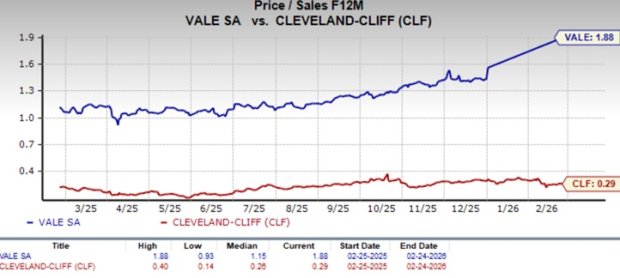
Image Source: Zacks Investment Research
VALE or CLF: Which is a Better Pick?
Both companies will benefit from long-term steel demand tied to infrastructure and industrial growth. However, despite a premium valuation, a diversified metals portfolio, strong production execution, improving cost structure, positive earnings growth projections as well as upward revision activity strengthen the investment case for Vale.
Cleveland-Cliffs, on the other hand, continues to face earnings pressure, heavy exposure to the cyclical automotive sector and ongoing losses despite cost optimization. Downward estimate trends and high sensitivity to steel price fluctuations weigh on its outlook, even as management pursues strategic initiatives and cost discipline.
Investors seeking exposure to the space might consider VALE to be the more favorable option at this time and steer clear of CLF. While VALE currently carries a Zacks Rank #3 (Hold), Cleveland-Cliffs has a Zacks Rank #4 (Sell).
You can see the complete list of today’s Zacks #1 Rank (Strong Buy) stocks here.
Zacks Names #1 Semiconductor Stock
This under-the-radar company specializes in semiconductor products that titans like NVIDIA don't build. It's uniquely positioned to take advantage of the next growth stage of this market. And it's just beginning to enter the spotlight, which is exactly where you want to be.
With strong earnings growth and an expanding customer base, it's positioned to feed the rampant demand for Artificial Intelligence, Machine Learning, and Internet of Things. Global semiconductor manufacturing is projected to explode from $452 billion in 2021 to $971 billion by 2028.
See This Stock Now for Free >>Want the latest recommendations from Zacks Investment Research? Today, you can download 7 Best Stocks for the Next 30 Days. Click to get this free report
VALE S.A. (VALE): Free Stock Analysis Report
Cleveland-Cliffs Inc. (CLF): Free Stock Analysis Report
This article originally published on Zacks Investment Research (zacks.com).





Comentarios
Aún no hay comentarios