
VA Disability Fraud: A Systemic Vulnerability, Not a National Scandal
The central investor question for the VA disability program is not about isolated fraud, but about systemic failure. With a $193 billion budget supporting 6.9 million beneficiaries, the program's sustainability hinges on its operational integrity. The evidence points to a system where the cost of error and delay far outweighs the cost of the rare, prosecuted fraud case.
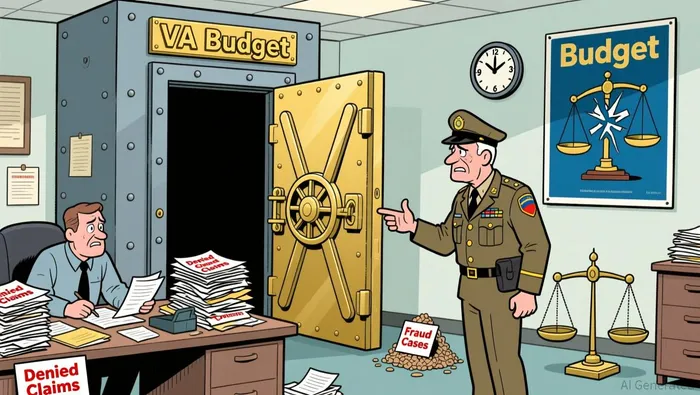
The scale of scrutiny is telling. The VA Office of Inspector General opens approximately 63 fraud investigations per year, a rate that scrutinizes only about 0.001% of beneficiaries. This minuscule caseload relative to program size demonstrates how small the fraud problem is in absolute terms. The stark ratio is even more revealing: for every fraud prosecution since 2017, there were roughly 12,857 denied claims in FY2024 alone. This isn't a story of rampant fraud; it's a story of a system where the vast majority of its operational burden-hundreds of thousands of denied claims-arises from processing errors, staffing shortages, and complex adjudication, not criminal intent.
Contrast this with broader federal fraud contexts, and the VA's position becomes clear. The Pentagon's failed audit involved $4.1 trillion in assets with control failures. Healthcare fraud is estimated at 3-10% of total spending, a range that dwarfs the VA's investigation rate. In this light, the VA disability program operates with one of the lowest fraud footprints in the federal government. The editorial choice to focus investigative resources here, rather than on trillions in Pentagon assets or hundreds of billions in healthcare fraud, reveals a narrative framing that prioritizes dramatic individual cases over systemic statistical context.
The real vulnerability is operational. A July 2024 OIG report found that processing errors in disability ratings caused $84.7 million in underpayments to veterans, a figure that is more than eight times the $9.8 million in overpayments. This is the system's flaw: it systematically harms the very beneficiaries it is designed to serve. The cost of this failure-delayed care, financial hardship, and veteran deaths while waiting for decisions-is a direct drain on the program's legitimacy and budget. For investors in the broader federal fiscal landscape, the lesson is structural: the most significant risks to large, complex programs often lie not in criminal fraud, but in the high cost of systemic inefficiency and error.
The Mechanics of Accidental and Intentional Exploitation
The VA disability compensation program's financial and operational health is strained by a dual burden: deliberate fraud and a vast pool of administrative overpayments. The system's complexity creates distinct pathways for both, with the latter often being the more costly and systemic issue.
The first pathway is intentional exploitation through unaccredited intermediaries. The evidence shows a clear market for predatory claims assistance, where third parties charge illegal fees and submit unsupported claims. While the VA prohibits most paid help outside its accredited representative network, veterans remain legally responsible for submissions made on their behalf. This creates a vulnerability where a veteran's good-faith reliance on bad advice can trigger an investigation or debt collection action. This mechanism is a direct conduit for fraud, as these consultants have a financial incentive to inflate claims and bypass proper oversight.
The second, and more insidious, pathway is "accidental fraud" driven by self-reported information and complex rules. The VA's reliance on veterans to accurately report symptoms and changes in circumstances sets up a high-friction system. As the evidence notes, discrepancies between a veteran's statements and medical records are a common trigger for fraud referrals, even when there is no intent to deceive. This is particularly acute for conditions like Total Disability based on Individual Unemployability (TDIU), where the rules around reporting employment are not intuitive. A veteran returning to work may reasonably assume their benefits continue, leading to an overpayment that is later flagged as potential fraud. The process itself can feel punitive, with investigations and benefit suspensions occurring long before intent is resolved.
The third, and most structurally problematic, pathway is the perverse incentive embedded in the program's design. The rating system creates a financial distortion where easily treatable, non-combat conditions cost billions while severe, combat-related injuries receive comparatively less. The numbers are stark: about 556,000 veterans receive benefits for eczema and 332,000 for hemorrhoids, conditions that rarely hinder employment. In contrast, fewer than 1,700 receive payments for losing limbs during the wars in Afghanistan and Iraq. This imbalance is not just a matter of scale but of value. The evidence highlights that VA typically pays veterans diagnosed with sleep apnea more than a combat vet with a leg amputated below the knee. This regulatory gap turns the program into a rich target for exploitation, as con artists can focus on high-value, easily manipulable claims.
The bottom line is that the program's mechanics generate a significant and persistent overpayment problem. While deliberate fraud, like the $1.1 million and $1.2 million cases cited, is headline-grabbing, the systemic overpayments from accidental misreporting and flawed incentives are the deeper, more costly wound. They strain the budget, delay processing for legitimate claims, and create a cycle of debt and investigation that burdens both the VA and the veterans it serves.
Risks, Reforms, and the Path Forward
The political and operational risks facing the VA disability system are converging, creating a powerful catalyst for change that may prioritize cost savings over beneficiary support. The immediate trigger is a wave of bipartisan criticism, with Project 2025 proposing to target significant cost savings by revising disability rating awards for future claimants. This isn't just a policy tweak; it's a structural shift aimed at altering the program's financial trajectory. The primary driver, however, is political pressure to cut costs, not a fundamental need to reduce fraud. The evidence shows the scale of the fraud problem is minuscule relative to the program's size. The VA Office of Inspector General opens about 63 fraud investigations per year, scrutinizing 0.001% of the 6.9 million beneficiaries. For every prosecution, there were roughly 12,857 claims denied in FY2024 alone. The focus on a tiny fraction of cases risks becoming a pretext for broader reforms that could reduce benefits for legitimate claimants.
This political pressure is amplified by a broader federal context of control failures. The Pentagon's failed its seventh consecutive audit in FY2024, with approximately 63% of its assets improperly accounted for. This systemic audit failure demonstrates that control breakdowns are a widespread issue across government, not unique to the VA. It provides a convenient backdrop for critics to argue that all federal programs, including VA disability, need stricter oversight and cost discipline. The implication is that reforms may be driven more by a desire to demonstrate fiscal responsibility across the federal government than by a targeted effort to combat a specific fraud epidemic.
The operational risk is that these reforms will compound existing systemic failures. The VA disability system is already burdened by processing delays and high denial rates, with approximately 36% of claims denied in FY2024. Many of these denials are later overturned on appeal, pointing to quality issues in initial adjudication. A "flawed system" in this context is one that fails veterans through bureaucratic complexity and error, not through widespread fraud. As former VA Secretary David Shulkin noted, the system places the burden on them to gather extensive documentation. Any reform that simplifies or revises future disability awards could inadvertently increase the administrative burden on claimants or make it harder to secure benefits, turning a system that already struggles to serve its beneficiaries into a more frustrating and less fair one.
The bottom line is that the path forward is being shaped by political expediency rather than a balanced assessment of risk. The catalyst for change is the political will to cut costs, using the narrative of fraud as justification. This creates a clear vulnerability: reforms aimed at "cost savings" could lead to a reduction in benefits for legitimate claimants and an increase in administrative appeals, further straining an already overburdened system. The outcome will depend on whether policymakers can distinguish between the rare instances of fraud and the systemic challenges of processing millions of complex claims.







Comentarios
Aún no hay comentarios