
UXLINK's Strategic 2026 Transformation and Scalability in Web3: AI-Driven Monetization and Asia's Expansion
In the rapidly evolving Web3 landscape, UXLINK has positioned itself as a pivotal player through a dual strategy of AI-driven monetization and aggressive regional expansion in Asia. As the project enters 2026, its roadmap reflects a calculated shift toward scalability, tokenomics optimization, and localized innovation. This analysis examines how UXLINK's strategic initiatives-ranging from AI-native infrastructure to cross-chain interoperability-could redefine its role in the Web3 ecosystem and attract institutional and retail investors alike.
Tokenomics Reinvention: Buybacks and Strategic Reserves
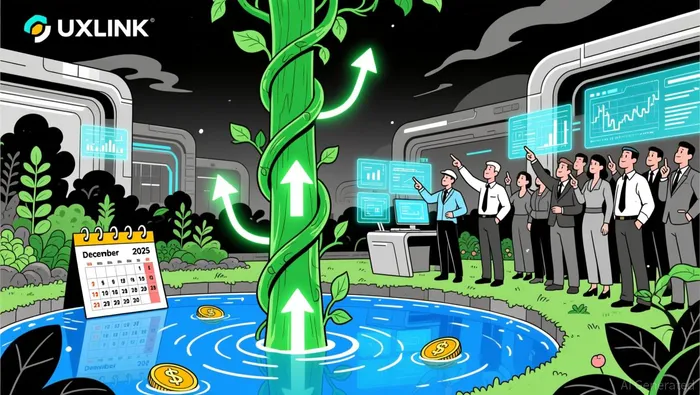
UXLINK's recent community-approved buyback and strategic reserve program marks a bold step in Web3 governance. Starting in December 2025, the project began repurchasing at least 1% of its total token supply monthly using project profits, with tokens deposited into a strategic reserve pool according to the project proposal. This mechanism not only stabilizes the token's value but also signals a commitment to long-term value accumulation. By prioritizing token buybacks, UXLINK addresses market volatility while aligning incentives between the project and its holders. According to RootData, this approach reflects a "paradigm shift in decentralized governance," where token holders directly influence treasury management.
AI-Driven Monetization: Infrastructure for the Future
UXLINK's 2026 roadmap hinges on AI-driven monetization, with the launch of the UXLINK ONE Mainnet in Q1 2026 as a cornerstone. This Optimistic Rollup, optimized for social applications, promises to reduce gas fees by approximately 70% and enable cross-chain interoperability. The platform's AI-native functionalities-such as autonomous agents and secure AI storage-position it to capture a significant share of the AI-driven Web3 market.
Complementing this is the AI Growth Agents Upgrade in Q2 2026, which introduces personalized recommendations and automated social tasks to enhance user engagement. By leveraging AI to streamline user acquisition and retention, UXLINK aims to reduce operational costs while scaling its user base. For instance, the AI Growth Agents platform, powered by DeepSeek V3 technology, already offers smart content generation and precision matching with target markets, KOLs, and communities. These tools are critical for monetizing Web3's fragmented user base, particularly in Asia, where social media penetration is high.
Asia's Expansion: Localized Partnerships and Cross-Chain Accessibility
UXLINK's regional expansion in Asia is anchored by two key strategies: localized partnerships and cross-chain accessibility. The "One Account One Gas" system simplifies cross-chain transactions, allowing users to access dApps with a single UXLINK account and pay gasGAS-- fees using $UXLINK tokens. This innovation addresses a major barrier to adoption in Asia, where users often juggle multiple blockchain ecosystems.
Partnerships with Asian social platforms further underscore UXLINK's focus on the region. For example, its integration with LINE-a dominant messaging app in Japan and Southeast Asia-enables seamless onboarding for millions of users. Additionally, the strategic partnership with Japanese Web3 accelerator Pacific Meta highlights UXLINK's localized approach, including KOL collaborations and offline events to deepen market penetration according to ChainCatcher. While specific country plans for Thailand or Indonesia remain unannounced, the broader strategy to integrate platforms like TikTok and X into its infrastructure suggests a scalable model for 2026.
FujiPay and Real-World Adoption
UXLINK's FujiPay initiative, set to expand beyond its Seoul pilot to Japan and the U.S. in H2 2026, represents a critical bridge between crypto and traditional finance. By enabling everyday transactions using crypto, FujiPay aims to accelerate mass adoption in Asia, where digital payments are already mainstream. This aligns with broader trends in the APAC region, where countries like Thailand and Indonesia are strengthening data sovereignty regulations. UXLINK's ability to adapt to these regulatory environments will be key to its success.
Risks and Mitigations
Despite its ambitious roadmap, UXLINK faces challenges, including regulatory scrutiny in Asia and competition from established Web3 platforms. However, its proactive approach to addressing past security incidents-such as the migration and compensation plan for affected users-demonstrates a commitment to transparency. The buyback program also serves as a buffer against token price volatility, reinforcing investor confidence.
Conclusion: A Strategic Play for 2026
UXLINK's 2026 transformation is a masterclass in balancing innovation with pragmatism. By combining AI-driven monetization, cross-chain scalability, and localized partnerships, the project is well-positioned to capture a significant share of Asia's Web3 market. For investors, the combination of tokenomics optimization, infrastructure upgrades, and strategic regional expansion presents a compelling case for long-term growth. As the Web3 ecosystem matures, UXLINK's ability to adapt to both technological and regulatory shifts will determine its success-and its current trajectory suggests a strong foundation for 2026.







Comentarios
Aún no hay comentarios