
Is Utz Brands (UTZ) a Misunderstood Value Play in a Shifting Snacks Landscape?
The snack food industry is undergoing a quiet revolution. As consumer preferences pivot toward healthier, more sustainable options, traditional players are scrambling to adapt. Amid this backdrop, Utz BrandsUTZ-- (UTZ) has emerged as a potential outlier-its stock languishing despite a compelling mix of valuation dislocation and strategic realignment. This article examines whether UtzUTZ-- is a misunderstood value play, leveraging its undervalued price-to-sales (P/S) ratio, discounted cash flow (DCF) valuation, and aggressive pivot toward high-margin, health-conscious snacking to signal a compelling entry point for investors.
Valuation Dislocation: A Tale of Two Ratios
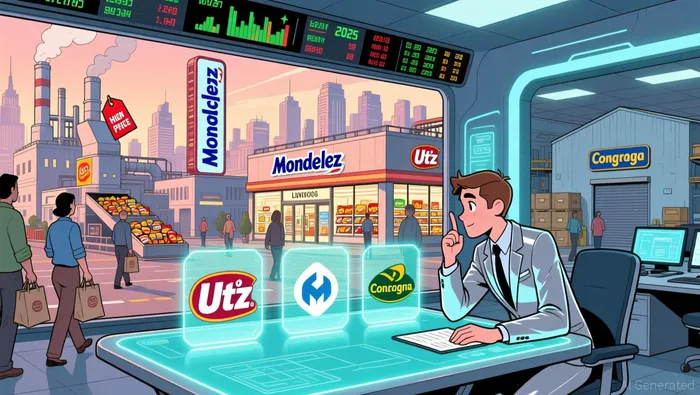
Utz Brands' P/S ratio of 0.79 in 2025 starkly contrasts with industry peers like Mondelez International (18.94) and Conagra Brands (8.68). This chasm suggests a significant valuation dislocation, particularly when compared to the broader market's P/S ratio of 3.3 for the S&P 500 in late 2025. While Utz's low P/S ratio may reflect skepticism about its ability to sustain growth in a declining industry (U.S. snack food revenue fell to $44.2 billion in 2025), it also creates a margin of safety for investors.
 A DCF analysis further underscores this opportunity. Utz is trading at a 14.4% discount to its estimated intrinsic value of $11.19 per share, implying the market is underpricing its long-term cash generation potential. This discount is particularly striking given Utz's recent operational improvements, including a 210-basis-point expansion in adjusted gross profit margin to 41.1% in Q3 2025. Such margin resilience, driven by productivity gains and supply chain optimizations, challenges the narrative of a struggling company.
Growth Narrative Alignment: Strategic Shifts and Industry Tailwinds
Utz's strategic realignment toward healthier snacking and margin expansion directly addresses the industry's evolving dynamics. The company's focus on branded salty snacks-a category with a $4.1 billion market in California- has driven organic net sales growth of 5.8% in Q3 2025. This expansion into a high-growth, high-margin market aligns with broader consumer trends: plant-based and nutrient-dense snacks now account for over 30% of industry revenue.
Moreover, Utz's deleveraging plan and productivity initiatives position it for long-term margin expansion. The company aims to reduce its net leverage ratio from 3.9x to 3x by year-end 2025 while targeting a 15% EBITDA margin through supply chain enhancements and best-in-class productivity savings. These efforts are not theoretical; Utz has already achieved 6% productivity savings in 2025, up from 1% in 2020, demonstrating tangible progress.
The California Gambit: Short-Term Pain for Long-Term Gain
Critics may argue that Utz's California expansion-a $4.1 billion market- will dilute margins in 2026 due to upfront costs. However, this short-term drag is a calculated trade-off for long-term growth. As CFO B.K. Kelley noted, the company remains confident in its ability to achieve a 15% EBITDA margin once the expansion matures. This strategic patience mirrors the approach of successful consumer goods firms that prioritize market share over immediate profitability.
Conclusion: A Compelling Contrarian Case
Utz Brands' valuation dislocation and strategic alignment with industry tailwinds present a compelling case for investors willing to look beyond its multi-year underperformance. While the stock's technical indicators may appear conflicting, the fundamentals tell a different story: a company trading at a meaningful discount to intrinsic value, executing on margin-enhancing initiatives, and capitalizing on a $4.1 billion growth opportunity in California. In a snacks landscape increasingly defined by health-conscious consumers, Utz's pivot toward high-margin, branded salty snacks could position it as a hidden gem.





Comentarios
Aún no hay comentarios