
Utility Risk Management in the Wildfire Era: Southern California Edison's $2 Billion Plan and the Future of Energy Investment
The energy sector is undergoing a seismic shift as climate-driven disasters force utilities to rethink risk management and regulatory strategies. Southern California Edison's (SCE) $2 billion wildfire and mudslide recovery plan, paired with its $6.2 billion 2026–2028 mitigation strategy, epitomizes this transformation. These efforts are not just about infrastructure resilience—they are a blueprint for how utilities are navigating the intersection of climate risk, regulatory oversight, and investor expectations in an era of escalating natural disasters.
The Cost of Catastrophe: A $2 Billion Settlement and Its Implications
SCE's recent settlement to recover $2 billion in losses from the 2017–2018 wildfires, including the Woolsey Fire, underscores the financial toll of climate-related disasters. The agreement, approved by the California Public Utilities Commission (CPUC), allows the utility to recover 43% of its total costs, with $1.6 billion in uninsured claims and $400 million in legal fees covered[1]. This settlement is critical for SCE's financial stability, as it shifts part of the burden to ratepayers and shareholders while retaining 35% of post-May 2025 losses[2].
Investors are watching closely. For every dollar recovered, there is a ripple effect on credit ratings and capital allocation. Moody's RMS, which developed a wildfire risk model for SCE, has shown that such settlements reduce liability exposure but also highlight the need for proactive mitigation[3]. The utility's ability to balance recovery with reinvestment—such as its $50 million earmarked for system enhancements—signals a strategic approach to managing both immediate and long-term risks[4].
A Layered Defense: Technology, Regulation, and Innovation
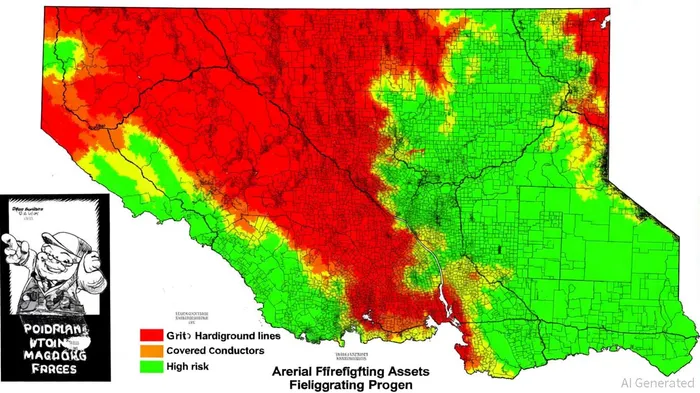
SCE's 2026–2028 plan is a masterclass in layered risk mitigation. The $6.2 billion investment includes 440 circuit miles of covered conductor, 260 circuit miles of underground distribution lines, and AI-driven diagnostics to detect faults[5]. These measures are not just about hardening the grid—they are about redefining utility operations in a world where wildfires are no longer outliers but annual threats.
Regulatory approval has been a tightrope walk. The CPUC's 5-0 approval of the 2025 plan, despite the EatonETN-- Fire investigation, reflects regulators' prioritization of continuity over delay[6]. This decision aligns with California's broader push to insulate utilities from bankruptcy via the California Wildfire Fund, which now boasts $21 billion in insurance protection[7]. For SCE, this means access to a safety net that other states lack, giving it a competitive edge in capital markets.
Industry Trends: From Liability to Resilience
SCE's strategy mirrors a sector-wide shift. Utilities like Pacific Gas & Electric (PG&E) and PacifiCorp have spent billions on wildfire mitigation, with PG&E alone allocating $18 billion for 2023–2025[8]. The market for wildfire risk solutions—hardware, software, and services—is projected to grow exponentially, driven by federal programs like the Grid Resilience Innovation Partnership (GRIP) and state-level mandates[9].
Investor sentiment is equally pivotal. A Stanford study found that utilities in the Southeast and Midwest lag in preparedness, exposing them to higher liability risks[10]. In contrast, California's regulatory framework—coupled with SCE's technological investments—has bolstered investor confidence. For example, SCE's 2024 financial report showed $18.4 billion in revenue and $1.37 billion in net income, despite $10 billion in wildfire-related liabilities[11]. This resilience is a testament to the power of proactive risk management.
The Road Ahead: Balancing Affordability and Safety
The challenge lies in balancing affordability with safety. While SCE's mitigation efforts have reduced wildfire risk by 85–90% since 2018[12], ratepayers are bearing a growing share of costs. California's legislative push to expand the Wildfire Fund by $18 billion—split between ratepayers and shareholders—aims to ease this burden[13]. However, utilities in states like Texas and Idaho, which lack such mechanisms, face a steeper climb.
For investors, the lesson is clear: utilities that integrate climate risk into their DNA will outperform peers. SCE's layered approach—combining technology, regulatory alignment, and financial planning—sets a benchmark. Yet, as the Eaton Fire investigation shows, even the most robust plans can face scrutiny[14]. The key is continuous innovation and transparency.
Conclusion: A New Paradigm for Energy Investment
Southern California Edison's journey from liability to resilience reflects a broader transformation in the energy sector. As wildfires become a defining risk of the 21st century, utilities must evolve from passive responders to proactive stewards of infrastructure. For investors, the stakes are high: those who back companies like SCE, with their blend of innovation and regulatory foresight, will likely see stronger returns in a world where climate risk is no longer a distant threat but a daily reality.







Comentarios
Aún no hay comentarios