
Utilities' AI Growth Story: A Scalable Engine or a Regulatory Minefield?
The AI revolution is not just changing software and hardware; it is fundamentally reshaping the physical infrastructure of the economy. At the heart of this transformation is a massive, structural surge in data center power demand, which is turning the utility sector from a defensive yield play into a scalable growth engine. The forecast is staggering: according to 451 Research, U.S. data center power demand is projected to nearly triple from 2024 to 2030. This isn't a temporary spike but a multi-decade expansion cycle, with grid power needs for these facilities expected to climb from roughly 61.8 GW in 2025 to a projected 134.4 GW by 2030.
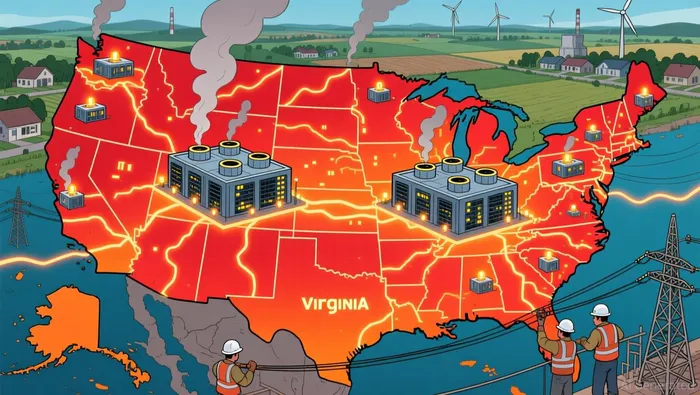
This demand is highly concentrated geographically, creating powerful regional opportunities. The two dominant hubs are Virginia and Texas. In 2025, utility power demand from data centers is forecast to reach roughly 12.1 GW in Virginia and about 9.7 GW in Texas. This concentration means utilities operating in these key states are directly positioned to capture a disproportionate share of the growth, as their customer base shifts toward massive, power-hungry AI workloads.
The financial impact is already materializing. The utilities sector is experiencing its strongest earnings acceleration in years, directly fueled by this AI-driven load growth. In the third quarter of 2025, the sector reported year-over-year earnings growth of 23.1%. This performance was the third-highest among all S&P 500 sectors, with 74% of companies beating estimates. The data center boom is the primary catalyst, providing a durable, long-term tailwind that is expected to drive capital deployment and revenue growth for the foreseeable future. For investors, this represents a clear shift: the utility sector is entering a new growth phase where its traditional stability is now paired with a powerful, secular expansion story.
Business Model Scalability: Capital Deployment and Earnings Impact
The utilities poised to win in the AI era are deploying capital at a scale that directly targets the new power demand. This isn't incremental spending; it's a strategic reallocation of resources to build the grid of the future. Dominion Energy's plan is a prime example, with a $50 billion capital investment slated for the 2025-2029 period. A significant portion of that will fund the state's largest data center market, where the utility has already seen a 17% increase in requests for 47.1 gigawatts of power over the past year. Similarly, EntergyETR-- is constructing two new gas plants with a combined capacity of 1.5 GW to specifically power Meta's $10 billion AI data center complex in Louisiana. These are massive, tangible commitments to expand generation and transmission, directly linking investment to the AI boom.
The scalability of this growth is built into their financial targets. NextEra Energy, the industry leader, has set a clear path, targeting more than 8% annual adjusted earnings per share growth over the next decade. Dominion Energy's plan is more conservative but still robust, with management expecting its investment rate to support 5% to 7% annual EPS growth over the long term. This demonstrates a model where capital expenditure is not a cost but a direct lever for earnings expansion. The utilities are betting that the power demand from data centers will be a durable, high-margin revenue stream that can be captured through regulated rate cases, allowing them to translate billions in plant construction into steady, predictable earnings growth.
Yet the path from shovel to shareholder return is not without friction. The key risk is regulatory attrition, where new tariffs and policies can delay or reduce the financial upside. Ohio's Public Utilities Commission recently directed its utility, AEPAEP-- Ohio, to file new data center tariffs that will "cull duplicative or speculative requests". The new rules require large data center customers to pay for at least 85% of their subscribed energy, regardless of actual usage, a move designed to protect other ratepayers from stranded costs. Analysts note this tariff-driven attrition "should tighten AEP's load signal while lowering stranded cost risk". For investors, this is a critical reality check. It means that while the demand is real and massive, the timeline for revenue recognition and the ultimate profitability of these projects can be extended by regulatory decisions. The scalability of the earnings model is therefore contingent on navigating this evolving policy landscape, where utilities must balance growth ambitions with the need to maintain regulatory goodwill.
Comparative Performance and Valuation: Pricing the Growth
The utilities sector's recent performance tells a clear story of a defensive name being pulled into the AI growth narrative. Year-to-date through late November, the sector delivered a 20.25% total return, outperforming the S&P 500 by nearly 500 basis points. This surge has been so powerful that it has closely mirrored the rally of the tech-heavy Nasdaq 100, a stark departure from its historical role as a portfolio anchor during downturns. The catalyst is straightforward: the explosive demand for electricity to power AI data centers. This has transformed utilities from a traditional yield play into a growth-plus-income opportunity, with consensus earnings growth estimates for 2026 at 9.1%.
Valuation now sits at a critical inflection point. The sector's forward price-to-earnings ratio has climbed to nearly 18.5x, above its historical average but still below the broader market's 21.7x. This gap suggests the market sees room for further multiple expansion if the AI-driven earnings growth materializes as expected. The current price is a bet on the sector's ability to capture a significant share of the projected energy demand, with one forecast estimating the need for over 50 GW of incremental capacity by 2028 to meet data center needs.
Yet the path to justifying this premium is fraught with execution risks. The primary threat is regulatory pushback. As utilities become essential partners for hyperscalers, there is growing scrutiny over whether they can fairly serve both their traditional customer base and the massive new power demands from tech firms. Supply chain bottlenecks also pose a tangible constraint. The sudden surge in orders for turbines and other equipment is straining manufacturers, leading to extended delivery times and delays in bringing new power generation online. This could create a supply-demand imbalance that pressures costs and timelines.
Most critically, the entire investment thesis hinges on the sustainability of the demand forecast. The projection of a 90 GW additional load by 2030 is a massive number, but it assumes a relentless, uninterrupted growth in AI adoption and data center build-out. If demand forecasts are overly optimistic, or if economic cycles slow hyperscaler spending, the earnings trajectory could falter. The sector's recent outperformance has already priced in a best-case scenario. For the growth story to hold, utilities must not only build the grid but also successfully monetize their role in the AI economy without triggering regulatory or operational headwinds.
Catalysts and Risks: Execution and What to Watch
The investment thesis for the utility sector hinges on a single, massive execution cycle. The primary near-term catalyst is the deployment of capital. Utilities are planning $208 billion in grid upgrades for 2025 and more than $1 trillion through 2029, a direct response to the explosive demand from data centers and electrification. This unprecedented investment cycle is the engine for future earnings growth. The sector's recent performance reflects this optimism, with utilities posting 23.1% year-over-year earnings growth in Q3 2025 and delivering a 20.25% year-to-date return in 2025. The path forward is clear: as this capital is spent and new capacity comes online, it should translate into sustained revenue and profit expansion for the companies that build and operate it.
To monitor this thesis, investors must watch three key execution points. First, regulatory decisions on data center tariffs will directly impact utility profitability. Second, the actual build-out pace of hyperscaler projects is the ultimate demand signal. If the promised gigawatts of capacity materialize on schedule, it validates the entire growth narrative. Third, the resolution of supply chain constraints for critical materials and equipment will determine whether the planned $1 trillion investment can be executed efficiently and on time.
Yet a critical uncertainty looms over the entire forecast: the potential for a speculative bubble. Some analysts warn that utility projections for data center load growth may be overstated. A report from Grid Strategies suggests that while utilities forecast 90 GW of additional data center load by 2030, market analysis indicates actual growth in that timeframe is likely closer to 65 GW. This discrepancy is a major red flag. If the build-out of data centers is slower than anticipated, or if a significant portion of proposed projects fails to materialize due to economic or logistical hurdles, the demand tailwind for utilities could falter. This would pressure the earnings growth that has driven the sector's recent rally and multiple expansion.
The bottom line is a framework of high-stakes execution. The catalyst is massive, capital-intensive investment. The watchpoints are regulatory, project, and supply chain. The risk is that the underlying demand story is inflated. For a value investor, the margin of safety depends on the sector's ability to convert this capital plan into tangible, reliable earnings, even if the data center load growth is more moderate than the most aggressive forecasts suggest.







Comentarios
Aún no hay comentarios