
USDH Proposal V2 and the $20M Incentives with PayPal Integration: A Strategic Catalyst for Fintech Adoption?
The USDHUSDC-- stablecoin, a cornerstone of the Hyperliquid ecosystem, has long been positioned as a bridge between decentralized finance (DeFi) and traditional payment rails. However, its recent Proposal V2—backed by Paxos and PayPal—marks a pivotal shift in strategy. By integrating PayPal's global infrastructure and committing $20 million in incentives, USDH aims to leapfrog competitors in the race to dominate cross-border fintech adoption. This analysis evaluates the proposal's mechanics, strategic alignment, and potential to reshape the stablecoin landscape.
The PayPalPYPL-- Integration: A Gateway to Mass Adoption
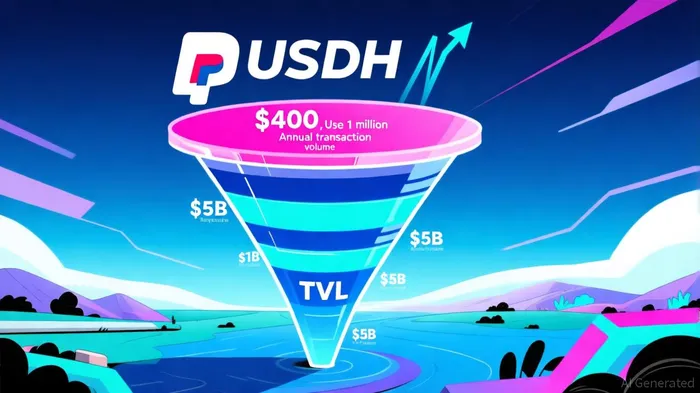
PayPal's partnership with USDH is not merely a listing on its platforms but a full-scale integration across its payment infrastructure, including Checkout, Braintree, Hyperwallet, and Xoom. This infrastructure already processes $1 trillion in annual transaction volume and serves 400 million users globally[1]. For USDH, this means immediate access to a liquidity pool and user base that dwarfs most DeFi-native stablecoins.
The inclusion of free on/off-ramp services for USDH is particularly significant. Traditional stablecoins like USDCUSDC-- or USDTUSDC-- rely on third-party services for fiat conversions, often incurring fees. By embedding USDH directly into PayPal's ecosystem, users can transact seamlessly between fiat and crypto without intermediaries, reducing friction and accelerating adoption[2]. This integration also positions USDH as a default stablecoin for PayPal's 30 million Venmo users, a demographic skewed toward younger, crypto-savvy consumers[3].
Incentive Structure: Aligning Success with Growth
The $20 million incentive fund from PayPal is not a handout—it's a performance-driven investment. Paxos, as the issuer of USDH, earns no fees until the stablecoin reaches $1 billion in total value locked (TVL). Beyond $5 billion TVL, Paxos' earnings are capped at 5%, ensuring its success is tied to Hyperliquid's long-term health rather than short-term gains[4].
This structure mirrors venture capital principles: investors (in this case, PayPal) take on early risk in exchange for upside potential. For USDH, it creates a flywheel effect: the $20 million fund can subsidize liquidity mining programs, developer grants, or user acquisition campaigns, all while aligning incentives between Paxos, Hyperliquid, and PayPal. The cap at 5% also mitigates the risk of overcompensation, a common criticism of traditional stablecoin models where issuers profit disproportionately from TVL growth[1].
Regulatory Compliance: A Differentiator in a Crowded Market
Paxos' emphasis on regulatory compliance is a critical differentiator. Unlike many stablecoins, USDH is issued under a New York-chartered trust and is fully collateralized by U.S. Treasuries, providing transparency and legal clarity[4]. This is particularly important in Europe, where the MiCA (Markets in Crypto-Assets) regulation will impose strict requirements on stablecoin issuers starting in 2026. By proactively aligning with global standards, USDH is primed to capture market share in regions where competitors like TetherUSDT-- or CircleCRCL-- may face compliance hurdles[3].
Strategic Implications for Fintech Markets
The USDH-PayPal partnership could disrupt three key fintech segments:
1. Cross-Border Payments: PayPal's infrastructure already facilitates cross-border transactions. By pairing it with USDH's blockchain-native speed and low fees, the duo could undercut traditional SWIFT transfers and even rival stablecoin projects like USDC.
2. Embedded Finance: PayPal's Braintree and Hyperwallet platforms enable businesses to embed financial services into their workflows. USDH's integration could allow startups to offer crypto-based invoicing, payroll, or lending without building their own infrastructure[2].
3. DeFi Liquidity: Hyperliquid's focus on derivatives trading means USDH could become a default collateral asset for margin trading, further entrenching its role in the DeFi ecosystem[1].
Risks and Challenges
While the proposal is ambitious, risks remain. PayPal's incentives are time-bound, and sustaining growth beyond the initial $20 million phase will require organic adoption. Regulatory shifts—such as the SEC's ongoing scrutiny of stablecoins—could also disrupt the model. Additionally, Hyperliquid's relatively small market share in derivatives trading compared to Binance or Bybit may limit USDH's immediate impact[4].
Conclusion: A High-Stakes Bet on Synergy
USDH Proposal V2 represents a bold experiment in merging DeFi's innovation with PayPal's scale. The $20 million incentives and performance-based structure are designed to create a self-sustaining ecosystem where growth is both incentivized and aligned. For investors, the key question is whether this synergy can overcome the inherent risks of a nascent stablecoin in a highly competitive market. If USDH can capture even a fraction of PayPal's transaction volume, it could become a linchpin in the next phase of fintech evolution.





Comentarios
Aún no hay comentarios