
USDH's Path to Dominance: How Paxos and PayPal Are Reshaping the Stablecoin Landscape
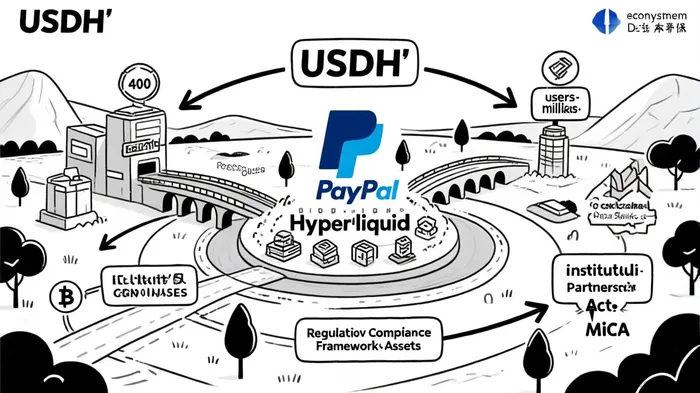
The stablecoin landscape in 2025 is witnessing a seismic shift, driven by the convergence of institutional-grade infrastructure and decentralized finance (DeFi). At the forefront of this transformation is USDH, a stablecoin backed by Paxos and integrated into PayPal's global payment network. This collaboration, combined with strategic regulatory alignment and DeFi innovation, positions USDHUSDC-- as a formidable contender in the race to redefine digital assetDAAQ-- liquidity.
Strategic Institutional Adoption: PayPal's Network Effects
Paxos and PayPal's partnership represents a masterstroke in institutional adoption. By embedding USDH into PayPal's ecosystem—spanning 400 million users and 35 million merchants—USDH gains immediate access to a mainstream audience. According to a report by CoinLaw, this integration includes free on/off-ramps across PayPalPYPL-- Checkout, Venmo, Xoom, Braintree, and Hyperwallet, effectively turning USDH into a seamless bridge between traditional finance and DeFi[1].
The partnership is further amplified by a $20 million incentive pool to drive liquidity in the Hyperliquid ecosystem, a decentralized exchange (DEX) platform[2]. This capital injection not only boosts USDH's utility but also aligns Paxos's revenue model with long-term growth: fees are performance-based, with no charges until USDH reaches $1 billion in TVL, and capped at 5% once TVL exceeds $5 billion[1]. Crucially, these fees are paid in HYPE tokens, Hyperliquid's native governance token, creating a symbiotic relationship between Paxos and the DeFi community[1].
DeFi Gateway Potential: Bridging Ecosystems
USDH's DeFi gateway potential is underscored by its integration into multiple protocols and cross-chain capabilities. As of Q3 2025, USDH's TVL has surged to $62.7 million, a 527% increase from June 2025[3]. This growth is part of a broader trend: Ethereum-based DeFi TVL stands at $223 billion in Q3 2025, with institutional inflows into EthereumETH-- products reaching $33 billion—contrasting sharply with Bitcoin's outflows[2].
Paxos's USDH is uniquely positioned to capitalize on Ethereum's post-Dencun and Pectra upgrades, which reduced gas fees by 90% and enabled $13 billion in tokenized real-world assets (RWA) growth[2]. By deploying USDH across both HyperEVM and HyperCore chains, Paxos ensures its stablecoin can support high-throughput trading and institutional-grade liquidity pools[3]. Additionally, Orbiter Finance's expansion of cross-chain bridges—enabling direct USDCUSDC-- transfers to Hyperliquid—further enhances USDH's utility in derivatives trading and global liquidity networks[4].
Regulatory Compliance: A Differentiator in a Crowded Market
Regulatory scrutiny has long been a barrier to stablecoin adoption, but USDH's compliance-first approach sets it apart. The stablecoin adheres to the U.S. GENIUS Act and the EU's MiCA framework, ensuring transparency and legal clarity for global users[1]. This alignment is critical as institutional investors increasingly prioritize compliance. For instance, Kraken's listing of USDH and the HYPE token in Q3 2025 added a layer of credibility, attracting institutional capital seeking regulated exposure to DeFi[4].
Moreover, Paxos's reserve management strategy—allocating 95% of reserve interest to HYPE token buybacks—creates a flywheel effect, incentivizing liquidity providers and validators to stake in the ecosystem[3]. This model contrasts with traditional stablecoins, which often lack such direct community alignment.
Competitive Landscape: USDH vs. Alternatives
While USDH faces competition from other stablecoins, its strategic advantages are clear. Ethena Labs, for example, proposed a USDH variant backed by USDtb (linked to BlackRock's BUIDL fund), but its 95% reserve revenue share to Hyperliquid still lags behind Paxos's performance-based incentives[1]. Agora's 100% net revenue sharing model is ambitious, but Paxos's PayPal integration provides unmatched user acquisition and liquidity scale[2].
The broader DeFi ecosystem also benefits from USDH's non-dilutive loan structures, which have driven AI and GPU-based lending innovations[3]. These use cases, combined with PayPal's merchant network, create a self-sustaining loop of adoption and value accrual.
Conclusion: A New Era for Stablecoins
USDH's path to dominance is not just about technological innovation—it's about redefining the role of stablecoins as interoperable, compliant, and institutionally scalable assets. By leveraging PayPal's network effects, Ethereum's infrastructure upgrades, and a performance-driven revenue model, Paxos has created a stablecoin that bridges the gap between legacy finance and DeFi. As institutional capital continues to reallocate toward Ethereum-based ecosystems, USDH's strategic positioning makes it a compelling investment for those seeking exposure to the next phase of digital asset adoption.





Comentarios
Aún no hay comentarios