
USDC's Path to Dominance: Strategic Growth and Institutional Adoption in the 2027 Stablecoin Landscape
The stablecoin market is on the cusp of a seismic shift, and USDCUSDC-- is positioned to lead the charge. With a 24.56% market share in October 2025 and a total stablecoin market cap exceeding $300 billion, according to Bernstein, the stage is set for a new era of institutional-grade digital money. USDC's strategic growth, regulatory alignment, and institutional adoption are notNOT-- just reshaping the stablecoin landscape-they're building a foundation for dominance by 2027.
Market Share and Supply Growth: A Recipe for Scalability
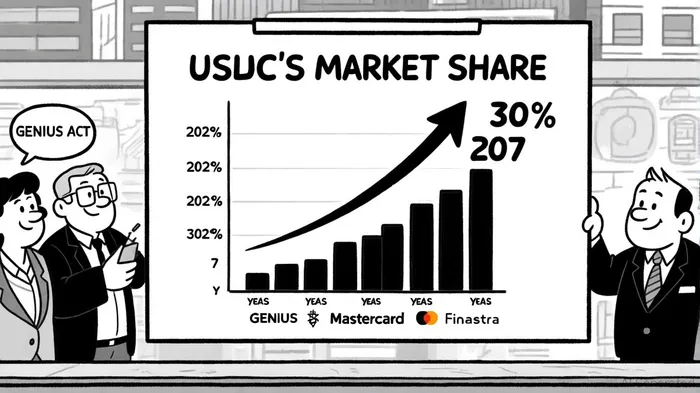
USDC's trajectory is nothing short of explosive. By Q3 2025, its market capitalization had surged 18% to $74 billion, with a 24.7% share of the stablecoin market. This growth is fueled by a perfect storm: regulatory clarity from the U.S. GENIUS Act, which mandates 1:1 reserves and bans algorithmic stablecoins, and a bull market cycle that's driving institutional demand.
Projections from Bernstein and Goldman SachsGS-- paint a compelling picture. Bernstein estimates USDC's supply could hit $173 billion by 2027, capturing roughly a third of the stablecoin market. Goldman Sachs forecasts a 40% annual growth rate through 2027, driven by USDC's expansion into the $240 trillion global payments market. Meanwhile, JPMorgan highlights that stablecoins could generate $1.4 trillion in new U.S. dollar demand by 2027, with USDC and TetherUSDT-- at the forefront.
Institutional Adoption: The New Gold Standard
Institutional adoption is the linchpin of USDC's dominance. By mid-2025, 80% of North American fintech apps supporting stablecoin payments included USDC, while 26% of DeFi lending TVL was locked in USDC across platforms like AaveAAVE-- and CompoundCOMP--. Over 280 enterprise platforms, including SaaS firms and e-commerce gateways, now favor USDC for its compliance advantages.
Circle's strategic partnerships are accelerating this trend. The CircleCRCL-- Payments Network (CPN) now allows banks and fintechs to customize risk controls for cross-border payments, slashing settlement times, as detailed in Circle's operational rules. Collaborations with Finastra and Mastercard are embedding USDC into systems for instant settlements, reducing transaction costs by up to 90% in emerging markets. BlackRock and Coinbase have also joined the fray, leveraging USDC's regulatory alignment for tokenized deposits.
Regulatory Clarity: The Unseen Catalyst
USDC's compliance framework is a key differentiator. Circle's 100% cash and U.S. Treasury-backed reserves, validated by monthly audits, have made it a safe harbor in a post-FBUSD world. The GENIUS Act's passage in Q3 2025 further solidified this, enabling banks to custody stablecoins and issue tokenized deposits. This regulatory clarity has spurred confidence, with Circle applying for a national trust bank charter to align with traditional financial standards.
Strategic Expansion: Beyond the Blockchain
Circle's multi-chain strategy is another growth lever. USDC is now natively supported on EthereumETH--, AlgorandALGO--, SolanaSOL--, and Stellar, with plans to expand to more blockchains. This cross-chain interoperability ensures USDC remains the preferred stablecoin for DeFi, CeFi, and traditional finance. Additionally, Circle's public listing-a first for a stablecoin issuer-has attracted institutional capital, further entrenching USDC's market position.
The 2027 Outlook: A New Monetary Paradigm
By 2027, USDC's dominance will be defined by three pillars:
1. Scale: A projected $173–$220 billion supply, driven by institutional demand and global payments adoption.
2. Trust: Unmatched regulatory compliance and transparency, reinforced by the GENIUS Act and MiCA alignment.
3. Integration: Deep partnerships with financial infrastructure providers, enabling USDC to power instant settlements, tokenized assets, and cross-border commerce.
The competition, particularly USDTUSDT--, is fading. While USDT maintains a presence on DEXs, its lack of regulatory clarity and recent controversies have eroded institutional trust. USDC's lead in transaction volume and TVL is widening, and its strategic alignment with regulators and institutions ensures this trend will accelerate.
Conclusion: The Inevitability of USDC
The data is clear: USDC is not just a stablecoin-it's a foundational asset in the next-generation payment ecosystem. With regulatory tailwinds, institutional adoption, and a multi-chain strategy, USDC is poised to dominate the stablecoin market by 2027. For investors, this isn't just a bet on a token; it's a bet on the future of money.





Comentarios
Aún no hay comentarios