
USD1's Strategic Expansion and Institutional Adoption Signal a Shifting Stablecoin Landscape
The stablecoin market in 2025 is no longer a niche corner of the crypto ecosystem but a critical pillar of global finance. With a total market cap of $280 billion and annual transaction volumes exceeding $4 trillion, stablecoins have become the backbone of cross-border payments, derivatives trading, and institutional treasury workflows according to the State of Crypto Report 2025. Amid this explosive growth, USD1-a U.S. dollar-backed stablecoin launched by World Liberty FinancialWLFI-- (WLFI)-has emerged as a disruptive force. Its strategic partnerships with FalconX and the Canton Network, coupled with regulatory alignment under the GENIUS Act, position USD1 to redefine institutional-grade blockchain integration and capture a meaningful share of the $280 billion stablecoin market.
Institutional-Grade Infrastructure: FalconX and Canton Network Drive Liquidity and Compliance
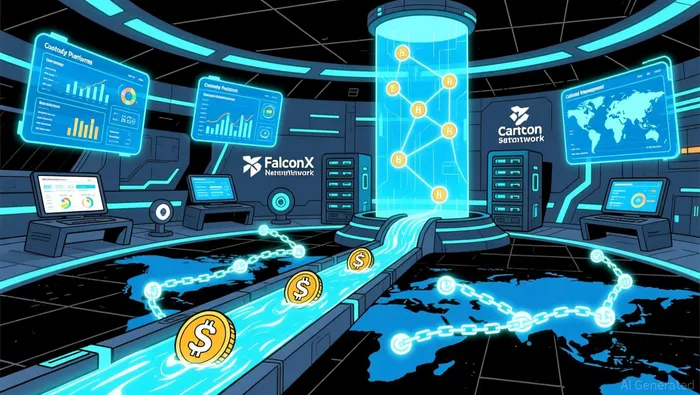
USD1's rapid ascent is underpinned by its integration into institutional-grade blockchain infrastructure. FalconX, a leading digital asset execution and custody platform, has enabled USD1 to be traded, used as collateral for derivatives, and securely custodied by institutional clients. This partnership addresses a critical pain point for institutional investors: the need for seamless, on-chain liquidity without sacrificing compliance. FalconX's platform now offers USD1USD1-- at competitive pricing, allowing clients to leverage the stablecoin for financing transactions and treasury management.
Simultaneously, USD1's deployment on the Canton Network-a privacy-enabled blockchain designed for regulated financial markets-has expanded its utility in institutional workflows. Canton Network processes $6 trillion in tokenized real-world assets annually across 600+ institutions, with daily transaction volumes reaching 500,000. By leveraging Canton's infrastructure, USD1 gains access to a compliant, interoperable ecosystem where institutions can reuse collateral and access expanded liquidity pools. This is particularly significant for onchain treasury financing, where USD1's 1:1 backing by U.S. government treasuries and cash equivalents ensures trust and regulatory alignment.
Regulatory Tailwinds: The GENIUS Act and USD1's Compliance-First Model
The U.S. government's 2025 regulatory framework, particularly the GENIUS Act, has created a fertile environment for USD1's growth. The Act mandates that stablecoins be fully backed by reserves such as U.S. dollars or cash equivalents, prohibits yield on stablecoins, and requires monthly reserve disclosures. USD1's structure-fully collateralized by short-term U.S. government treasuries and held in BitGo-managed reserves-aligns perfectly with these requirements according to FalconX's partnership announcement. This compliance-first approach has attracted institutional investors wary of regulatory risks, particularly in the wake of USDT's dominance and USDC's recent challenges according to market analysis.
Moreover, the GENIUS Act's emphasis on transparency has elevated USD1's credibility. With a market cap of $2.9 billion as of late 2025, USD1 has grown faster than most stablecoin rivals, including PayPal's PYUSD and Cloudflare's NET Dollar. This growth is not merely speculative; it reflects institutional confidence in USD1's ability to serve as a bridge between traditional finance and blockchain-based systems.
Market Capture Potential: USD1's Position in a Fragmented Landscape
While USDTUSDT-- and USDCUSDC-- still dominate the stablecoin market (64% and 25% market share, respectively), USD1's institutional-grade features and regulatory compliance position it to capture a growing share of the $280 billion market. Its partnerships with FalconX and Canton Network have already facilitated $6 trillion in transactions, demonstrating its scalability and utility in high-value, institutional contexts. Additionally, USD1's integration into onchain treasury financing-where it enables real-time collateral reuse and liquidity optimization-addresses a $4 trillion annual gap in traditional financial systems.
The broader market dynamics further favor USD1. As of 2025, institutional adoption of stablecoins has surged, with major banks like JP Morgan and fintechs like Stripe processing substantial stablecoin volumes. USD1's focus on institutional workflows-cross-border payments, derivatives collateral, and digital asset settlement-aligns with this trend. Its 1:1 peg to the U.S. dollar, combined with the privacy and compliance features of the Canton Network, makes it an attractive alternative to legacy stablecoins that lack robust regulatory frameworks according to the GENIUS Act implementation.
Conclusion: A New Era for Stablecoins
USD1's strategic expansion and institutional adoption signal a paradigm shift in the stablecoin landscape. By leveraging FalconX's liquidity infrastructure and Canton Network's privacy-enabled blockchain, USD1 has established itself as a compliance-first, institution-grade stablecoin. Its alignment with the GENIUS Act and rapid growth in a $280 billion market underscore its potential to challenge dominant players like USDT and USDC. For investors, USD1 represents not just a stablecoin but a foundational asset in the ongoing convergence of traditional finance and blockchain technology.






Comentarios
Aún no hay comentarios