
USA Rare Earth vs. MP Materials: A Strategic Diversification Play for Rare Earth Bulls
The U.S. rare earths sector has emerged as a critical battleground in the global race for supply chain independence, driven by geopolitical tensions with China and the strategic importance of rare earth elements (REEs) in defense, clean energy, and technology. Two companies-USA Rare Earth (USAR) and MP Materials (MP)-stand at the forefront of this effort, but their divergent strategies and risk profiles present distinct opportunities for investors. This analysis evaluates their comparative value and risk-adjusted potential in a world increasingly focused on securing domestic rare earths.
MP Materials: Government-Backed Stability and Scalability
MP Materials, operator of the Mountain Pass Rare Earth Mine in California, has positioned itself as the U.S. government's preferred partner in decoupling from Chinese supply chains. In July 2025, the company secured a $400 million investment from the Department of Defense (DoD) in exchange for a 15% equity stake, alongside a 10-year offtake agreement for 100% of output from its upcoming "10X Facility" and a guaranteed price floor of $110 per kilogram for neodymium-praseodymium (NdPr) oxide according to MP Materials' announcement. This partnership, 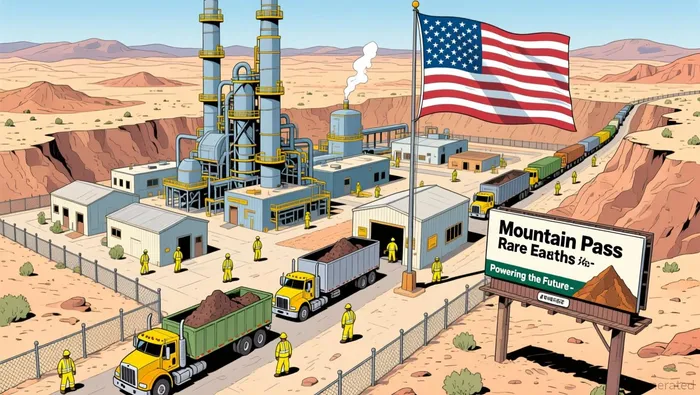 coupled with a $150 million loan for expanding heavy rare earth separation capabilities and $1 billion in commercial debt from JPMorgan Chase and Goldman Sachs, underscores the federal government's commitment to MP MaterialsMP-- as a cornerstone of U.S. rare earths independence as reported.
Financially, MP Materials reported $53.55 million in Q3 2025 revenue, a 14.9% year-over-year decline, and an EBITDA loss of $34.44 million, reflecting the high costs of scaling operations. However, its $10.86 billion market capitalization and $1.42 billion in liabilities suggest a balance sheet that, while leveraged, is supported by long-term offtake agreements and strategic debt financing according to financial data. The company's recent production milestones-721 metric tons of NdPr and 13,254 metric tons of rare earth oxides (REO) in Q3 2025-highlight its operational momentum as detailed in investor reports.
USA Rare Earth: High-Risk, High-Reward Vertical Integration
USA Rare Earth, by contrast, is pursuing a vertically integrated supply chain centered on its Round Top Mountain mine in Texas and the acquisition of Less Common Metals (LCM), a British rare earths processor as stated in company materials. This strategy aims to reduce reliance on Chinese suppliers and create a self-sufficient production chain from ore to magnets. However, the company's stock has been volatile, plummeting 30.8% in November 2025 after China paused new export controls-a move that dampened speculative fervor as reported.
Financially, USA Rare EarthUSAR-- appears less leveraged, with $258 million in cash and no significant debt as of September 2025 according to company disclosures. Its market capitalization of $1.75 billion and EBITDA loss of $15.82 million reflect a smaller scale but also highlight its potential for rapid growth if its Texas mine and LCM acquisition deliver on expectations as noted in financial analysis. The company's lack of debt provides flexibility but also exposes it to market sentiment swings, as evidenced by its sharp post-China-announcement decline according to market commentary.
Strategic Diversification: Balancing Risk and Reward
The key distinction between the two lies in their risk profiles and strategic dependencies. MP Materials benefits from government guarantees and long-term contracts, which provide revenue stability but may limit upside potential as a public-private partnership. Its debt-heavy expansion, however, could strain margins if rare earth prices fall below the $110 floor. USA Rare Earth, meanwhile, operates with greater financial flexibility but faces execution risks tied to its Texas mine's timeline and the integration of LCM. Its success hinges on geopolitical developments and the ability to scale production without external financing.
For investors seeking strategic diversification, a portfolio including both companies could hedge against sector-specific risks. MP Materials offers defensive characteristics through its DoD and Apple partnerships as reported, while USA Rare Earth provides speculative upside in a market sensitive to trade dynamics. The former's guaranteed pricing and offtake agreements mitigate volatility, whereas the latter's debt-free balance sheet and vertical integration could yield outsized returns if the U.S. rare earths boom accelerates.
Conclusion: A Sector-Wide Bet on U.S. Supply Chain Independence
The U.S. rare earths sector remains a high-stakes arena, with both companies playing pivotal roles in reducing reliance on China. MP Materials' government-backed scalability and USA Rare Earth's agile vertical integration represent complementary approaches to this challenge. While MP Materials' financials suggest a risk-averse play with near-term visibility, USA Rare Earth's debt-free model and strategic acquisitions cater to investors willing to tolerate short-term volatility for long-term growth. In a world where rare earths are as critical as semiconductors or lithium, diversifying exposure to both could offer a balanced path for rare earth bulls.







Comentarios
Aún no hay comentarios