
Urban Transportation Resilience in Emerging Markets: Navigating Risks in Sub-Saharan Africa and South Asia
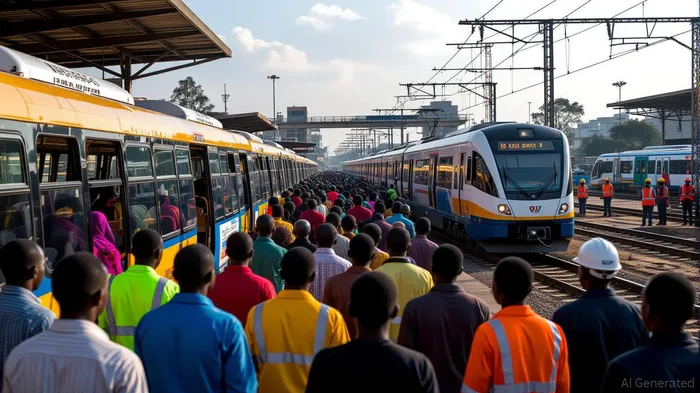
The global push for resilient urban infrastructure has spotlighted emerging markets in sub-Saharan Africa and South Asia, where rapid urbanization and economic growth are colliding with systemic challenges in public transit. For investors, the promise of transformative infrastructure projects is tempered by a volatile landscape of labor strikes, political instability, and policy shifts. This article dissects the risks and opportunities in these regions, offering a roadmap for navigating the complexities of urban transportation resilience.
The Infrastructure Deficit and Its Economic Toll
Sub-Saharan Africa's public transit systems remain heavily reliant on informal networks, with over 95% of urban trips in 2025 handled by unregulated services. This model, while adaptive to local needs, lacks the scalability and sustainability required for long-term growth. The African Development Bank estimates an annual infrastructure investment gap of $100 billion, which translates to lost economic output: inadequate transport infrastructure reduces business productivity by up to 40% and annual GDP growth by two percentage points.
South Asia fares better but is far from immune to challenges. India's recent expansion of grid electricity access (adding 29.2 million people from 2017–2022) contrasts with persistent rural gaps. Meanwhile, Bangladesh and Nepal face annual infrastructure funding shortfalls of $25 billion and $1 billion, respectively, stalling projects critical for regional connectivity.
Labor Strikes and Political Instability: Catalysts for Disruption
Sub-Saharan Africa's Mining-Driven Volatility
Labor unrest in South Africa's mining sector—where platinum and coal mines have seen kidnaps and illegal strikes—has spillover effects on transit infrastructure. A 200% surge in kidnappings since 2014 has raised operational costs for companies, with security expenditures diverting funds from infrastructure development. The Democratic Republic of the Congo (DRC) exemplifies the intersection of conflict and transit: M23 rebel group activity in the east has disrupted key trade routes, forcing rerouted logistics and delaying rail projects like the Lubumbashi-Kinshasa line.
Policy Instability in South Asia
In South Asia, policy shifts have created a patchwork of opportunities and roadblocks. Sri Lanka's 2022 economic crisis exposed the fragility of its infrastructure financing model, while Pakistan's reliance on Chinese Belt and Road Initiative (BRI) loans has sparked debates over debt sustainability. Bangladesh's reluctance to commit to 24 of 27 BRI projects offered in 2016 underscores the region's cautious approach to foreign investment.
Case Studies: Lessons from the Field
Mozambique's LNG Dilemma
Total's $20 billion LNG project in Cabo Delgado was paused for over two years due to Islamic State-linked attacks. The project's restart in 2024 required enhanced security measures and renegotiated government contracts, illustrating how instability demands adaptive risk management.Ethiopia's Rail Ambitions
The Addis Ababa-Djibouti railway, a cornerstone of Ethiopia's transport strategy, has faced delays due to ethnic conflicts and illicit mining. Security costs now account for 20% of operational expenses, highlighting the need for integrated security-logistics frameworks.South Africa's Mining-Transit Nexus
The Bafokeng Rasimone Platinum Mine's 2023 strike, which lasted 45 days, disrupted rail freight corridors. The incident underscored the importance of crisis management protocols and labor engagement strategies to mitigate operational downtime.
Mitigation Strategies for Investors
- Robust Risk Management Frameworks
- Security-First Planning: In high-risk zones like DRC and Mozambique, investors must integrate real-time threat assessments and localized security partnerships. For example, mining firms in South Africa now allocate 10–15% of project budgets to security, a trend likely to spread to transit projects.
Policy Agility: Engaging with local stakeholders to anticipate regulatory shifts—such as Zambia's 2023 mining code revisions—can help align projects with evolving frameworks.
Public-Private Partnerships (PPPs)
PPPs are gaining traction in India and Kenya, where governments are incentivizing private capital through revenue-sharing models. The Nairobi Expressway, a PPP project, has shown how blended finance can accelerate infrastructure while sharing risks.
Regional Cooperation
- Cross-border initiatives, such as India's proposed Bangladesh-Bhutan-India (BBI) freight corridor, demonstrate the value of harmonized policies. Such projects reduce exposure to unilateral policy changes in any single country.
Investment Outlook: Balancing Risk and Reward
The infrastructure gap in sub-Saharan Africa and South Asia represents a $6.3 trillion opportunity by 2030, per the Asian Development Bank. However, success hinges on navigating three key factors:
- Political Stability: Countries with consistent policy frameworks, like Rwanda and Vietnam, offer safer bets.
- Labor Dynamics: Projects in sectors with stable labor relations (e.g., Ethiopia's industrial parks) are less prone to disruptions.
- Climate Resilience: Climate-adaptive infrastructure, such as flood-resistant transit hubs in Bangladesh, will become increasingly critical.
Conclusion: A Call for Strategic Patience
Investing in urban transportation resilience in emerging markets is akin to navigating a minefield with a map. The rewards—transformative infrastructure, access to high-growth economies—are substantial, but they require a nuanced understanding of local dynamics. For investors willing to adopt agile strategies, prioritize security, and embrace regional collaboration, the path to long-term value lies in balancing bold vision with pragmatic risk management.
As the world's urban population grows, the cities of sub-Saharan Africa and South Asia will either rise as hubs of innovation or falter under the weight of their challenges. The choice, in part, will be shaped by those who dare to invest wisely in their resilience.







Comentarios
Aún no hay comentarios