
Urban Sustainability Infrastructure in Los Angeles: The Return of the Recycled Water Fill Station as a Catalyst for Green Investment
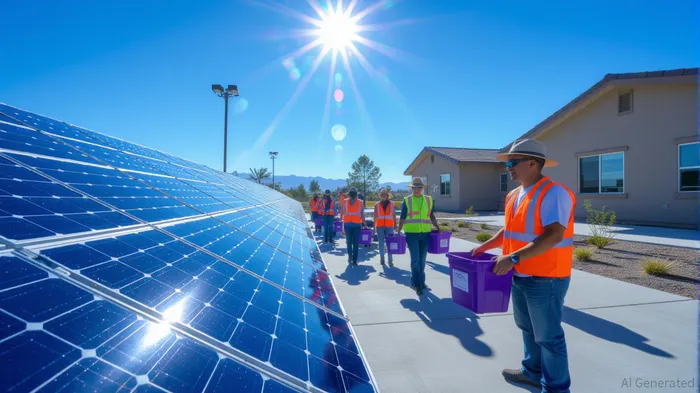
Los Angeles is no longer just a city of stars—it's a beacon for investors seeking high-impact, low-risk opportunities in climate-resilient infrastructure. The reopening of the Los Angeles Recycled Water Fill Station on August 1, 2025, is more than a municipal service update; it's a microcosm of a broader urban sustainability revolution. This initiative, managed by the Los Angeles Department of Water and Power (LADWP), offers free recycled water for landscaping, but its implications ripple far beyond the immediate benefits of water conservation. For investors, it represents a convergence of regulatory clarity, private capital inflows, and the urgent need for circular economy models in arid urban regions.
Regulatory Tailwinds: A Framework for Scalability
California's recent adoption of Direct Potable Reuse (DPR) regulations in October 2024 has removed a critical barrier to water innovation. These rules, enforced by the State Water Board, now allow advanced purified recycled water to be directly integrated into drinking water supplies—a shift that transforms recycled water from a niche utility into a strategic asset. Los Angeles is already testing these waters (literally) with the Headworks DPR Demonstration Project, which evaluates cutting-edge treatment processes. Such regulatory progress, paired with streamlined permitting under the Statewide Water Reclamation Requirements, ensures that projects like the fill station can scale efficiently.
The city's 2030 target of producing 150 million gallons of purified water daily through the Groundwater Replenishment Project and Pure Water Los Angeles is backed by $224 million in WIFIA loans and $125 million in WaterSMART grants. These federal and state partnerships reduce upfront costs for developers, making green infrastructure projects more attractive to private equity and institutional investors.
Private Capital: A $300 Billion Opportunity
The fill station's reopening is not an isolated event but part of a $300 billion urban water resilience market. Private investors are flocking to Los Angeles, recognizing its potential to become a blueprint for arid-region cities. The Pure Water Southern California project, a $1.2 billion endeavor, has already secured equity from green bond issuers and institutional investors, including Xylem and Ecolab (both components of the WATER ETF).
Los Angeles' model of public-private partnerships (P3s) is gaining traction. For instance, the Vista Ridge project in San Antonio—a $38 million P3 for recycled water—has inspired similar risk-sharing frameworks in LA. These models allow investors to participate in long-term revenue streams while municipalities retain control over public service delivery. The Water Recycling Funding Program (WRFP), which allocates $8.3 billion under the Bipartisan Infrastructure Law, further sweetens the deal by subsidizing up to 75% of project costs for qualifying infrastructure.
Los Angeles' water innovation ecosystem is also attracting green bond investors. The city's recent $1.5 billion green bond issuance, with a 4.25% yield, has drawn ESG-focused capital due to its alignment with the UN Sustainable Development Goals (SDG 6: Clean Water). For investors, this represents a rare combination of double-bottom-line returns: environmental impact and financial stability.
Economic Impact: Water as a Multiplier
The fill station's economic footprint extends beyond water conservation. By reducing reliance on imported water (which costs LA $2.1 billion annually), the city is freeing up capital for local development. For example, the Second Dominguez Gap Connection Project—which replaces imported water with recycled water for seawater intrusion barriers—has already created 150 jobs and is projected to save $12 million yearly in operational costs.
Los Angeles' water reuse goals also align with the $161.9 million California Water Recycling Program, which funds projects that create jobs in engineering, construction, and technology. Startups like Infinity Water Solutions, which monetizes water scarcity by extracting minerals from recycled water, are further diversifying the economic value of water.
Why Los Angeles? A Case for the Circular Economy
Los Angeles' success hinges on its embrace of the circular economy—a system where waste is minimized, and resources are reused. The fill station exemplifies this: it turns wastewater into a resource for 470,000 residents, reducing demand for potable water by an estimated 30 million gallons annually. This approach is not only environmentally sustainable but also economically scalable.
For investors, the city's 100% water reuse goal by 2030 is a catalyst for innovation. The Pure Water Los Angeles program, for instance, will require $4.5 billion in infrastructure over the next decade, creating opportunities for technology firms (e.g., Renovo Resources), construction companies, and ESG-focused funds.
Investment Advice: Where to Put Your Money
- ETFs and Green Bonds: The Water ETF (WATER), which includes leaders like XylemXYL-- and EcolabECL--, offers diversified exposure to water tech. Green bonds from municipalities like LA, with their competitive yields and ESG alignment, are ideal for conservative investors.
- Private Equity in Startups: Firms like Infinity Water Solutions and Renovo Resources are pioneering mineral extraction from recycled water—a niche with high margins and regulatory tailwinds.
- Infrastructure P3s: Los Angeles' P3 model for water projects is a blueprint for risk-sharing. Investors should monitor upcoming bids for groundwater replenishment and desalination projects.
Conclusion: A Blueprint for the Future
Los Angeles' recycled water fill station is more than a drop in the bucket—it's a harbinger of a new era in urban sustainability. By combining regulatory innovation, private capital, and circular economy principles, the city is proving that green infrastructure isn't just a moral imperative but a financial one. For investors, the message is clear: cities that lead in water innovation will dominate the 21st-century urban landscape. The time to act is now, while the market is still in its early innings.





Comentarios
Aún no hay comentarios