
Urban Redevelopment and Real Estate Investment Opportunities in Wuhan
A Resurgent Housing Market
The first half of 2025 saw a significant rebound in Wuhan's real estate sector. Sales of newly built homes surged by 30.6% year-on-year to 5.07 million square meters, while pre-owned home sales rose by 10.8% to 5.33 million square meters, according to a Yicai Global report. This acceleration reflects the success of localized policies aimed at stimulating demand, such as government purchases of new housing for affordable housing programs and increased land supply in premium central districts, the Yicai Global report found. The average time to sell a new home has also shortened, dropping from 17.6 months at the end of 2024 to 12 months, signaling improved market confidence.
These trends align with broader national efforts to stabilize the real estate sector. The 2025 Government Work Report emphasizes a "white list" mechanism to improve liquidity for developers and urban redevelopment initiatives, including the renovation of old housing stock, according to a Global Times analysis. Such measures are designed to reduce inventory and stabilize prices, particularly in cities like Wuhan, where demand remains robust.
Land Use Intensity and Urban Expansion
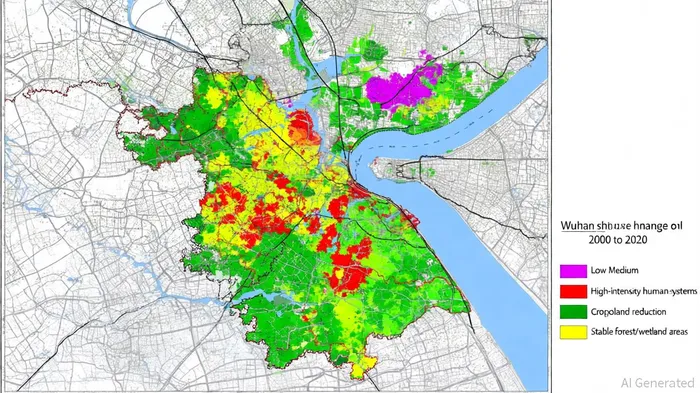
Wuhan's real estate growth is underpinned by evolving land use patterns. From 2000 to 2020, the city experienced a marked expansion of low- and medium-intensity human-settlement systems, which encroached on cropland and reshaped urban morphology, as shown in a ScienceDirect study. While forest and wetland systems have remained relatively stable, the study's spatial-temporal analysis of land use conflicts reveals an inverted U-shaped curve, with high-intensity conflicts concentrated in the core urban area, according to a Research Square paper. This suggests that Wuhan's rapid urbanization has strained land resources, necessitating careful planning to balance development with ecological sustainability.
Though no explicit 2025 policy mandates industrial-to-residential land conversion, the city's focus on urban regeneration implies a de facto shift in land use priorities. Academic research highlights the integration of land cover and socioeconomic systems to optimize urban expansion, while government reports stress the need to "redevelop urban areas" to support housing demand (the Yicai Global report). These efforts align with global trends in repurposing underutilized industrial zones for residential and commercial use, a strategy that could unlock new value in Wuhan's real estate market.
Investment Opportunities and Risks
For investors, Wuhan's evolving land use policies present a dual-edged opportunity. The city's emphasis on sustainable urbanization and infrastructure development-such as the allocation of special-purpose bonds for land acquisition and property reactivation, noted in a Cushman Wakefield briefing-creates a favorable environment for long-term gains. Central districts, where premium land supply has increased (per the Yicai Global report), are particularly attractive, as are areas undergoing ecological prioritization, which could reduce land use conflicts and enhance property values (the Research Square paper).
However, risks persist. The lack of a formal industrial-to-residential conversion policy means that regulatory clarity remains limited, potentially complicating large-scale redevelopment projects. Additionally, the inverted U-shaped distribution of land use conflicts (the Research Square paper) suggests that core urban areas may face heightened competition for resources, driving up costs and regulatory scrutiny. Investors must also consider the broader economic context: while Wuhan's real estate market is resilient, national deleveraging efforts and shifting demographic trends could temper growth in the medium term.
Conclusion
Wuhan's real estate market is at a pivotal juncture, driven by a combination of policy support, urban regeneration, and shifting land use dynamics. While the absence of a formal industrial-to-residential conversion policy introduces uncertainty, the city's broader commitment to sustainable development and infrastructure investment creates a compelling case for long-term investment. Investors who prioritize flexibility and adaptability-targeting areas with clear redevelopment trajectories and ecological resilience-will be well-positioned to capitalize on Wuhan's next phase of growth.







Comentarios
Aún no hay comentarios