
Urban Redevelopment and Industrial Real Estate Investment in Webster, NY
The FAST NY Grant: A Catalyst for Shovel-Ready Development
At the heart of Webster's transformation is the $9.8 million FAST NY grant awarded to the town for infrastructure upgrades at the Northeast Area for Technology (NEAT) site. This former Xerox campus, once a symbol of industrial decline, is now being redeveloped into a 300-acre "shovel-ready" site with modernized roads, expanded sewer systems, and a reimagined electrical grid according to reports. These improvements, slated for completion by 2026, have already reduced industrial vacancy rates to 2%-well below the national average of 7.5% as data shows.
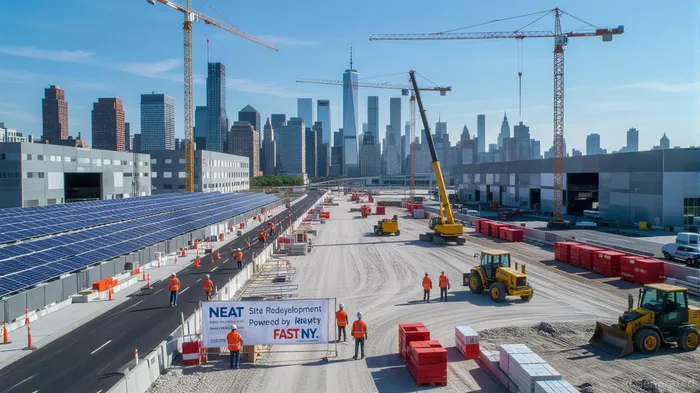
The grant's impact extends beyond infrastructure. By creating a framework for advanced manufacturing and logistics, it has attracted high-value investments such as the $650 million fairlife® dairy plant, which is projected to generate 250 jobs by 2025 according to projections. Such projects underscore how public funding can de-risk private-sector participation, enabling developers to capitalize on newly viable land.
600 Ridge Road: From Brownfield to Bluefield
Complementing the NEAT site's redevelopment is the 600 Ridge Road project, another pivotal component of Webster's industrial revival. This site, also a former brownfield, is undergoing environmental remediation and infrastructure upgrades supported by a $90,000 transportation planning grant. These efforts aim to enhance connectivity and pedestrian access, further solidifying the area's appeal for industrial and commercial use.
The transition of 600 Ridge Road from a contaminated site to a "bluefield"-a term for redeveloped brownfields that become productive assets-exemplifies Governor Kathy Hochul's broader strategy to decentralize manufacturing and strengthen regional supply chains as outlined in official reports. By addressing environmental and logistical barriers, Webster is positioning itself as a magnet for industries requiring reliable infrastructure, such as food processing and semiconductor supply chains according to industry analysis.
Economic and Real Estate Impacts: A Win-Win for Investors
The combined effect of these projects is already evident in Webster's real estate market. Residential property values have surged by 10.1% since 2023, driven by the influx of high-paying jobs and the town's enhanced economic profile. Meanwhile, industrial space is set to expand to nearly one million square feet by 2026 according to forecasts, creating a window of opportunity for investors to secure properties at favorable prices before demand outstrips supply.
The economic ripple effects are equally striking. Median household income in the area is projected to rise by 4.31% from 2023 to 2024, largely due to the dairy plant's job creation. Such gains not only stabilize the local economy but also reinforce the long-term viability of industrial real estate as an asset class.
Strategic Partnerships and the Role of the Webster Economic Alliance
The success of Webster's redevelopment hinges on strategic partnerships, particularly the role of the Webster Economic Alliance. By collaborating with the Webster Community Coalition for Economic Development, Inc., the alliance secured the FAST NY grant and coordinated infrastructure upgrades that made the NEAT site attractive to private developers. This model of public-private collaboration highlights the importance of local economic development organizations in translating state-level funding into tangible outcomes.
Conclusion: A Model for Future-Proofing Industrial Real Estate
Webster's experience offers a roadmap for other municipalities seeking to future-proof their industrial real estate. By aligning public infrastructure grants with private-sector needs, towns can transform underutilized land into high-value assets while fostering economic resilience. For investors, the key takeaway is clear: early-stage investments in redeveloped sites like NEAT and 600 Ridge Road are poised to deliver outsized returns as demand for advanced manufacturing and logistics space continues to grow.
As the FAST NY program's broader $283 million investment in Upstate New York projects demonstrates according to official announcements, the state is committed to decentralizing economic activity and reducing reliance on traditional urban centers. Webster's story is not just about bricks and mortar-it's about reimagining how infrastructure can serve as a bridge between public policy and private prosperity.







Comentarios
Aún no hay comentarios