
Urban Political Stability and Real Estate Investment in Boston: Implications of Wu's Strong Reelection Lead
Boston's real estate market has long been shaped by its political climate, and the recent preliminary mayoral election results underscore a critical shift in stability. Mayor Michelle Wu, with a commanding 67.6% of the vote in the preliminary election, has secured a near-certain path to the November general election, where she faces a fragmented field led by challenger Josh Kraft, who garnered just 27.6% of the vote[1]. This political continuity—coupled with Wu's well-defined policy agenda—creates a predictable environment for investors navigating Boston's complex urban development landscape.
Policy Continuity and Affordable Housing Priorities
Wu's administration has prioritized combating gentrification and expanding affordable housing, initiatives that directly influence real estate investment strategies. To date, her team has taken 700 homes off the market and reclassified them as affordable housing, while also committing to constructing 11,000 new affordable units[2]. These efforts align with broader economic research indicating that public housing investments generate significant returns: for every $1 million invested by Boston's Public Housing Authorities (PHAs), approximately $1.89 million in economic activity is created, supporting 11 full-time jobs[3].
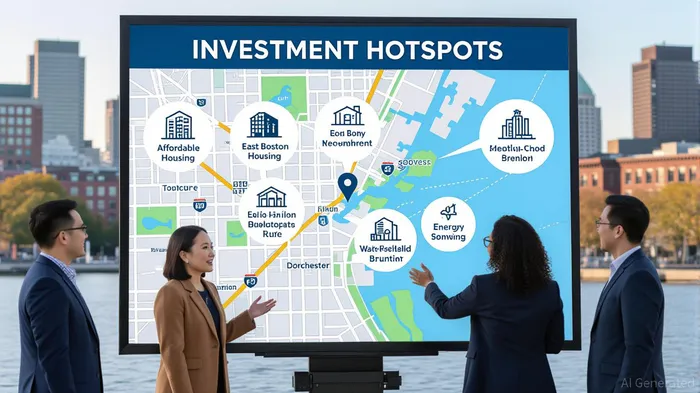
However, affordability challenges persist. The city's median home price in 2025 stands at $800,000, with an average rent of $3,100, despite compressed cap rates (3.5–4.5%) and a low vacancy rate (2.8%)[4]. Investors must weigh Wu's focus on equitable development against the risk of gentrification, particularly in neighborhoods like Roxbury and East Boston, where adaptive reuse projects—such as converting underutilized office spaces into affordable housing—are gaining traction[2].
Commercial Real Estate and the Office Market Dilemma
The office sector, however, faces a more precarious outlook. A 2025 report warns that plummeting office values—projected to drop 35% to 45% due to remote work trends and high interest rates—could cost Boston $1.7 billion in revenue over five years[5]. Wu's proposed solution—a temporary shift in property tax burdens from residential to commercial properties—aims to mitigate a potential 33% spike in residential taxes[6]. While this policy could stabilize homeowners, it raises questions for commercial investors, particularly in downtown Boston, where Wu has prioritized converting 1,000 office units into housing by summer 2025[2].
Energy Efficiency and Sustainable Development
Wu's climate agenda further shapes investment trajectories. A $150 million partnership with EversourceES-- and the National GridNGG--, launching in fall 2025, will fund energy efficiency upgrades for homes and businesses[2]. Additionally, all new “big buildings” will be required to meet net-zero energy standards[2]. These measures align with Boston's status as a hub for green infrastructure, though academic studies caution that such projects must be carefully managed to avoid exacerbating socioeconomic divides[7].
Strategic Considerations for Investors
Political stability under Wu's leadership offers clarity for long-term planning, but investors must adapt to evolving policy priorities:
1. Affordable Housing Focus: Prioritize developments aligned with Wu's affordable housing goals, particularly in high-growth areas like DorchesterDMLP--, where improved rent-to-price ratios make DSCR financing attractive[4].
2. Commercial Flexibility: Re-evaluate office investments in favor of mixed-use or residential conversions, especially in downtown Boston, where adaptive reuse is incentivized[2].
3. Energy Compliance: Factor in net-zero requirements and energy efficiency grants when assessing new construction or renovation projects[2].
Conclusion
Boston's political landscape, anchored by Wu's strong reelection lead, provides a framework for strategic real estate investment. While her policies address affordability, climate resilience, and fiscal equity, they also introduce challenges for commercial property owners and developers. Investors who align with Wu's priorities—particularly in affordable housing and sustainable development—stand to benefit from a stable regulatory environment, but must remain agile in response to shifting tax policies and market dynamics.







Comentarios
Aún no hay comentarios