
Urban Infrastructure Safety and Regulatory Reform in Asia: The Economic and Investment Implications of the Hong Kong High-Rise Fire Disaster
Hong Kong's Regulatory Overhaul and Economic Rebalancing
The Hong Kong government's immediate response to the fire included arrests of construction company officials for alleged negligence and a pledge to phase out bamboo scaffolding in public projects. Beyond criminal accountability, the 2025 Policy Address outlined a HK$30 billion annual investment in public works over three years, targeting the Northern Metropolis and housing renewal. Digital tools, such as an AI-powered project cost management platform and streamlined approvals via a Project Facilitation Office, aim to enhance transparency and efficiency in infrastructure delivery.
Economically, the construction sector faced headwinds in 2025, with growth slowing to 0.7% due to a weak housing market and high inflation. However, large-scale projects like the $12.8 billion Skytopia initiative-featuring an arts hub and driverless transport-signal resilience. By the second half of 2025, public sector investments in healthcare and education began offsetting private sector declines, supported by a 3.1% GDP growth in Q1 2025.
Regional Fire Safety Innovations and Investment Shifts
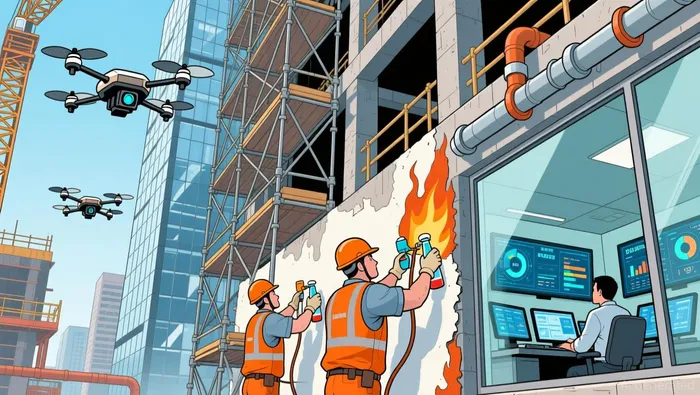 The Hong Kong fire has indirectly influenced neighboring markets to prioritize fire safety in urban planning. Japan, for instance, has accelerated adoption of AI and IoT-enabled fire detection systems, integrating them into smart city frameworks. South Korea, while not explicitly citing the Hong Kong incident, has strengthened its Clean Hydrogen Power Standard (CHPS) and invested in advanced fire suppression technologies for high-rise buildings. Singapore, though not directly referenced in the sources, is likely to follow similar trajectories given its emphasis on smart infrastructure.
These reforms are reshaping investment flows. The global fire stopping materials market is projected to grow as stringent regulations drive demand for advanced fire safety solutions in high-rise developments. In Japan, the fixed automatic fire suppression system market is valued at USD 400 million in 2024, with forecasts of USD 700 million by 2033. Such trends highlight the intersection of regulatory mandates and technological innovation in attracting capital.
Economic Implications: From Compliance Costs to Long-Term Resilience
The short-term costs of compliance with new safety standards are evident. Hong Kong's Fire Services Department issued over 8,661 Fire Hazard Abatement Notices (FHANs) post-disaster, with 90% compliance achieved. While these measures increase upfront costs for developers, they also create opportunities for firms specializing in retrofitting and smart fire alarm systems. Hong Kong's pilot scheme to install smart alarms in 3,600 old buildings, for instance, offers a cost-effective model for urban renewal.
Longer-term, the reforms are aligning with global sustainability goals. Hong Kong's Government Green Bond Programme, which issued HK$120 billion in green bonds from 2019 to 2023, reflects a broader trend toward ESG-driven investments. Institutional investors in the city now recognize climate-related financial risks, with 73% publishing disclosures aligned with international standards. This shift is mirrored in Japan and South Korea, where hydrogen energy and clean infrastructure projects are attracting foreign capital.
Investment Outlook: Navigating Policy-Driven Markets
For investors, the post-Hong Kong fire landscape presents both challenges and opportunities. The construction sector's tender price index is expected to stabilize or decline due to increased competition and administrative cost pressures. However, niche areas like modular construction and AI-driven project management are gaining traction. The Northern Metropolis development, with its focus on housing and urban renewal, is positioned to sustain long-term growth.
Regional policy linkages further complicate the investment calculus. ASEAN nations like Indonesia and Malaysia have tightened ownership transparency rules for offshore investments, indirectly affecting Hong Kong's role as a financial intermediary. Meanwhile, South Korea's fourfold safety enhancement for a $350 billion U.S. investment underscores the growing emphasis on risk mitigation in infrastructure projects.
Conclusion: A New Era of Safety-First Urban Development
The Hong Kong fire has accelerated a paradigm shift in Asia's approach to urban infrastructure safety. While the immediate economic costs are significant, the long-term benefits-enhanced resilience, technological adoption, and sustainable growth-position the region for a more secure and investment-friendly future. For investors, the key lies in aligning with policies that prioritize safety and innovation, ensuring that today's regulatory reforms translate into tomorrow's market opportunities.







Comentarios
Aún no hay comentarios