
Urban Industrial Real Estate in Post-Corporate-Divestiture Markets: Strategic Capital Allocation and the Xerox Webster Campus Model
The Xerox Webster Campus: A Case Study in Post-Industrial Revitalization
The 300-acre Xerox Webster campus, once a symbol of mid-20th-century corporate dominance, is now a flagship project for post-industrial redevelopment. According to a report by WEDA, the site has secured a $9.8 million FAST NY grant to catalyze its transformation into a hub for advanced manufacturing and logistics. This funding, paired with a $4.5 million NY Forward Program allocation, underscores the critical role of public-private partnerships in de-risking large-scale redevelopments.
Infrastructure upgrades have already begun reshaping the campus's value proposition. Road, sewer, and electrical system improvements have reduced industrial vacancy rates to 2% in 2024, attracting anchor projects like the $650 million fairlife® dairy plant, which is projected to create 250 jobs. These investments are not isolated but part of a broader $1 billion development vision for the NEAT (North East Accessible Transit) corridor by 2026, supported by $283 million in public and private capital. The Reimagine Webster Master Plan further solidifies this trajectory by designating the campus as a Brownfield Opportunity Area, ensuring future projects receive priority for state funding. 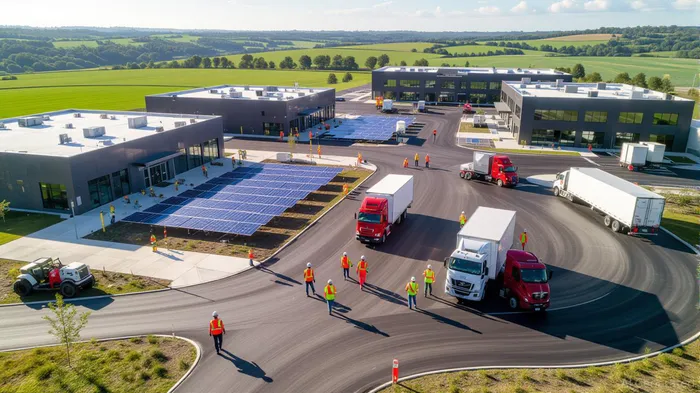
Strategic Capital Allocation: Lessons for Investors
The Webster case highlights three key principles for capital allocators targeting post-corporate-divestiture markets:
Infrastructure as a Catalyst for Value Creation
The $9.8 million FAST NY grant demonstrates how targeted infrastructure investment can unlock latent value in brownfield sites. By addressing connectivity and utility gaps, such funding reduces the risk profile of adjacent land, making it attractive to advanced manufacturers. For example, the transfer of Orchard Street and Panama Road to public ownership has enhanced the campus's accessibility, a critical factor for logistics-intensive industries.Public-Private Synergy in Risk Mitigation
The collaboration between WEDA, the Village of Webster, and community stakeholders illustrates the power of aligned incentives. Public grants act as a down payment, enabling private developers to scale projects with confidence. The fairlife® dairy plant's rapid advancement-despite its $650 million scale-was possible because infrastructure upgrades were completed ahead of construction timelines.
- Long-Term Vision and Policy Alignment
The Reimagine Webster Master Plan's designation of the campus as a Brownfield Opportunity Area ensures sustained public support for future projects. This policy framework reduces regulatory uncertainty, a key barrier in post-industrial markets. For capital allocators, such alignment signals a stable environment for long-horizon investments.
Opportunities for Private Equity and Infrastructure Funds
The Webster model presents compelling opportunities for early-stage private equity and infrastructure-focused funds. With vacancy rates near zero and a $1 billion development pipeline, the campus is entering a phase where capital can be deployed with high confidence in absorption rates. Funds specializing in brownfield reactivation should prioritize:
- Pre-Development Equity: Investing in infrastructure upgrades that directly enhance land value, such as road and utility expansions.
- Anchor Tenant Partnerships: Co-investing with manufacturers like fairlife® to secure long-term lease agreements, ensuring cash flow stability.
- Policy-Linked Instruments: Structuring deals that leverage state funding mechanisms, such as tax credits or grants tied to job creation metrics.
The broader NEAT corridor's $283 million in public and private investment further amplifies these opportunities. By 2026, the corridor is expected to become a regional hub for advanced manufacturing, driven by Webster's role as a catalyst.
Conclusion
The Xerox Webster campus is more than a redevelopment project-it is a microcosm of the next phase in urban industrial real estate. For capital allocators, the lessons from Webster underscore the importance of strategic infrastructure investment, policy alignment, and early-stage participation in post-corporate-divestiture markets. As brownfield sites across the U.S. face similar transitions, the Webster model offers a replicable framework for turning industrial obsolescence into economic vitality.







Comentarios
Aún no hay comentarios