
Is Uranium Energy Overvalued Amid a Nuclear Renaissance?
The global energy landscape is undergoing a seismic shift as nuclear power reemerges as a cornerstone of decarbonization strategies. Uranium Energy CorpUEC-- (UEC), a leading player in the uranium sector, has surged 64% in 2025 amid this "nuclear renaissance," but questions linger: Is its valuation justified by fundamentals, or is the market overbidding on speculative optimism? This analysis examines UEC's valuation metrics against the backdrop of uranium's long-term supply-demand dynamics to determine whether the stock is overvalued, fairly priced, or undervalued.
Valuation Fundamentals: A High-Priced Play?
UEC's current price-to-book (P/B) ratio of 4.6x according to market data starkly contrasts with the US Oil and Gas sector's average of 1.4x and its peer group's 4.2x as reported by SimplyWall St, signaling a premium valuation. This premium is further amplified by a 59% year-on-year increase in market capitalization to $6.25 billion. However, intrinsic valuation models suggest a more nuanced picture. A discounted cash flow (DCF) analysis estimates UEC's fair value at $12.49 per share according to Yahoo Finance, aligning closely with its current price. Analysts, meanwhile, project a 26.5% upside, with a $15.80 average price target according to stock analysis, though a low valuation score of 2/6 implies much of the anticipated growth may already be priced in as noted by financial sources.
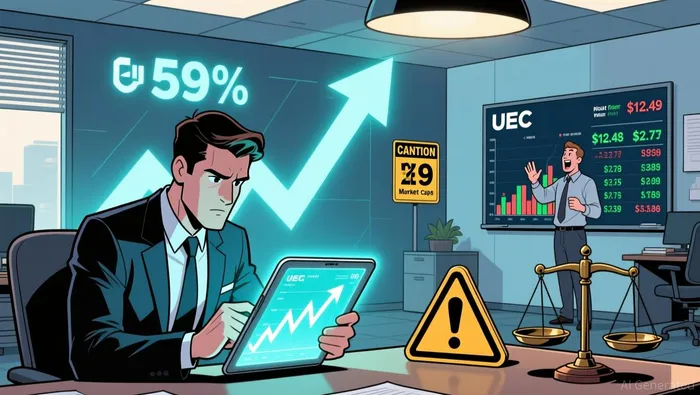 Critically, UEC's financials reveal a company in an investment-heavy phase. Free cash flow turned negative (-$92.81 million in the last 12 months according to stock analysis), reflecting capital expenditures to expand production capacity. While this underscores near-term risks, it also highlights UEC's strategic alignment with the sector's long-term trajectory.
Supply-Demand Dynamics: A Structural Tailwind
The uranium market is experiencing a perfect storm of tightening supply and surging demand. By 2030, global uranium demand is projected to rise 28% to 87,000 metric tons annually, with the World Nuclear Association forecasting a doubling to 150,000 metric tons by 2040. This growth is driven by AI-driven power demands, government policy support, and the U.S. commitment to 10 new reactors by 2030.
Conversely, supply constraints are intensifying. Kazakhstan's consolidation of uranium production and the U.S.'s reliance on foreign imports (producing only 1 million pounds annually vs. 50 million pounds consumed according to PowerMag) create geopolitical vulnerabilities. Secondary supplies, once a buffer, are dwindling, while historical underinvestment in mining has left production capacity lagging. Uranium prices, already up sharply in 2025, are expected to reach $90–$100 per pound by year-end as projected by Global Electricity, with further gains anticipated in 2026 as utilities lock in long-term contracts according to industry analysis.
Reconciling Valuation with Fundamentals
UEC's valuation appears elevated when viewed through traditional metrics like P/B ratios. Yet, this must be contextualized within the sector's structural transformation. The company's premium pricing reflects investor anticipation of uranium's role in the energy transition, supported by federal initiatives like the Nuclear Fuel Supply Act and enCore Energy's production expansions as reported by Crux Investor.
However, risks persist. UEC's negative free cash flow and low valuation score suggest reliance on future cash flows, which could be jeopardized by regulatory delays, production bottlenecks, or a slowdown in reactor construction. Conversely, the tightening supply-demand gap and geopolitical tailwinds-such as the U.S.-Japan collaboration on advanced reactors-position uranium as a strategic asset, potentially validating UEC's premium.
Conclusion: A Balancing Act
UEC's valuation is neither clearly overvalued nor undervalued. Its P/B ratio and DCF model suggest alignment with intrinsic value as noted by financial analysis, while analyst optimism reflects confidence in the nuclear renaissance. The key lies in whether the company can execute its capital-intensive plans and capitalize on the projected 28% demand surge. For investors, the decision hinges on two factors: the pace of uranium price appreciation and UEC's ability to navigate supply-side challenges. In a sector where geopolitical and technological forces are reshaping fundamentals, UEC's valuation may yet prove to be a forward-looking bet rather than a mispricing.





Comentarios
Aún no hay comentarios