
UPS's Valuation and Competitive Positioning Post-33% 2024 Share Decline: A Value Investor's Perspective
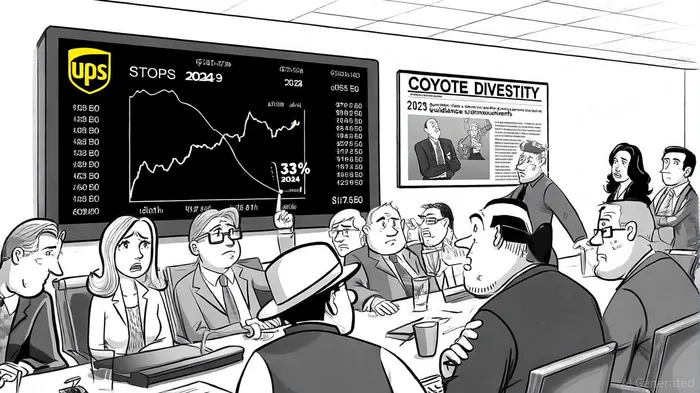
The recent 33% decline in United Parcel ServiceUPS-- (UPS) shares in 2024 has sparked debate among investors about whether the stock represents a compelling value opportunity or a warning sign of structural challenges. From a value investing lens, however, the drop appears to be an overreaction to short-term headwinds, masking UPS's resilient financials, strategic transformation, and long-term positioning in a logistics sector poised for growth.
Financial Resilience Amid Transformation
UPS's 2024 financial results underscore its operational discipline. For the full year, the company generated $91.1 billion in revenue, with non-GAAP operating profit of $8.9 billion and a 9.8% adjusted operating margin, according to UPS's 4Q 2024 earnings release. Despite a 3.44% decline in EBITDA to $12.077 billion compared to 2023, per Macrotrends' EBITDA data, the company maintained a consistent EBITDA margin of 10.8%, demonstrating effective cost management amid inflationary pressures and transformation costs.
The U.S. Domestic segment, which accounts for 60% of revenue, delivered $17.3 billion in Q4 2024, with a 10.1% adjusted operating margin, the earnings release shows. Meanwhile, the International segment outperformed, achieving a 21.6% adjusted operating margin, driven by e-commerce growth and pricing discipline. These results highlight UPS's ability to balance scale with profitability, a critical trait for long-term value creation.
Valuation Metrics Suggest Undervaluation
UPS's current valuation appears attractive relative to its fundamentals. With a market capitalization of $70.24 billion as of October 2025, the stock trades at a price-to-earnings (P/E) ratio of approximately 10.7x (based on $7.72 non-GAAP EPS in 2024, per the company's release). This is significantly below the logistics sector's average P/E of 14x, suggesting potential undervaluation.
The price-to-book (P/B) ratio further supports this view. At a book value per share of $18.57, according to StockAnalysis's valuation page, UPS's P/B ratio stands at 4.46x, well below its historical average of 6.5x. Meanwhile, the enterprise value-to-EBITDA (EV/EBITDA) ratio is 9.14x, calculated using an enterprise value of $110.42 billion (market cap of $70.24 billion + net debt of $21.5 billion - cash of $6.11 billion, per the company's release and Simply Wall St) and EBITDA of $12.077 billion. This compares favorably to the sector's EV/EBITDA of 12x, indicating UPSUPS-- is trading at a discount to peers.
Competitive Positioning in a Transforming Sector
UPS's competitive advantages lie in its diversified business model and global logistics network. The earnings release underscores the International segment's 21.6% adjusted operating margin, highlighting strength in high-growth markets where e-commerce demand is surging. Meanwhile, the Supply Chain Solutions segment, despite a revenue decline due to the Coyote divestiture, maintained a 7.4% operating margin, reflecting the durability of its core services.
The company's transformation initiatives, including automation and fleet electrification, are expected to yield $400 million in annualized savings by 2025, supporting long-term trends in logistics such as sustainability and last-mile delivery optimization and positioning UPS to capture market share from less agile competitors.
Long-Term Growth Drivers
The logistics sector is set for sustained growth, driven by e-commerce expansion, supply chain resilience investments, and urbanization. UPS's 2025 guidance-$89 billion in revenue and a 10.8% operating margin-reflects confidence in these trends. The company's $3.5 billion in planned capital expenditures for 2025 will further enhance its infrastructure, while $5.5 billion in dividends and $1.0 billion in share repurchases underscore its commitment to shareholder returns.
Risks and Considerations
While UPS's fundamentals are robust, investors should remain cautious about its net debt of $21.5 billion, as noted by Simply Wall St, and the risk of margin compression from rising fuel costs or labor disputes. However, the company's $6.11 billion in cash reserves and strong EBITDA provide ample liquidity to navigate these challenges.
Conclusion: A Compelling Value Play
UPS's post-2024 share decline has created an opportunity for value investors to acquire a high-quality logistics business at a discount to intrinsic value. With a resilient business model, improving margins, and alignment with long-term sector trends, UPS is well-positioned to deliver superior returns over the next five years. For those willing to look beyond short-term volatility, the current valuation offers a compelling entry point.





Comentarios
Aún no hay comentarios