
UPS's Strategic Reimagining: A Calculated Bet on Long-Term Resilience in a Post-Amazon Era
The recent upheaval in UPS's stock price—plummeting 14.57% following its announcement to reduce AmazonAMZN-- deliveries by 50% by mid-2026—has sparked a critical question for long-term investors: Is this a buying opportunity or a warning sign? To answer this, one must dissect UPS's strategic recalibration, its financial resilience, and the broader industry dynamics reshaping the e-commerce logistics sector.
Strategic Shift: From Amazon Dependency to Diversified Growth
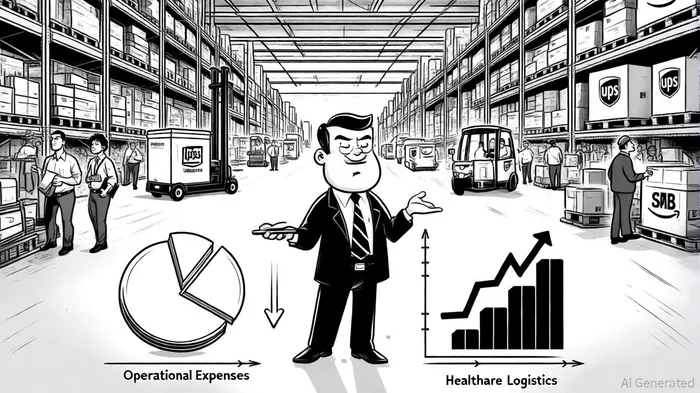
UPS's decision to scale back Amazon business is not a retreat but a calculated pivot. Amazon accounts for 11.8% of UPS's revenue[1], yet its insourcing of logistics operations—exemplified by Amazon's $1 billion investment in fulfillment and transportation upgrades[2]—has eroded third-party margins. By redirecting resources to small- and medium-sized businesses (SMBs) and healthcare logistics, UPSUPS-- is targeting segments with higher profitability and less volatility.
SMBs now represent 31.2% of U.S. volume for UPS, the highest in a decade[3], while healthcare logistics is projected to grow to $20 billion in revenue by 2026, up from $10 billion in 2023[4]. This shift is underpinned by strategic acquisitions, such as Andlauer Healthcare Group, and operational innovations like the Labport facility in Louisville, which specializes in temperature-sensitive medical shipments[5]. These moves position UPS to capitalize on the healthcare sector's stable demand and premium pricing, contrasting with the cyclical nature of e-commerce.
Financial Resilience Amid Transition Costs
UPS's financials reflect both the challenges and opportunities of this transition. While Q2 2025 revenue fell 2.74% year-over-year to $21.2 billion[6], the company's debt-to-equity ratio of 1.83[7] and free cash flow yield of 4.99%[7] suggest manageable leverage and attractive returns for patient investors. The “Efficiency Reimagined” initiative—targeting $3.5 billion in annual savings through automation, facility closures, and workforce reductions—signals disciplined cost management[1].
However, near-term pain is inevitable. Analysts project a 12% decline in international margins due to shifting trade policies and reduced e-commerce volumes[8]. UPS's P/E ratio of 12.45[7] and current stock price of $84.41, below the $112.59 average analyst price target[8], hint at undervaluation if the company executes its long-term vision.
Competitive Positioning: Navigating a Crowded Market
UPS's competitive edge lies in its ability to adapt. While Amazon's $15 billion warehouse expansion[2] and Amazon-owned last-mile delivery networks threaten traditional logistics providers, UPS's Roadie acquisition has extended its U.S. delivery coverage to 97%[3], countering fragmentation. Its healthcare logistics division, with its advanced cold-chain infrastructure and global reach, offers a moat against rivals like FedEx and DHL, which lack comparable specialization in medical shipments[5].
Yet, the SMB market is fiercely competitive. Amazon's recent wage hikes and automation investments[2] could further pressure third-party margins. UPS's success here hinges on its ability to differentiate through reliability and tailored services, such as its Ground Saver domestic shipping product[1].
Analyst Sentiment and Risk Factors
Wall Street's mixed outlook—29 analysts assigning 2 “Sell,” 14 “Hold,” and 13 “Buy” ratings[8]—reflects uncertainty about the transition's execution. While Bank of America's Ken Hoexter maintains a “Buy” rating, citing UPS's “attractive dividend yield” and long-term strategic clarity[8], others warn of short-term revenue declines and operational disruptions from facility closures.
Key risks include:
1. Execution Risk: Can UPS's $3.5 billion cost-cutting plan offset lost Amazon revenue without harming service quality?
2. Market Volatility: Trade policy shifts and e-commerce slowdowns could delay the healthcare and SMB segments' growth.
3. Debt Management: A debt-to-equity ratio of 3.50 (as of June 2025)[9] raises concerns about refinancing costs in a rising interest rate environment.
Verdict: A Calculated Entry Point for Patient Investors
UPS's stock price slide, while painful, may represent a compelling entry point for long-term investors who can stomach near-term volatility. The company's strategic pivot to high-margin healthcare logistics and SMBs, coupled with its $3.5 billion efficiency drive, creates a strong foundation for post-2026 growth. At a P/E of 12.45[7] and a projected 10.8% operating margin in 2025[1], UPS appears undervalued relative to its long-term potential.
However, success is not guaranteed. Investors must monitor execution risks and macroeconomic headwinds. For those with a 5–7 year horizon and a tolerance for strategic transitions, UPS's reimagined logistics model offers a compelling case: a company shedding low-margin dependencies to build a diversified, resilient business in an era of e-commerce evolution.







Comentarios
Aún no hay comentarios