
Upbit's Strategic Token Listings: A Gateway to Emerging DeFi Opportunities?
In the rapidly evolving world of decentralized finance (DeFi), exchange listings have become a double-edged sword. On one hand, they unlock liquidity and visibility for emerging protocols; on the other, they risk inflating short-term hype without addressing long-term fundamentals. Upbit, South Korea's largest cryptocurrency exchange, has emerged as a pivotal player in this dynamic, with its 2025 listing strategyMSTR-- sparking debates about whether it serves as a gateway to genuine DeFi innovation or merely amplifies speculative cycles. For risk-aware investors, the question is clear: Do tokens like EtherFiETHFI-- (ETHFI), newly listed on Upbit, represent compelling long-term opportunities, or are they fleeting beneficiaries of exchange-driven momentum?
Upbit's Listing Mechanics and Market Impact
Upbit's token listing criteria in 2025 emphasize transparency, technical robustness, and regulatory compliance, with projects required to undergo rigorous due diligence, including KYC verification and vulnerability assessments [1]. The exchange's aggressive expansion—nearly one listing per day in September 2025—has been driven by competitive pressures, particularly from Bithumb, but has also raised concerns about the quality of due diligence [2].
Historically, Upbit listings have triggered immediate price surges. For instance, WorldcoinWLD-- (WLD) rose 20% and FLOCK spiked 219% intra-day post-listing [1]. These gains are fueled by Upbit's reputation for reliability, global trading pairs (BTC, USDT, KRW), and the influx of speculative capital. However, recent trends suggest diminishing returns. Tokens often experience rapid sell-offs, with traders adopting a “sell the news” strategy as the broader market matures [2]. EtherFi's September 2025 listing exemplifies this pattern: The token peaked at $1.6790 on September 18, only to drop to $1.4756 by September 20, despite a 170 million trading volume spike [3].
EtherFi: A Case Study in DeFi Fundamentals
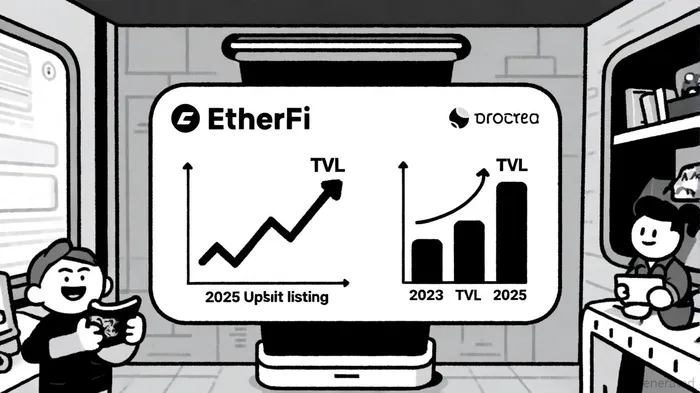
To assess whether Upbit-listed tokens like EtherFi offer long-term value, it is critical to examine their underlying fundamentals. EtherFi, a non-custodial liquid restaking protocol on EthereumETH--, has emerged as a key player in the DeFi ecosystem. Launched in May 2023 by co-founders Mike Silagadze (ex-Top Hat, Ripple Ventures) and Rok Kopp, the platform allows users to stake ETHETH-- while retaining liquidity through its eETH token [4]. By mid-2025, EtherFi's total value locked (TVL) had surged to $11.1 billion, making it the fourth-largest Ethereum protocol [5].
The project's governance token, ETHFIETHFI--, launched in March 2024, is allocated to incentivize community participation, with 21.6% reserved for the DAO treasury and 17.6% for airdrops [4]. Its utility extends beyond governance, including node operator collateralization and DeFi vaults that generate yield on eETH. EtherFi's roadmap further strengthens its appeal, with plans for multi-chain staking, Layer-2 integrations, and a crypto-native cash card offering 3% cashback [4]. These features position EtherFi as a competitor to custodial staking platforms, emphasizing user autonomy and real-time rebase functionality.
Balancing Momentum and Substance
While Upbit's listings provide short-term liquidity, the long-term success of tokens like ETHFI hinges on their ability to sustain user growth and adapt to market shifts. EtherFi's TVL growth—surging 6,159% in 2024 to $11.1 billion—demonstrates robust adoption, driven by institutional and retail demand for non-custodial staking solutions [5]. However, the protocol faces challenges, including competition from EigenLayerEIGEN-- and other restaking platforms, as well as regulatory scrutiny in South Korea following the TerraLUNA-- collapse.
For investors, the key is to differentiate between exchange-driven hype and intrinsic value. EtherFi's technical execution, team credibility, and expanding use cases suggest it is more than a fleeting market darling. Yet, its post-listing volatility underscores the risks of relying solely on Upbit's momentum. As one analyst notes, “The real test for ETHFI is whether it can convert its TVL into sustainable revenue streams and governance participation, rather than just trading volume [6].”
Conclusion: A Calculated Bet for Risk-Aware Investors
Upbit's strategic listings undeniably shape price discovery and liquidity, but their long-term investment value depends on the quality of the underlying projects. EtherFi, with its strong fundamentals and growing TVL, represents a compelling case for risk-aware investors willing to navigate short-term volatility. However, the rapid delisting rate of tokens failing to meet Upbit's standards—and the broader market's “sell the news” behavior—cautions against treating all listings as guaranteed opportunities.
For those who prioritize substance over speculation, EtherFi's non-custodial model, governance innovation, and real-world adoption metrics offer a foundation for long-term growth. Yet, investors must remain vigilant, balancing the allure of exchange-driven momentum with a critical evaluation of a project's ability to deliver on its roadmap. In the DeFi arena, as in any market, the most enduring opportunities are those built to outlast the hype cycle.






Comentarios
Aún no hay comentarios