
The Unraveling of Bitmine's Crypto Treasury Model: A Critical Analysis of Kerrisdale's Short Thesis
The Unraveling of Bitmine's Crypto Treasury Model: A Critical Analysis of Kerrisdale's Short Thesis
The recent Kerrisdale report on Bitmine ImmersionBMNR-- (BMNR) has ignited a firestorm in the crypto treasury sector, exposing critical vulnerabilities in the business model of digital-asset treasuries (DATs). At the heart of the critique lies a fundamental question: Can a company sustain value by issuing shares at a premium to buy EthereumETH-- while ignoring the long-term consequences of dilution and market saturation? The answer, according to Kerrisdale, is a resounding no.
Flawed Financial Modeling: A House of Cards Built on Dilution
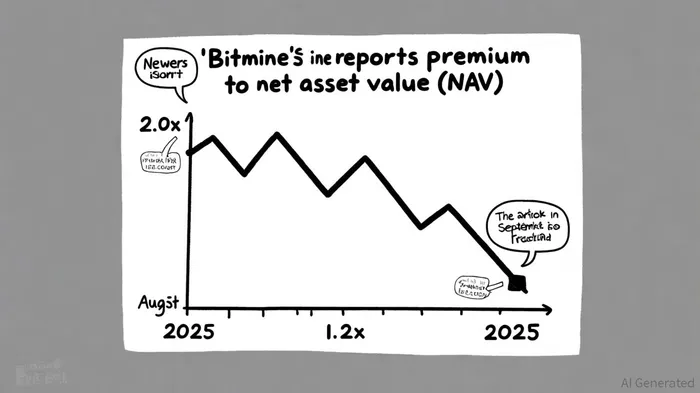
Bitmine's core strategy-issuing stock at a premium to its net asset value (NAV) to purchase Ethereum-has been a double-edged sword. While the model initially attracted investors with its simplicity, Kerrisdale argues it is structurally unsustainable. Over the past three months, the company has issued over $10 billion in new stock, averaging $170 million per day, according to the Kerrisdale report. This aggressive dilution has eroded investor confidence, with the premium-to-NAV ratio collapsing from 2.0x in August to 1.2x by September, as the report documents.
The recent $365 million direct offering, which included warrants, was labeled a "discounted giveaway" by Kerrisdale. The firm contends that such offerings reward short-term liquidity at the expense of long-term shareholders, creating a vicious cycle where rising Ethereum prices are met with more share sales-further pressuring the stock. This dynamic mirrors the "value extraction" seen in overhyped tech IPOs, where capital-raising becomes a self-fulfilling prophecy of decline.
Operational Scalability: A Sector Oversaturated with "Snake Oil"
Kerrisdale's critique extends beyond BitmineBMNR-- to the broader DAT sector. As reported in BMNR stock declines, a $100 billion wave of planned capital raises by U.S.-listed firms pursuing similar strategies risks creating a "race to the bottom" in premium valuations. With over 20 DATs now trading near or below NAV, the self-sustaining financial model that once defined the sector is collapsing under its own weight.
The scalability issue is twofold. First, the DAT model relies on perpetual capital inflows to maintain premium valuations, a strategy that falters when investor appetite wanes. Second, operational costs-such as Ethereum staking rewards, infrastructure maintenance, and regulatory compliance-have notNOT-- kept pace with the rapid expansion of these firms. As one analyst noted, "DATs are the crypto equivalent of a Ponzi scheme: They work until they don't."
Leadership and Investor Fatigue: The Human Element
Kerrisdale also scrutinized Bitmine's leadership, particularly executive chair Tom Lee. The firm argues that Lee lacks the "charismatic appeal" of peers like Michael Saylor, whose aggressive advocacy for BitcoinBTC-- has fueled investor enthusiasm. This perceived gap in leadership has exacerbated investor fatigue, with many now viewing DATs as a "solution in search of a problem."
The market's reaction has been swift. Following the report's release, Bitmine's stock plummeted, reflecting a broader skepticism toward DATs. Investors are increasingly questioning whether these firms add value beyond acting as intermediaries for Ethereum purchases-a role that can be replicated more efficiently via ETFs or direct crypto ownership.
Conclusion: A Cautionary Tale for Crypto Capitalism
Kerrisdale's short thesis on Bitmine is not merely a bearish bet-it is a wake-up call for the DAT sector. The flaws in Bitmine's financial modeling and the sector's operational scalability issues underscore a deeper problem: the reliance on speculative narratives over sustainable business practices. As the market matures, investors must ask whether these firms are building bridges to crypto or simply inflating bubbles.
For now, the data tells a clear story. Bitmine's premium-to-NAV contraction, coupled with the sector's saturation, suggests that the "Ethereum treasury" model is nearing its inflection point. As Kerrisdale aptly put it, "The snake oil is running out."





Comentarios
Aún no hay comentarios