
Unlocking Value with VFLO: A GARP Investor's Satellite Strategy
For growth-at-a-reasonable-price (GARP) investors, the quest for stocks that blend robust fundamentals with attractive valuations is never-ending. Enter the VictoryShares Free Cash Flow ETF (VFLO), a tool that marries high-quality, free cash flow (FCF)-driven companies with disciplined diversification—a perfect satellite allocation for portfolios anchored in broad-market core holdings. Here's how it fits into GARP strategies and why it deserves a place in your tactical toolkit.
The GARP Lens: Why FCF Matters
GARP investors prioritize companies with strong earnings growth and reasonable valuations, often avoiding overpriced momentum stocks. VFLO's methodology aligns with this philosophy by focusing on FCF yield, a metric that measures a company's cash generation relative to its market value. Companies with high FCF yield are typically undervalued or underappreciated, offering a margin of safety—a cornerstone of GARP.
Key VFLO Methodology:
- Selects 50 large-cap U.S. companies from the S-Network U.S. Equity Large/Mid-Cap 1000 Index.
- Ranks firms by expected FCF, blending trailing 12-month FCF with forward estimates.
- Applies a growth filter to exclude companies with stagnant prospects.
- Limits sector exposure (no more than 45% per sector) and individual holdings (≤4%).
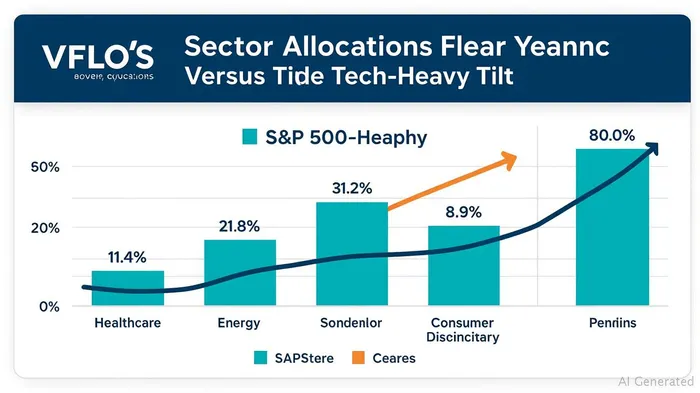
This approach ensures VFLO avoids overconcentration in volatile sectors like technology, steering clear of the “Magnificent Seven” (Alphabet, AmazonAMZN--, AppleAAPL--, MetaMETA--, MicrosoftMSFT--, NVIDIANVDA--, Tesla). As of May 2025, its top sectors included healthcare (25.98%), energy (19.63%), and consumer discretionary (20.24%), offering a stark contrast to the tech-heavy S&P 500.
Diversification Benefits: Low Correlation with Core Holdings
The core of most GARP portfolios—whether tracking the S&P 500 or Russell 1000—leans heavily on growth-driven sectors. VFLO's moderate correlation of 0.70 with SPY (the S&P 500 ETF) means it can act as a stabilizer during market downturns. For instance, during the tech rally of 2023–2024, VFLO's lack of exposure to high-flying tech stocks allowed it to outperform the Russell 1000 Value Index (14.37% vs. VFLO's 21.81% in 2024).
This low correlation also reduces portfolio volatility. While VFLO's volatility (3.46%) is slightly higher than SPY's (2.99%), its maximum drawdown since inception (-17.78%) is far less severe than SPY's historical -55.19% peak decline. For GARP investors seeking balance, this combination of growth exposure and risk mitigation is compelling.
Performance and Tactical Use Cases
VFLO's track record since its June 2023 launch underscores its appeal. It delivered a 21.81% return in 2024—beating the Russell 1000 Value Index—despite avoiding tech's dominance. In 2025, its $2.47 billion in net inflows reflect investor confidence in its strategy.
For GARP investors, here's how to deploy VFLO:
1. Satellite Allocation: Use it to complement core holdings (e.g., S&P 500 ETFs) by targeting 5–15% of equity exposure.
2. Value Rotation: Shift toward VFLO during market corrections when FCF-driven stocks outperform growth darlings.
3. Sector Diversification: Replace single-sector tech ETFs with VFLO to reduce concentration risks.
Risks and Considerations
No strategy is risk-free. VFLO's reliance on FCF metrics means it could underperform if:
- Interest rates rise sharply, squeezing companies with high debt.
- Energy or healthcare sectors face regulatory headwinds (e.g., drug pricing crackdowns).
- Market sentiment swings toward growth over value.
Additionally, its quarterly rebalancing may lead to higher turnover, though its 0.39% expense ratio remains competitive.
Final Take: A GARP Investor's Edge
VFLO offers GARP investors a nuanced solution: a rules-based ETF that hunts for quality at reasonable prices while sidestepping tech's boom-and-bust cycles. Its focus on FCF, growth, and diversification aligns perfectly with GARP principles, making it a standout satellite allocation. For portfolios that need resilience without sacrificing growth potential, VFLO is a must-consider.
Investment Advice: Allocate 5–10% of equity exposure to VFLO as a satellite, rebalancing annually to maintain core-satellite balance. Pair it with core broad-market ETFs for a well-rounded GARP portfolio.
Stay informed, stay diversified.







Comentarios
Aún no hay comentarios