
Unlocking Value in United Maritime: Navigating Post-Pandemic Challenges with Strategic Digitalization and Fleet Optimization
Financial Performance: A Mixed Picture
United Maritime's Q3 2025 results reflect both the challenges and opportunities of the current environment. Net revenues for the quarter fell to $11.0 million, down from $11.6 million in Q3 2024, while nine-month revenues declined to $31.2 million from $34.6 million in the prior year, according to a StockTitan report. Adjusted EBITDA, however, held steady at $5.4 million for the quarter, per the StockTitan report. The company's Time Charter Equivalent (TCE) rate of $15,093 per day, though lower than the $16,365 recorded in the same period of 2024, remains competitive in a market where rates have been volatile due to rerouted shipping lanes and geopolitical disruptions, as noted in the StockTitan report.
The decline in revenues is partly attributable to broader industry trends. According to a UNCTAD report, global maritime trade growth is projected to stall at 0.5% in 2025, down from 2.2% in 2024, as political tensions and rerouted vessels add costs and delays. For example, the Red Sea conflict has forced container lines to take longer routes around the Cape of Good Hope, increasing transit times and reducing the efficiency of traditional trade corridors, as reported by FreightWaves. United Maritime's TCE rate, while slightly down, suggests the company is managing these pressures better than some peers.
Strategic Moves: Fleet Optimization and Digitalization
United Maritime's value-unlocking strategy hinges on two pillars: fleet optimization and digital transformation. In 2025, the company sold two older Capesize vessels, generating $18.8 million in liquidity and transitioning to a pure Panamax and Kamsarmax fleet, as detailed in the StockTitan report. This move aligns with strong market demand for these vessel types, particularly as infrastructure projects in regions like Mumbai drive growth in logistics and industrial cargo, according to a Republic World article. The company also secured three index-linked time charters, ensuring exposure to favorable market conditions, per the StockTitan report.
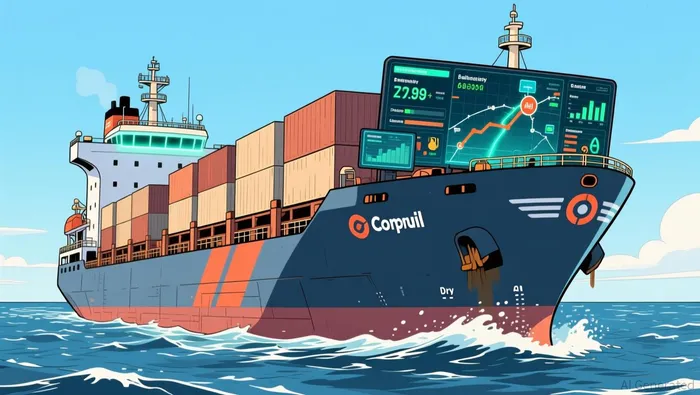
Digitalization is another key focus. United Maritime has invested in an AI-driven maritime software platform, aiming to enhance route efficiency, reduce fuel consumption, and improve transparency in ship management, as noted in the StockTitan report. While specific fuel savings metrics for Q3 2025 have not yet been disclosed, the broader industry is seeing tangible benefits from such technologies. For instance, HD Hyundai's OceanWise AI solution has achieved 5.3% fuel savings on average, according to a Businesstimes article. By adopting similar tools, United Maritime is positioning itself to reduce operational costs-a critical advantage in an industry where margins are increasingly squeezed by rising bunker prices and compliance costs, as highlighted in a Shipfinex blog.
Industry Context: A Sector in Transition
The post-pandemic maritime sector is undergoing a structural shift. Infrastructure-linked investments, such as Mumbai's $1.2 billion in real estate inflows in 2025, are creating new demand for dry bulk and container shipping, as noted in the StockTitan report. Meanwhile, environmental regulations-most notably the IMO's net-zero emissions target by 2050-are pushing companies to adopt cleaner technologies. United Maritime's focus on digitalization and fleet modernization aligns with these trends, as does its emphasis on index-linked charters, which provide flexibility in a volatile pricing environment, as reported in the StockTitan report.
However, challenges remain. The industry faces a crew shortage, port congestion, and rising compliance costs, all exacerbated by geopolitical risks. For example, the Suez Canal's tonnage remains 70% below 2023 levels, while the Strait of Hormuz continues to pose disruption risks, as noted in the UNCTAD report. United Maritime's strategic divestments and digital tools are designed to mitigate these issues, but execution will be critical.
Risks and Opportunities
Investors should weigh United Maritime's strategic initiatives against several risks. The company's liquidity, while bolstered by asset sales, remains constrained by debt obligations, as detailed in the StockTitan report. Additionally, the effectiveness of its AI-driven optimizations has yet to be fully quantified. If the platform fails to deliver promised efficiency gains, the stock could underperform.
On the flip side, the company's alignment with long-term trends-such as the shift to Panamax/Kamsarmax vessels and the adoption of digital tools-positions it to benefit from industry-wide tailwinds. The maritime digitization market, valued at $175.92 billion in 2023, is projected to grow at a 10.8% CAGR through 2030, according to a KBV Research report, suggesting that United Maritime's early investments could yield significant competitive advantages.
Conclusion: A Calculated Bet
United Maritime's Q3 2025 results underscore a company in transition. While revenue declines reflect broader industry headwinds, its strategic focus on fleet optimization, digitalization, and market-aligned chartering offers a clear path to value creation. For investors, the key question is whether the company can execute its digital transformation effectively and sustain its dividend amid a challenging macroeconomic environment. If it can, United Maritime may emerge as a resilient player in a sector poised for long-term structural change.







Comentarios
Aún no hay comentarios