
Unlocking Shareholder Value: Kansai Electric's Strategic Asset Sales Under Activist Pressure
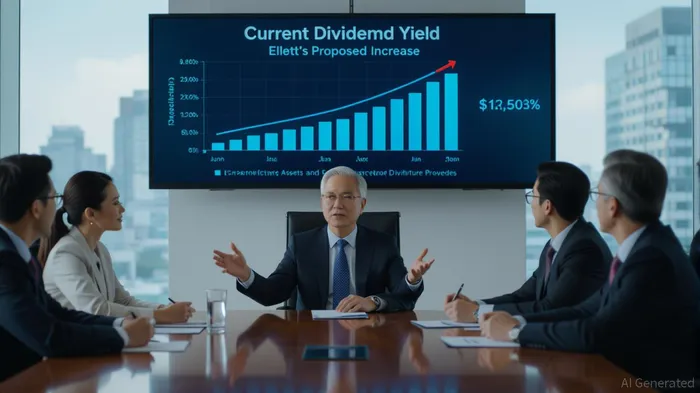
In the evolving landscape of Japanese utilities, Kansai Electric Power Co. (KEPCO) finds itself at a crossroads. Activist investor Elliott Management, now a top-three shareholder with a 4%-5% stake, has launched a high-stakes campaign to unlock value by selling 150 billion yen ($1 billion) in non-core assets annually[1]. This push, targeting over 2 trillion yen ($13.58 billion) in underutilized holdings—including 1 trillion yen in real estate and a construction firm stake—aims to fund a dividend hike from 60 yen to 100 yen per share and accelerate buybacks[3].
The Case for Divestiture
Elliott's strategy hinges on a simple premise: utilities in Japan, long insulated from aggressive capital efficiency, can generate superior returns by shedding non-core assets. KEPCO's current dividend yield, already modest, is set to shrink as profits contract by 30% to 295 billion yen in 2025[1]. By monetizing real estate carried at historical book values and non-core investments, the company could redirect cash to shareholders without compromising its core energy operations.
According to a report by Reuters, Elliott has identified a “low-hanging fruit” in KEPCO's portfolio: real estate holdings in Osaka and Kyoto, which have appreciated significantly since their acquisition in the 1990s[2]. These properties, now valued at over 1 trillion yen, could fetch premium prices in a market where commercial real estate remains resilient despite broader economic headwinds[3].
Operational Refocusing: Nuclear as the Growth Engine
While Elliott's focus is on shareholder returns, KEPCO is simultaneously pivoting toward nuclear energy as its primary growth driver. The company has initiated feasibility studies for a new reactor at the Mihama power station, signaling a long-term commitment to nuclear despite Japan's post-Fukushima caution[3]. This dual strategy—selling non-core assets while investing in high-margin nuclear infrastructure—could theoretically balance short-term value creation with long-term operational resilience.
However, the tension between these priorities is evident. KEPCO's refusal to increase dividends, even as profits decline, suggests a preference for capital preservation over shareholder appeasement[1]. This stance contrasts sharply with Elliott's playbook, which has previously pressured Tokyo Gas to streamline operations and boost returns[4].
Risks and Opportunities
The success of Elliott's campaign depends on KEPCO's willingness to embrace change. Selling 150 billion yen in assets annually would require navigating regulatory hurdles and potential pushback from local stakeholders, particularly in real estate-heavy regions. Yet, the potential rewards are substantial: a 100-yen dividend would elevate KEPCO's yield to 2.5%, outpacing peers like TEPCO (1.8%) and Chubu Electric (1.2%)[5].
Moreover, the proceeds from asset sales could fund nuclear projects, creating a virtuous cycle of capital efficiency. For instance, a 300-billion-yen investment in Mihama's new reactor—financed partly by asset sales—could generate stable cash flows for decades, offsetting the loss of non-core income[3].
Conclusion
KEPCO's current strategy, while prudent in a low-growth environment, risks alienating investors seeking higher returns. Elliott's proposal, though aggressive, aligns with global trends of activist-driven value creation in utilities. If KEPCO can balance its nuclear ambitions with disciplined asset management, it may emerge as a model for Japanese utilities navigating the dual pressures of energy transition and shareholder expectations.
For now, the ball is in KEPCO's court. The company's response to Elliott's demands—and its ability to execute a coherent divestiture plan—will determine whether it becomes a cautionary tale or a case study in strategic reinvention.







Comentarios
Aún no hay comentarios