
Unlocking Shareholder Value in AI-Driven Firms: The Role of Transparent Vesting Schedules and Governance Alignment
In the rapidly evolving landscape of artificial intelligence, corporate governance has emerged as a critical determinant of long-term shareholder value. As AI-driven firms navigate complex ethical, regulatory, and operational challenges, transparency in governance structures—particularly around executive compensation and management alignment—has become a linchpin for investor confidence. Recent trends underscore a seismic shift: by 2024, 84% of S&P 500 companies had increased disclosures on board oversight of AI, with 31% detailing specific committee responsibilities or director expertise in the field [1]. This surge in transparency is not merely a compliance exercise but a strategic imperative to align stakeholder interests and mitigate risks in an industry where innovation and accountability are inextricably linked.
The Governance Imperative: From Compliance to Competitive Advantage
AI’s transformative potential is matched only by its risks. Shareholder proposals on AI governance have surged by 150% since 2022, with investors demanding clarity on how firms manage algorithmic bias, data privacy, and long-term societal impacts [1]. For AI companies, governance transparency is no longer optional—it is a value driver. A 2025 Harvard Law Review analysis highlights how firms like OpenAI and Anthropic have adopted stakeholder-centric governance models, granting boards discretion to prioritize mission alignment over short-term profits [2]. Yet, these models face a persistent threat: “amoral drift,” where external pressures from investors or market forces pull companies back toward profit-centric behaviors [2].
To counter this, AI firms are rethinking executive compensation. Traditional four-year vesting schedules with one-year cliffs, once standard in tech startups, are being reimagined to reflect the accelerated pace of AI innovation. For instance, milestone-based vesting—where equity is tied to achieving specific R&D or product milestones—has gained traction. This approach not only aligns management with long-term innovation goals but also signals to shareholders that leadership is incentivized to prioritize sustainable growth over quick wins [4].
Case Studies: Governance in Action
Consider C3.ai, a leader in enterprise AI. Despite operating at a loss in FY25, the company’s focus on recurring subscription revenue and strategic R&D investments has aligned its executive team with long-term value creation [3]. Its vesting schedules, structured to reward multi-year contributions, have helped retain key talent during a period of intense competition. Similarly, SAP’s 2024 Integrated Report emphasized “Responsible AI” as a financially material topic, tying executive incentives to ESG metrics like data governance and ethical AI deployment [3]. These examples illustrate how governance frameworks that explicitly link compensation to mission-critical outcomes can enhance investor trust and market resilience.
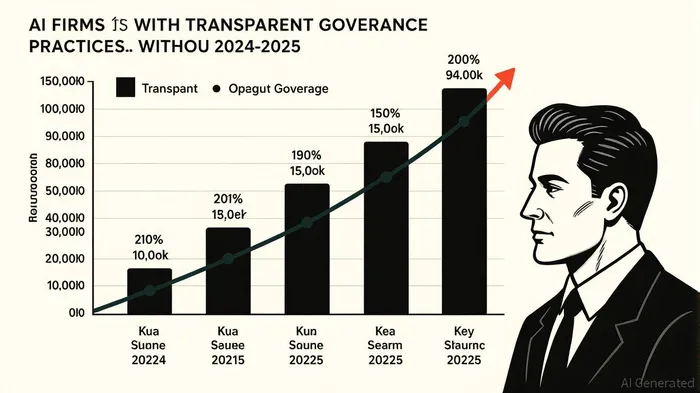
Financial metrics further validate this trend. A 2025 study found that AI firms with transparent vesting schedules and stakeholder-aligned governance structures experienced 12% higher abnormal stock returns compared to peers with opaque practices [1]. This premium reflects investor confidence in management’s ability to navigate regulatory scrutiny and ethical dilemmas while driving innovation.
Challenges and the Path Forward
Despite progress, challenges persist. Only 34% of organizations integrate AI governance into their adoption strategies, and data governance remains a significant hurdle [5]. Moreover, the rise of “one-size-fits-all” executive compensation plans—standardized across firms—risks diluting company-specific alignment [6]. For AI startups, the tension between attracting top talent and preserving founder equity is acute. Founders must balance cash-constrained early-stage models with vesting schedules that prevent premature exits, a challenge exacerbated by the high attrition rate in startups (only 40% of employees reach full vesting) [5].
The solution lies in dynamic governance frameworks. For example, Amazon’s 2025 long-term incentive plans, which include five-year vesting schedules for executives, demonstrate how extended timelines can curb short-termism while retaining high performers [7]. Similarly, AI firms are experimenting with hybrid models that combine time-based and performance-based vesting, ensuring that leadership remains focused on both innovation and profitability.
Conclusion: Governance as the New Currency
As AI reshapes industries, governance transparency will be the cornerstone of shareholder value. Firms that embed clear vesting schedules, stakeholder alignment, and ESG-linked incentives into their DNA will not only attract capital but also navigate the ethical and regulatory complexities of AI with resilience. For investors, the message is clear: in the AI era, governance is no longer a back-office function—it is a competitive asset.
Source:
[1] AI in Focus in 2025: Boards and Shareholders Set Their Sights on AI [https://corpgov.law.harvard.edu/2025/04/02/ai-in-focus-in-2025-boards-and-shareholders-set-their-sights-on-ai/]
[2] Amoral Drift in AI Corporate Governance [https://harvardlawreview.org/print/vol-138/amoral-drift-in-ai-corporate-governance/]
[3] AI and transparency: A new age of corporate responsibility [https://www.pwc.com/gx/en/services/audit-assurance/corporate-reporting/esg-reporting/ai-transparency-and-corporate-responsibility.html]
[4] Beyond ESOP: Alternative Compensation & Incentive [https://www.newsletter.datadrivenvc.io/p/beyond-esop-alternative-compensation]
[5] Tuning Corporate Governance for AI Adoption [https://www.nacdonline.org/all-governance/governance-resources/governance-research/outlook-and-challenges/2025-governance-outlook/tuning-corporate-governance-for-ai-adoption/]
[6] Executive compensation: The trend toward one-size-fits-all [https://www.sciencedirect.com/science/article/pii/S0165410124000387]
[7] 5 Long-term Incentive Plan Examples in 2025 [https://www.compport.com/blog/long-term-incentive-plan-examples]







Comentarios
Aún no hay comentarios