
Unlocking Retirement Potential: How Public Pension Recipients Benefit from the Social Security Fairness Act
The Social Security Fairness Act (SSFA), signed into law in January 2025, marks a historic shift for public-sector workers by eliminating the Windfall Elimination Provision (WEP) and Government Pension Offset (GPO). For millions of teachers, firefighters, police officers, and federal employees, this legislation removes a decades-old barrier that reduced their Social Security benefits due to non-covered pensions. The retroactive effective date of January 2024 means retirees are now seeing higher monthly payments—and advisors must act swiftly to recalibrate strategies for maximum lifetime benefits.
The SSFA: A Game-Changer for Public Workers
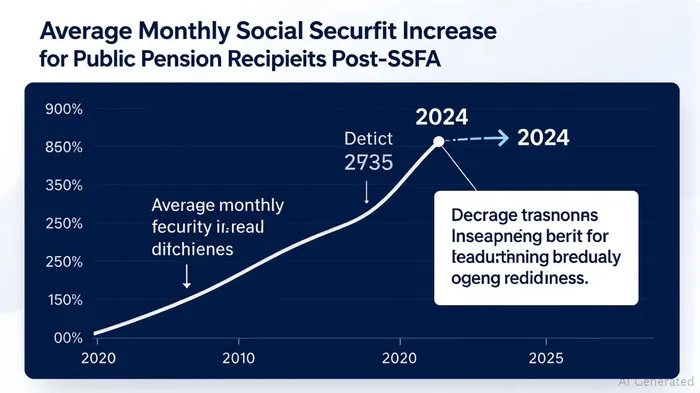
Before the SSFA, WEP and GPO rules penalized public employees who worked in jobs not covered by Social Security. For example, a teacher with a state pension might see their Social Security benefit cut by thousands annually. The SSFA's elimination of these provisions means affected retirees now receive up to 50% more in monthly benefits, with over $17 billion in retroactive payments already distributed by July 2025.
This law is particularly impactful for workers with 30+ years of service in non-covered roles, as their full pensions no longer conflict with Social Security. However, not all public employees qualify—the SSFA excludes those in Social Security-covered roles, which constitute 72% of state and local workers. Beneficiaries should verify their eligibility via the SSA's “my Social Security” portal or by contacting the agency directly.
Strategic Timing of Benefits: The 8% Delayed Retirement Credit
Wealth Enhancement experts emphasize that delaying Social Security until age 70 remains one of the most powerful strategies to maximize lifetime income. For public workers now unburdened by GPO/WEP reductions, this advice gains even greater urgency.
- Example: A retiree with a $2,000/month benefit at Full Retirement Age (FRA, age 67) can boost payments to $2,640/month by waiting until 70. This 32% increase translates to an extra $76,800 over 10 years.
- Break-Even Analysis: Those with a life expectancy beyond age 85 will recoup the “delayed” income lost by waiting past FRA.
While the Trust Fund is projected to cover 77% of benefits by 2033, delaying claims reduces reliance on future payouts. Advisors should model scenarios to balance longevity risk with potential benefit cuts.
Coordinating Pensions and Social Security: A New Paradigm
The SSFA's removal of offsets opens doors for retirees to align pensions and Social Security without penalty. Key steps include:
1. Reassess Pension Calculations: Verify that SSA has removed WEP/GPO reductions from past and future payments.
2. Optimize Spousal Benefits: Married couples can now fully leverage higher combined benefits. For instance, a spouse with a smaller Social Security payout can claim 50% of their partner's benefit.
3. Tax Efficiency: Up to 85% of Social Security benefits may still face federal taxes. Retirees should shift taxable accounts to states without income tax (e.g., Florida, Texas) to minimize liabilities.
Pitfalls to Avoid: Common Mistakes in Post-SSFA Planning
- Outdated Assumptions: Some retirees may still believe WEP/GPO apply. Advisors must review all past benefit calculations and correct errors.
- Ignoring Medicare Premium Adjustments: Beneficiaries paying premiums directly due to prior offsets should update their payment methods to avoid overpayments.
- Underestimating Longevity: The SSA's mortality tables assume life expectancy rises by 0.2% annually. Failing to account for this in delayed retirement strategies risks underfunding later years.
Wealth Enhancement's Top 3 Action Items for 2025
- Review All Retirement Accounts: Public employees should assess pensions, 401(k)s, and IRAs in light of increased Social Security income. Reallocate assets to prioritize tax efficiency.
- File for Benefits Promptly: Those who delayed applying due to WEP/GPO should submit claims immediately to secure retroactive payments.
- Consult a Financial Advisor: Navigate complex scenarios like divorce-related benefits or TSP withdrawals with a professional to avoid administrative backlogs.
Conclusion: A New Era of Retirement Security
The SSFA represents a rare win for public-sector retirees, but its benefits require proactive planning. By timing Social Security claims strategically, coordinating pensions without offsets, and addressing tax implications, retirees can secure higher lifetime income. Advisors must act now to update client plans—and retirees should seize this opportunity to build a more financially resilient future.
As Wealth Enhancement's blogs remind us: “The best time to plan was yesterday. The second-best time is today.”
Data sources: Social Security Administration, Wealth Enhancement blogs (2025), Congressional Budget Office projections.







Comentarios
Aún no hay comentarios