
Unlocking the Potential of AI-Driven Cybersecurity: A Strategic Investment Outlook for 2025 and Beyond
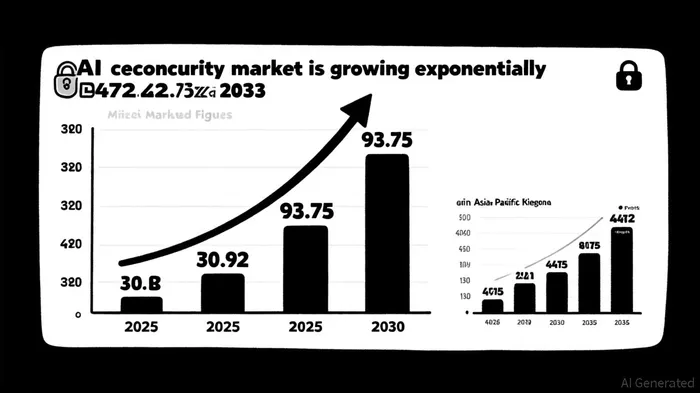
The global cybersecurity landscape is undergoing a seismic shift, driven by the escalating sophistication of cyber threats and the rapid adoption of AI-driven solutions. For investors, the AI cybersecurity market represents a compelling opportunity, with projections indicating a surge from USD 30.92 billion in 2025 to USD 472.73 billion by 2033, fueled by a compound annual growth rate (CAGR) of 34.58% [1]. This trajectory underscores a critical inflection pointIPCX-- in digital infrastructure, where AI is no longer a supplementary tool but a foundational element of security ecosystems.
Market Dynamics and Growth Drivers
The urgency to combat increasingly complex threats—such as zero-day exploits and ransomware—has accelerated demand for AI-powered solutions. According to a report by Mordor Intelligence, the market size in Q3 2025 already reached USD 30.02 billion, with a projected CAGR of 24.4% through 2030 [2]. This growth is underpinned by three key factors:
1. Digital Transformation: The proliferation of IoT devices and cloud computing has expanded attack surfaces, necessitating real-time threat detection.
2. Talent Shortages: A global deficit of 3.5 million cybersecurity professionals has forced organizations to automate routine tasks using AI [5].
3. Regulatory Pressure: Stricter data privacy laws, such as GDPR and CCPA, are compelling enterprises to adopt AI-driven compliance tools [4].
Regional Opportunities and Strategic Focus
While North America dominates the current market due to advanced infrastructure and stringent regulations, the Asia-Pacific region is emerging as the growth engine. Grand View Research notes that Asia-Pacific's digital adoption and government investments in cybersecurity are driving a CAGR of 34.58%—the highest among all regions [5]. Investors should prioritize markets like India and Southeast Asia, where AI adoption in cybersecurity is expected to rise by 25% over the next five years [4].
Technological Innovations and Competitive Edge
AI is reshaping cybersecurity through applications such as:
- Threat Detection: Machine learning algorithms can identify subtle anomalies and predict zero-day vulnerabilities [1].
- Security Orchestration, Automation, and Response (SOAR): AI-powered SOAR platforms reduce incident response times by up to 70% [3].
- Cloud Security: With 62.5% of AI cybersecurity revenue in 2025 tied to cloud deployment models, enterprises are prioritizing AI to secure hybrid environments [6].
Challenges and Mitigation Strategies
Despite the optimism, challenges persist. High implementation costs and adversarial AI attacks—where malicious actors manipulate AI models—remain barriers [1]. However, these hurdles also present opportunities for innovation. For instance, startups specializing in explainable AI (XAI) and bias-mitigation tools are well-positioned to address regulatory and ethical concerns [4].
Conclusion: A Call to Action for Investors
The AI cybersecurity market is not merely a defensive play but a strategic investment in the future of digital infrastructure. With the Asia-Pacific region's explosive growth and the maturation of AI applications in threat intelligence, investors should target firms offering scalable, cloud-native solutions. As the market evolves, early adopters will reap outsized rewards, transforming today's challenges into tomorrow's competitive advantages.







Comentarios
Aún no hay comentarios