
Unlocking Long-Term Value in European Real Estate: Strategic Entry Points and Compounding Returns
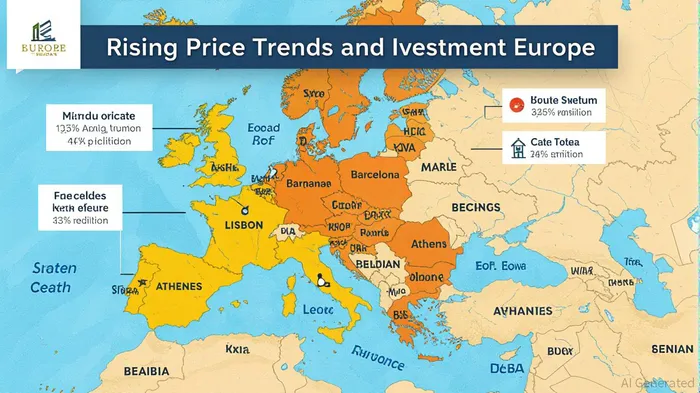
The European real estate market in 2025 is at a pivotal inflection pointIPCX--. After a year of stabilization in 2024—marked by peaking interest rates and declining inflation—buyers and sellers are aligning on pricing expectations, creating fertile ground for long-term value creation. According to a report by CBRECBRE--, total returns for European real estate are projected to reach 7.4% over the next 12 months, driven by sectors like logistics, offices, and high-quality sustainable buildings[1]. This optimism is underpinned by macroeconomic tailwinds, including the European Central Bank's (ECB) rate cuts and easing inflation, which are expected to boost corporate investment and real incomes, further fueling occupier demand[1].
Strategic Entry Points: Southern and Eastern Europe Shine
Southern and Eastern Europe have emerged as critical hubs for strategic investment, offering a blend of affordability, growth potential, and policy incentives. Portugal, for instance, has seen a 6.7% year-over-year price increase in prime properties, with cities like Lisbon and Porto attracting both domestic and international buyers[2]. Spain's coastal regions, including Barcelona and Malaga, are benefiting from a tourism rebound and expat relocations, with rental yields exceeding 6% in some areas[2]. Meanwhile, Italy's undervalued countryside and heritage properties are gaining traction, supported by government incentives for renovation[2].
Hungary and Poland stand out for their historical compounding returns. Over the past decade, Hungary's residential real estate prices surged by 296.62%, while Poland saw a 126.18% increase[1]. These figures underscore the resilience of Eastern European markets, which have weathered global volatility better than their Western counterparts. Romania and Croatia also posted robust growth, with 147.20% and 111.95% nominal price increases, respectively[1].
Compounding Returns: A Historical Perspective
European real estate's ability to compound value over time is rooted in its cyclical and structural dynamics. Historical data reveals that after bearish periods—such as the 36.6% annual plunge in the FTSE EPRA Nareit Developed Europe Index in 2022—the market typically rebounds with 9.94% and 9.54% average annualized returns in the 3 and 5 years following the downturn[2]. This resilience is amplified by sectors like logistics and residential, which are now leading the recovery. For example, industrial real estate in the Netherlands is attracting capital due to long-lease contracts and e-commerce growth, while undersupplied residential markets in France and the UK show tentative signs of revival[3].
The 2024 performance further validates this trend. European real estate delivered a 4.8% annualized total return, the highest since early 2022, with industrial and residential sectors driving the gains[5]. This momentum is expected to persist as nearshoring and sustainability goals reshape demand patterns.
Active Value-Add Strategies: The New Imperative
In a market where passive holding is no longer sufficient, active value-add strategies are critical. CBRE highlights that European real estate is undergoing a correction amplified by both cyclical and structural factors, creating opportunities for investors to “build, transform, and curate assets”[1]. For instance, Madrid and Lisbon are attracting capital for mixed-use developments that integrate climate-resilient infrastructure, despite regulatory challenges[3]. Similarly, data centers in Southern and Eastern Europe are emerging as a key theme, aligning with global tech and sustainability trends[3].
However, risks remain. Geopolitical tensions and trade policy uncertainty could dampen growth, particularly in export-dependent economies like Hungary and Poland[4]. Investors must balance these risks with the ECB's accommodative monetary policy, which is expected to ease borrowing costs and support rent growth[1].
Conclusion: A Volatile Yet Rewarding Landscape
European real estate in 2025 offers a compelling case for long-term value creation. Strategic entry points in Southern and Eastern Europe, coupled with historical compounding returns and active management strategies, position the asset class to outperform equities in a low-rate environment. While geopolitical and policy risks linger, the ECB's rate cuts and sectoral shifts—particularly in logistics and sustainability—provide a robust foundation for compounding wealth. For investors with a multi-year horizon, the time to act is now.





Comentarios
Aún no hay comentarios