
Unlocking Long-Term Value: Corporacion America Airports and the Future of Latin American Airport Infrastructure
The global aviation sector is undergoing a transformative phase, driven by technological innovation, sustainability imperatives, and shifting passenger demands. For investors seeking long-term value, Corporacion América Airports S.A. (CAAP) stands out as a compelling case study in Latin America—a region where airport infrastructure is poised for significant growth. By aligning its strategic initiatives with regional economic trends and regulatory momentum, CAAP is not only navigating near-term challenges but also positioning itself to capitalize on a $125.6 billion airport construction and modernization market projected to expand through 2031 [2].
Financial Resilience Amid Geopolitical Headwinds
CAAP's 2024 financial results underscore its ability to adapt to volatile environments. Despite a 2.7% decline in total passenger traffic to 79.0 million, the company achieved a 29.0% year-over-year increase in consolidated revenues (ex-IFRIC12) to $1,619.9 million, driven by 36.0% growth in aeronautical revenues and 22.4% growth in commercial revenues [1]. This performance highlights the company's diversification strategy, which mitigates risks from Argentina's hyperinflationary pressures (accounted for under IAS 29).
In Q2 2025, CAAP further demonstrated resilience, with 18.9% year-over-year revenue growth to $435.2 million and a 23.3% increase in Adjusted EBITDA ex-IFRIC12 to $167.9 million, supported by a margin expansion to 38.6% [1]. The company's liquidity remains robust, with $496.8 million in cash and cash equivalents as of June 30, 2025, and a net debt-to-LTM Adjusted EBITDA ratio of 1.0x—a testament to disciplined capital management [1].
Strategic Projects: From Duty-Free Expansion to eVTOL Readiness
CAAP's long-term value proposition is anchored in its proactive approach to infrastructure development. In Argentina, the expansion of Ezeiza Airport's duty-free arrivals area—which doubled in size—has already boosted commercial revenue, while similar initiatives in Uruguay (e.g., Montevideo's new covered parking facility) enhance service quality and passenger satisfaction [1]. These projects align with broader regional trends: governments are prioritizing smart technologies (biometrics, AI-driven security) and sustainability (renewable energy, carbon-neutral operations) to modernize airports [3].
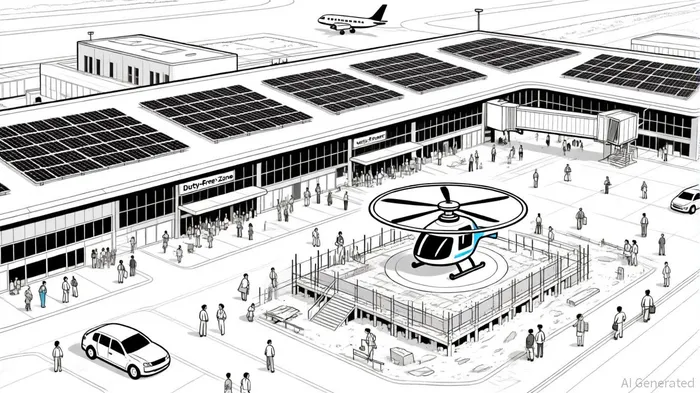
A particularly forward-looking move is CAAP's partnership with Skyports Infrastructure to develop vertiports for electric vertical takeoff and landing (eVTOL) aircraft in Latin America. This collaboration taps into the region's emerging Advanced Air Mobility (AAM) market, where Brazil's ANAC and Mexico's AFAC are actively shaping regulatory frameworks [1]. By integrating eVTOL infrastructure into its existing airport network, CAAP is positioning itself as a key player in the next frontier of urban air mobility—a sector projected to grow rapidly as cities seek to reduce congestion and emissions.
Regional Momentum: Policy, PPPs, and the Infrastructure Gap
Latin America's airport infrastructure growth is being fueled by public-private partnerships (PPPs) and government-led modernization programs. According to the Inter-American Development Bank (IDB), the region faces a $15 billion funding gap for airport projects alone, with over 23 million people lacking access to quality airport infrastructure within reasonable travel distances [3]. CAAP's model—leveraging private capital to expand capacity and services—directly addresses this gap while generating recurring revenue streams.
For example, the company's Brasília Airport shopping mall, slated to open in 2026, exemplifies its focus on non-aeronautical revenue. Such projects are critical in an environment where passenger traffic growth is uneven: while Argentina's international traffic rebounded by 11% year-over-year in late 2024 [1], other markets like Brazil require strategic investments to offset slower domestic demand.
Risks and Mitigants
CAAP's exposure to Argentina's economic instability remains a risk. The 0.4% revenue decline under IAS 29 in 2024 highlights the volatility of hyperinflationary accounting [1]. However, the company has diversified its geographic footprint, with strong performance in Italy, Uruguay, and Brazil offsetting Argentina's challenges. Additionally, its focus on sustainability-linked projects—such as energy-efficient terminal designs and carbon-neutral operations—aligns with global ESG trends, enhancing long-term resilience.
Conclusion: A Catalyst for Long-Term Value
Corporacion América Airports is uniquely positioned to benefit from Latin America's infrastructure renaissance. By combining financial discipline, strategic innovation, and alignment with regional policy priorities, the company is transforming airports into hubs of economic and technological progress. For investors, CAAP represents not just a bet on aviation, but a stake in the broader evolution of Latin America's connectivity and sustainability agenda.







Comentarios
Aún no hay comentarios