
Unlocking the Late-Night Food Delivery Gold Rush: Strategic Differentiation in the On-Demand Economy
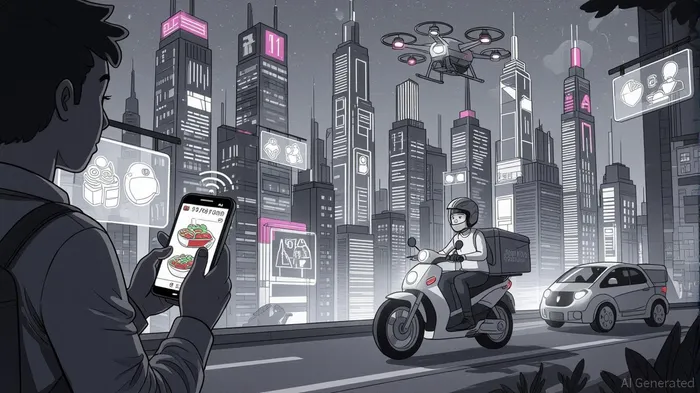
The late-night food delivery market is no longer a niche sector—it’s a $505.50 billion global juggernaut by 2030, growing at a 9.4% compound annual growth rate (CAGR) [2]. For investors, this represents a golden opportunity, but only for those who can navigate the crowded on-demand economy with strategic differentiation. As consumer demand for convenience, speed, and novelty intensifies, the winners will be those who innovate beyond the basics of delivery logistics.
Market Expansion: A Data-Driven Imperative
The U.S. food delivery market alone is projected to surge from $353.3 billion in 2024 to $505.50 billion by 2030, outpacing traditional dine-in growth by 300% [2]. This acceleration is fueled by generational shifts: 98% of Americans and 96% of Canadians use delivery for late-night cravings, a testament to the sector’s cultural entrenchment [1]. Meanwhile, the broader foodservice industry is set to hit $1 trillion in sales by 2025, with late-night demand driving 30.6% of U.S. market growth from 2025 to 2029 [5].
Strategic Differentiation: Beyond Faster Delivery
To capture this growth, businesses must transcend the “race to the bottom” of delivery speed and pricing. Three pillars of differentiation stand out:
Hyper-Personalization via AI
Platforms leveraging artificial intelligence to analyze user behavior are seeing higher retention. For example, DoorDash’s algorithm-driven meal recommendations increase order frequency by 20% [4]. By 2025, 70% of consumers expect brands to anticipate their needs, making data analytics a competitive moat [1].Sustainability as a Brand Pillar
Eco-conscious consumers are willing to pay a 15% premium for sustainable packaging, a trend that aligns with the 2025 surge in climate-conscious spending [4]. Domino’s PizzaDPZ--, for instance, has reduced delivery carbon footprints by 30% through optimized routing and electric vehicles, boosting its market share in urban areas [2].Cultural Curation and Niche Cuisines
The demand for “authentic” late-night experiences is reshaping menus. Cloud kitchens like Los Angeles’s Ghost Kitchens Inc. specialize in hyper-localized offerings—Korean tacos at 2 a.m., Ethiopian injera for midnight cravings—capturing a 12% market share in niche delivery segments [5].
Market Capture: Lessons from Global Leaders
India’s Swiggy and Zomato dominate 70% of their market by combining hyperlocal partnerships with AI-driven surge pricing [5]. Similarly, China’s Meituan leverages its 600 million active users to cross-sell groceries, nightlife, and even movie tickets, creating an ecosystem that locks in late-night consumers [1]. In the U.S., Wendy’s has countered fast-food saturation by introducing “digital-only” late-night menus and self-service kiosks, boosting its delivery orders by 40% in 2024 [3].
Operational Resilience: The Unsung Hero
Even the most innovative strategies falter without a robust supply chain. The 2025 “Great Ingredient Shortage” highlighted the need for agile sourcing. Restaurants that adopted AI-driven inventory systems, like New York’s CloudBites, reduced waste by 25% while maintaining 24/7 availability [3]. Meanwhile, robotic kitchens—pioneered by companies like Spyce in Boston—are slashing labor costs by 40%, enabling late-night operations at scale [2].
Conclusion: The On-Demand Economy’s Next Frontier
The late-night food delivery market is a microcosm of the on-demand economy’s potential—and its challenges. For investors, the key lies in backing platforms that combine technological agility with cultural insight. Those that master AI personalization, sustainability, and niche curation will not only survive but thrive in this $500+ billion arena. As the clock strikes midnight, the question isn’t whether this market will grow—it’s who will lead the charge.
Source:
[1] 50+ Food and Alcohol Delivery Statistics and Trends for 2025 [https://merchants.doordashDASH--.com/en-us/blog/food-delivery-statistics]
[2] Online Food Delivery Market Size | Industry Report, 2030 [https://www.grandviewresearch.com/industry-analysis/online-food-delivery-market-report]
[3] Fast Food & Quick Service Restaurant Market Trends [https://www.futuremarketinsights.com/reports/fast-food-and-quick-service-restaurant-market]
[4] (PDF) Review of Competitive Advantage within Restaurants [https://www.researchgate.net/publication/377482688_Review_of_Competitive_Advantage_within_Restaurants]
[5] US Online Food Delivery Market Size & Outlook, 2024-2030 [https://www.grandviewresearch.com/horizon/outlook/online-food-delivery-market/united-states]





Comentarios
Aún no hay comentarios