
Unlocking Institutional-Grade Exposure to Solana: The VanEck Pivotal SOL Spot ETF
The approval of a U.S. spot SolanaSOL-- (SOL) ETF is no longer a question of if but when. VanEck's proposed VSOL ETF, a direct exposure vehicle to Solana's high-performance blockchain, is navigating regulatory pathways with the urgency of a market primed for disruption. With the firm's updated S-1 filing and DTCC listing[1], the stage is set for institutional investors to access Solana without the friction of custody or volatility management. This article unpacks how the VSOL ETF could redefine institutional-grade exposure to Solana, leveraging its technical advantages and surging demand.
Regulatory Progress: A Clear Path Forward
VanEck's S-1 filing for the VSOL ETF has been updated to align with the SEC's evolving standards, mirroring the structure of its BitcoinBTC-- and EthereumETH-- spot ETFs[2]. The firm's leadership, including Matt Sigel, has signaled confidence in a July 31, 2025, approval deadline[3], a timeline bolstered by the SEC's recent request for updated filings from multiple asset managers. The DTCC listing of VSOL under “active and pre-launch”[4] is a critical milestone, indicating the ETF is technically prepared for trading once regulatory hurdles clear.
The SEC's cautious approach—similar to its Bitcoin and Ethereum ETF approvals—has delayed final rulings, but market sentiment remains bullish. Prediction markets like Polymarket assign a 91% probability of approval by October 2025[5], while Bloomberg analysts estimate a 70–91% chance by late 2025[6]. This regulatory clarity is essential for institutional adoption, as it reduces legal ambiguity and aligns crypto assets with traditional investment frameworks.
Institutional Adoption: A Quiet Revolution
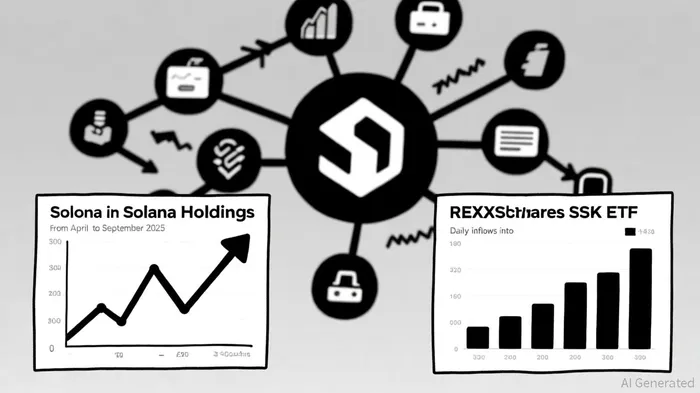
Even before ETF approval, Solana has seen a surge in institutional demand. Corporate treasuries at major firms have accumulated nearly 9 million SOLSOL-- (worth ~$2 billion) since April 2025[7], representing 1.55% of Solana's circulating supply. This trend is driven by Solana's scalable infrastructure, which supports high-speed transactions at low costs—a stark contrast to Ethereum's gas fees and Bitcoin's limited throughput.
The REXShares SSK ETF, a staking-focused vehicle, has further accelerated adoption. Since its launch, it has attracted $73 million in inflows[8], with a single-day net inflow of $10.6 million[9]. Staking strategies, offering 7–8% annual yields[10], make Solana an attractive asset for institutions seeking both capital appreciation and passive income. This dual utility—network security and financial return—cements Solana's role in diversified portfolios.
Market Implications: Liquidity, Stability, and Scalability
The approval of a Solana ETF would replicate the liquidity and price stability seen with Bitcoin and Ethereum. By enabling traditional investors to allocate capital via regulated vehicles, the ETF could unlock billions in institutional capital. Pantera Capital estimates that a spot Solana ETF could trigger $10–$20 billion in inflows[11], directly boosting SOL's price and market cap.
Moreover, Solana's technical advantages—such as its proof-of-stake consensus and high transaction throughput—position it as a superior infrastructure layer for decentralized finance (DeFi) and Web3 applications. Institutional adoption of the VSOL ETF would not only validate Solana's blockchain but also accelerate its integration into mainstream finance.
Conclusion: The Next Frontier in Digital Asset Investing
VanEck's VSOL ETF is more than a product—it's a bridge between Solana's blockchain and institutional finance. By offering a regulated, liquid, and scalable investment vehicle, the ETF addresses the core barriers to adoption: custody, volatility, and regulatory risk. As the SEC's October 2025 deadline looms, the race to launch a Solana ETF intensifies, with VanEck's experience and infrastructure giving it a competitive edge.
For investors, the implications are clear: Solana's institutional-grade exposure is no longer a distant possibility but an imminent reality. The question now is how quickly the market will capitalize on this opportunity.






Comentarios
Aún no hay comentarios