
Unlocking High-Growth Opportunities in the HVAC Air Filters Market (2025–2035): A Convergence of Air Quality Awareness, Smart Filtration, and Antimicrobial Innovation
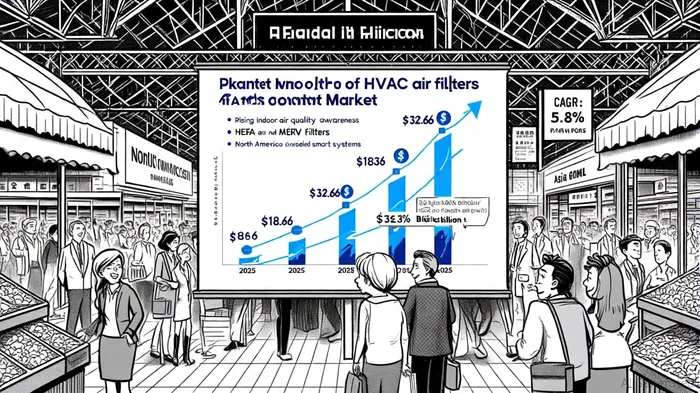
The global HVAC air filters market is poised for transformative growth between 2025 and 2035, driven by a confluence of structural demand shifts. According to a Future Market Insights report, the market is projected to expand from $18.66 billion in 2025 to $32.86 billion by 2035, with a compound annual growth rate (CAGR) of 5.8%. This trajectory is underpinned by rising indoor air quality (IAQ) awareness, technological innovation, and regulatory tailwinds. For investors, the intersection of these dynamics-particularly in antimicrobial filtration and smart IoT-enabled systems-presents compelling opportunities to capitalize on long-term demand.
Structural Demand Drivers: From Health Consciousness to Urbanization
The post-pandemic era has accelerated public focus on health and safety, with indoor air quality emerging as a critical concern. A 2025 Bloomberg report highlights that 72% of consumers now prioritize IAQ when purchasing HVAC systems, a shift that has directly boosted demand for high-efficiency particulate air (HEPA) filters and minimum efficiency reporting value (MERV) 5-8 filters. These filters, which capture 99.97% of particles as small as 0.3 microns and balance cost with performance, respectively, are expected to dominate market share, according to DataInsights Market.
Urbanization and industrialization further amplify demand. In Asia-Pacific, rapid construction activity and stringent air quality regulations are driving a 6.2% CAGR in HVAC filter adoption, outpacing global averages, per Fortune Business Insights. Meanwhile, North America's market, valued at $2.5 billion in 2025, is expanding at 5.5% CAGR, fueled by early adoption of smart HVAC systems and healthcare sector growth, according to Gminsights.
Antimicrobial Innovation: A New Frontier in Filtration
Antimicrobial technology is redefining filtration efficacy, particularly in commercial and healthcare settings. HiVR's platinum-based nanotechnology, for instance, has demonstrated a 95% reduction in microbial contamination in commercial buildings over three years. Similarly, Microban's fiber-level antimicrobial integration has extended filter lifespans by 30% in healthcare facilities, reducing maintenance costs while enhancing pathogen control.
Scientific advancements are further validating these solutions. A 2025 Nature study found that graphene-silver hybrid filters achieved near-complete inactivation of E. coli and SARS-CoV-2 within minutes, offering a scalable solution for high-risk environments. With demand for antimicrobial HVAC components projected to grow 25% annually, investors are well-positioned to benefit from companies pioneering these technologies.
Smart Filtration: IoT and AI Reshape Market Dynamics
The integration of IoT and AI into HVAC systems is unlocking unprecedented efficiency gains. Smart filters with real-time air quality monitoring and automated replacement alerts are gaining traction, reducing energy consumption by up to 25% in commercial buildings, according to Clover Filter. For example, IoT-enabled systems in North America now account for 18% of market revenue, with e-commerce channels projected to grow at 8.3% CAGR as subscription-based filter replacements normalize, per Expert Market Research.
AI-driven predictive maintenance is another game-changer. A 2025 McKinsey analysis revealed that AI-optimized HVAC systems cut operational costs by 15–20% in large-scale facilities, a metric that is driving adoption in sectors like retail and education. As these technologies mature, they are creating moats for firms that combine hardware innovation with data analytics.
Regional and Sectoral Opportunities
Asia-Pacific remains the most dynamic region, with India and Southeast Asia leading urbanization-driven demand. In contrast, North America's market is consolidating around premium solutions, with healthcare and semiconductor manufacturing sectors accounting for 34% of HEPA filter demand, per ResearchAndMarkets. The residential segment, though smaller, is seeing rapid adoption of MERV 5-8 filters due to their affordability and effectiveness.
Investors should also monitor sustainability trends. Reusable and washable filters, which reduce environmental waste, are gaining regulatory support in the EU and U.S., with market share expected to rise from 12% in 2025 to 22% by 2035, according to Fortune Business Insights.
Conclusion: Positioning for Long-Term Growth
The HVAC air filters market is transitioning from a commodity-driven sector to a high-tech, health-centric industry. For forward-thinking investors, the key lies in identifying firms at the forefront of antimicrobial innovation, smart filtration, and sustainable design. Companies like 3M, Camfil AB, and Johnson ControlsJCI-- are already leveraging these trends, but niche players specializing in nanotechnology or AI-driven systems may offer higher growth potential.
As global IAQ standards tighten and consumer preferences evolve, the market's structural demand is set to outperform broader industrial trends. By aligning portfolios with these innovations, investors can secure a stake in a $32.86 billion opportunity by 2035.







Comentarios
Aún no hay comentarios