
Unlocking High-Conviction Opportunities in Timber and Forestry Stocks: A Long-Term Investment Analysis
The timber and forestry sector has long been a cornerstone of diversified, long-term investment portfolios, offering a unique blend of stable returns, inflation hedging, and alignment with global sustainability goals. As climate-conscious investors seek resilient assets, the sector's historical performance and evolving ESG-driven innovation present compelling opportunities. This analysis explores the sector's track record, emerging trends, and high-conviction investment strategies for 2025 and beyond.
Historical Performance: Stability and Resilience
Timberland investments have historically outperformed many traditional asset classes. The National Council of Real Estate Investment Fiduciaries (NCREIF) Timberland Property Index delivered an annualized total return of 10.74% from 1987 to 2021, with a standard deviation of 6.9%, significantly lower than the S&P 500's 15.9% over the same period, according to the StartUs Insights report. This lower volatility stems from the biological predictability of tree growth and the sector's insulation from short-term economic cycles. Additionally, timber prices have historically outpaced inflation, making the asset class a natural hedge against rising costs, as noted in that report.
Publicly traded forestry ETFs, however, exhibit more volatility. The iShares Global Timber & Forestry ETF (WOOD) has shown mixed results from 2011 to 2025, with a 10-year total return of 91.47% (7.15% CAGR) but sharp declines in 2022 (-19.39%) and 2024 (-4.21%), as illustrated on the WOOD performance page. Despite recent setbacks, the 5-year CAGR of 4.41% underscores the sector's long-term growth potential, particularly as demand for sustainable materials rises.
Market Growth and ESG-Driven Innovation
Global industrial roundwood consumption is projected to grow at 1.1% annually, reaching 2.9 billion cubic meters by 2050, according to an MDPI study. This demand is driven by urbanization, green building trends, and the shift toward renewable materials. The StartUs Insights Forestry Market Report 2025 forecasts the sector's value to expand from $14,876 million in 2025 to $26,829 million by 2033, at a 7.65% CAGR.
ESG considerations are reshaping the sector. Companies like Dryad Networks (Germany) and OroraTech (wildfire detection) are leveraging IoT and satellite technology to enhance forest monitoring and carbon sequestration, as highlighted in the Inven.ai list. Similarly, Pachama uses AI to verify carbon credits, while EcoTree offers individual tree ownership models to promote biodiversity. These innovations align with global sustainability frameworks, such as the Principles for Responsible Banking, which prioritize climate-aligned investments.
Challenges and Opportunities
The sector faces headwinds, including a 9% contraction in the number of forestry establishments over five years and a projected 7% employment decline by 2027 due to foreign competition and the strong U.S. dollar, according to the StartUs Insights report. However, the influx of capital-2,000+ funding rounds in 2025 alone, averaging $40 million per round-signals growing confidence in the sector's potential, as the same report notes.
Publicly traded forestry companies with strong ESG practices, such as Södra (Sweden) and Sierra Pacific Industries (U.S.), are leading the charge. Södra, a cooperative with 53,000 forest owners, emphasizes renewable materials like biomethanol and FSC-certified pulp, and Sierra Pacific Industries manages 2.4 million acres of timberland with a focus on reforestation and wildlife conservation. These firms exemplify how ESG integration can drive both environmental and financial returns.
High-Conviction Investment Strategies
For investors seeking long-term exposure, a diversified approach is key:
1. Direct Timberland Ownership: Private timberland investments offer stable cash flows and capital appreciation, with lower volatility compared to public markets, according to the StartUs Insights report.
2. ESG-Aligned ETFs and Funds: While WOOD has faced volatility, thematic funds focusing on sustainable forestry and carbon credits may offer better risk-adjusted returns, based on WOOD's published performance history.
3. Innovation-Driven Startups: Early-stage investments in companies like Dendra Systems (drone-based reforestation) or Veracel Celulose (FSC-certified cellulose production) align with the sector's digital and sustainability transformation, as highlighted in the Inven.ai list.
Conclusion
The timber and forestry sector remains a compelling long-term investment, combining historical resilience with a forward-looking focus on sustainability and technological innovation. As global demand for renewable resources grows and ESG standards evolve, investors who prioritize companies with strong environmental stewardship and operational efficiency are well-positioned to capitalize on this sector's potential.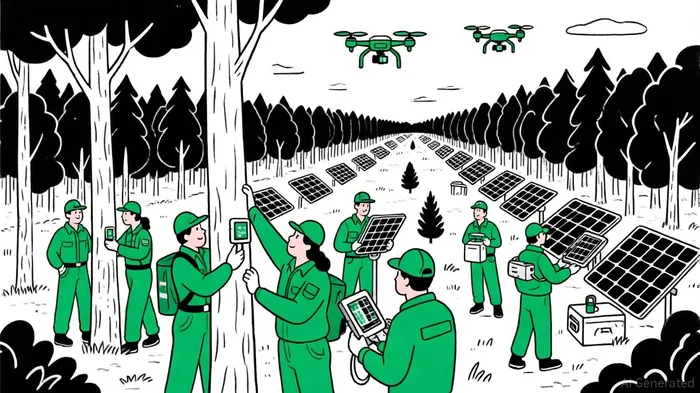







Comentarios
Aún no hay comentarios