
Unlocking High-Conviction Opportunities in AI-Driven Digital Workplace Transformation: A 2025 Investment Analysis
The global market for SaaS and enterprise AI platforms in digital workplace transformation is undergoing a seismic shift. By 2025, the enterprise AI market is valued at USD 97.20 billion, with a projected 18.90% CAGR from 2025 to 2030, reaching USD 229.30 billion by 2030 [1]. Simultaneously, the AI-created SaaS market is expanding at an even faster pace, growing from USD 101.73 billion in 2025 to USD 1,040.61 billion by 2032, driven by a 39.4% CAGR [2]. These figures underscore a clear trend: enterprises are prioritizing AI-driven solutions to automate workflows, enhance decision-making, and unlock productivity gains. For investors, this presents a compelling opportunity to target platforms at the forefront of this transformation.
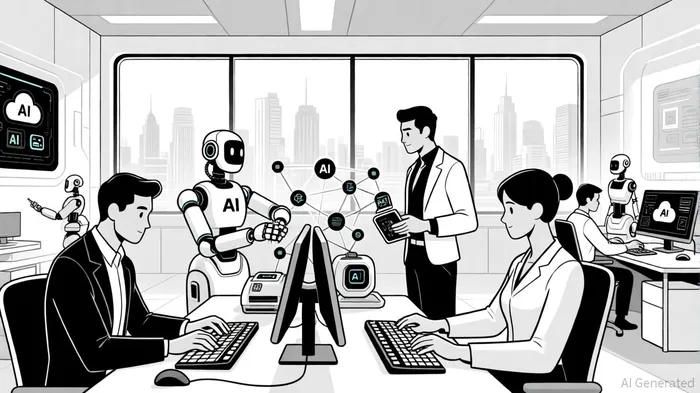
Market Dynamics: The AI-First Workplace
The digital workplace is no longer a luxury but a necessity. According to a report by Mordor Intelligence, 95% of organizations are expected to use AI-powered SaaS applications by 2025, with 51% leveraging generative AI and 42% employing natural language processing (NLP) tools [3]. The public cloud segment dominates the AI SaaS market, holding 54.8% of the share in 2025, due to its scalability and cost-effectiveness for compute-intensive AI workloads [2]. North America leads adoption, accounting for 46.2% of the global AI SaaS market, driven by innovation hubs like the U.S., where tech giants and startups alike are redefining enterprise workflows [2].
High-Conviction Investment Targets
Microsoft Azure: The AI Infrastructure Powerhouse
Microsoft's Azure has cemented its position as the backbone of enterprise AI. In Q1 and Q2 of fiscal 2025, Azure generated $65.6 billion and $70 billion in revenue, respectively, growing at 33% and 31% year-over-year [4]. The company's $80 billion CapEx plan for FY 2025-including 12 new Azure regions-signals a strategic bet on AI infrastructure, with $30 billion allocated to AI supercomputing and data center expansion [5]. Microsoft's Microsoft 365 Copilot, now priced on a usage-based model, further democratizes AI adoption, while partnerships with OpenAI and DeepSeek solidify its ecosystem leadership [4].
UiPath: Automating the Future of Work
UiPath's $1.43 billion revenue in FY 2025 and $1.666 billion ARR reflect its dominance in robotic process automation (RPA) [6]. The company's Autopilot and Agent Builder tools, coupled with the acquisition of Peak AI, position it as a leader in agentic automation. Strategic alliances with NVIDIA, Google, and Deloitte enable seamless integration of AI models into enterprise workflows, while its non-GAAP operating income of $241 million highlights operational efficiency [6].
Salesforce: AI-Driven Customer Experience
Salesforce's $37.9 billion FY 2025 revenue includes $900 million in ARR from Data Cloud and Agentforce, which grew 120% year-over-year [7]. The company's $15 billion investment in San Francisco-creating roles like Agentic Data Specialist and AI Architect-underscores its commitment to AI innovation. With Data Cloud managing 50 trillion records and Agentforce resolving 380,000 conversations at 84% accuracy, SalesforceCRM-- is redefining customer engagement [7].
Prompts.ai: The AI Orchestration Platform
Prompts.ai, a rising star in AI orchestration, offers a model-agnostic platform integrating 35+ AI models (e.g., GPT-5, Claude, LLaMA) into workflows. Its pay-as-you-go TOKN credit system reduces AI costs by up to 98%, while robust governance features address compliance needs [8]. Though its $5 million Seed round (led by AIX Ventures and Abstract Ventures) is modest, its model interoperability and secure data integration align with enterprise demands for flexibility and scalability [9].
Strategic Imperatives for Investors
- Cloud Infrastructure Leadership: The "Big Three" (AWS, Azure, Google Cloud) control 60% of the global cloud market, but Microsoft and Google are outpacing AWS in AI-specific growth (140–180% in Q2 2025) [10].
- Agentic AI Adoption: CFOs are allocating 25% of AI budgets to agentic AI, prioritizing automation for competitive advantage [7].
- Partnership Ecosystems: Collaborations between AI startups and tech giants (e.g., Amazon's $4 billion investment in Anthropic) are accelerating integration and scalability [11].
Conclusion
The AI-driven digital workplace is no longer a vision-it's a reality. With Microsoft, UiPath, Salesforce, and Prompts.ai leading the charge, investors have a rare opportunity to capitalize on platforms that are redefining productivity, automation, and enterprise innovation. As AIaaS (AI as a Service) markets surge toward $178.7 billion by 2034 [12], the imperative is clear: invest in platforms that combine scalable infrastructure, strategic partnerships, and enterprise-grade AI.







Comentarios
Aún no hay comentarios