
Unlocking Germany's Aviation Transformation: Investing in Undervalued Aerospace and Ground Services Firms
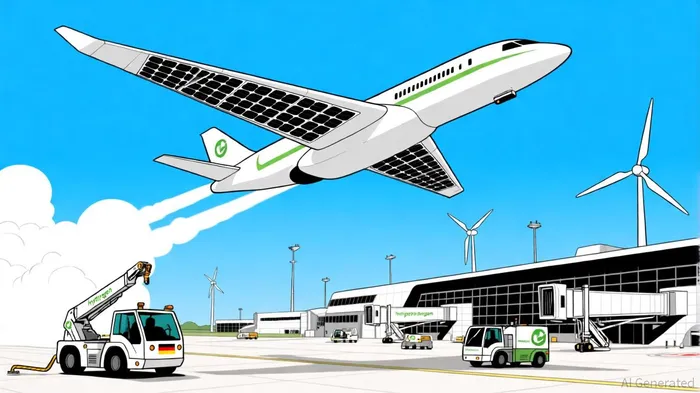
Germany's aviation sector is undergoing a seismic shift in 2025, driven by regulatory reforms, fiscal policy adjustments, and a national commitment to decarbonization. As the government aligns with ICAO's CO₂ reduction targets and implements cost-cutting measures like reduced air passenger taxes, the sector is primed for a wave of innovation. For investors, this presents a unique opportunity to capitalize on undervalued firms poised to benefit from these structural changes.
Regulatory and Fiscal Tailwinds: A Catalyst for Cost Reduction
Germany's 2025 coalition agreement has introduced a suite of fiscal reforms aimed at easing the financial burden on airlines and airports. The reversal of the 2024 air passenger tax hike and the abolition of the contentious Power-to-Liquid (P2L) quota signal a shift toward a more competitive aviation market[1]. These measures, coupled with digitization mandates for aircraft maintenance and cybersecurity upgrades, are reducing operational costs while accelerating the adoption of green technologies[2].
Simultaneously, the ICAO State Action Plan for Germany emphasizes sustainable aviation fuels (SAF), hydrogen-electric propulsion, and satellite-based navigation systems. By 2030, all German-produced aircraft will be SAF-compatible, and regional carriers are expected to transition to zero-emission hydrogen-powered models[3]. These regulatory shifts are not just environmental imperatives—they are economic opportunities for firms that can scale sustainable solutions.
Undervalued Aerospace Innovators: Spark e-Fuels and H2FLY
Spark e-Fuels, a Berlin-based startup, is revolutionizing SAF production with its demand-responsive e-fuel technology. By optimizing renewable energy use and eliminating the need for costly hydrogen storage, SparkSPK-- has secured €2.3 million in seed funding and plans to launch a pilot plant in 2025[4]. With an estimated $2.4 million in annual revenue and a 67% employee growth rate, the company is addressing a critical bottleneck in the SAF supply chain[5].
Meanwhile, H2FLY, a pioneer in hydrogen-electric aviation, is leveraging €9.3 million in public funding to develop a 350 kW fuel cell system for regional aircraft. The company's $21.6 million in annual revenue and 22% workforce growth underscore its scalability[6]. H2FLY's collaboration with Diehl Aerospace and the German Aerospace Center (DLR) positions it as a key player in Germany's hydrogen-powered future.
Ground Services and Digitalization: Diehl Aerospace and BALIS 2.0
Ground services firms are also reaping the rewards of regulatory modernization. Diehl Aerospace, a stalwart in defense and aviation, is advancing hydrogen-electric powertrain systems through the BALIS 2.0 project. Its expertise in digital control systems for fuel cell integration aligns with EASA's 2025 safety and cybersecurity mandates[7]. With the aerospace sector's average EBITDA margins at 7.41% in 2025[8], Diehl's focus on innovation and compliance makes it a resilient long-term bet.
The Investment Case: Policy-Driven Growth and Scalability
Germany's fiscal and regulatory environment is creating a virtuous cycle: reduced taxes lower operational costs, while green mandates drive demand for SAF and hydrogen technologies. For instance, Spark e-Fuels' load-flexible production model could cut SAF costs by 30% compared to traditional methods[9]. Similarly, H2FLY's hydrogen fuel cells, set for ground tests in 2025, could reduce regional airline emissions by 100%—a compelling value proposition as CORSIA penalties escalate[10].
Risks and Mitigations
While the outlook is optimistic, challenges remain. High production costs for SAF and hydrogen infrastructure gaps could delay commercialization. However, Germany's €500 billion infrastructure fund and the EU's NextGenerationEU recovery plan are addressing these hurdles[11]. For investors, diversifying across SAF producers, hydrogen enablers, and digital service providers offers a balanced approach to mitigate sector-specific risks.
Conclusion: A Golden Hour for Aviation Innovation
Germany's aviation sector is at an inflection point. By investing in firms like Spark e-Fuels, H2FLY, and Diehl Aerospace, stakeholders can align with a regulatory and fiscal framework that prioritizes sustainability and cost efficiency. These companies are not just adapting to change—they are engineering it. For those with a long-term horizon, the time to act is now.







Comentarios
Aún no hay comentarios