
Unlocking the Future: Early-Stage Blockchain Investments in Smart City Ecosystems
The convergence of blockchain technology and smart cityCITY-- development is reshaping urban infrastructure, creating a fertile ground for early-stage infrastructure investments. By 2025, blockchain has evolved from a niche financial tool to a foundational layer for decentralized governance, energy trading, and secure data exchange in urban ecosystems. This shift is driven by the need for transparency, scalability, and sustainability in rapidly urbanizing regions. For investors, the intersection of blockchain and smart cities offers a unique opportunity to capitalize on transformative projects that address real-world challenges while aligning with global sustainability goals.
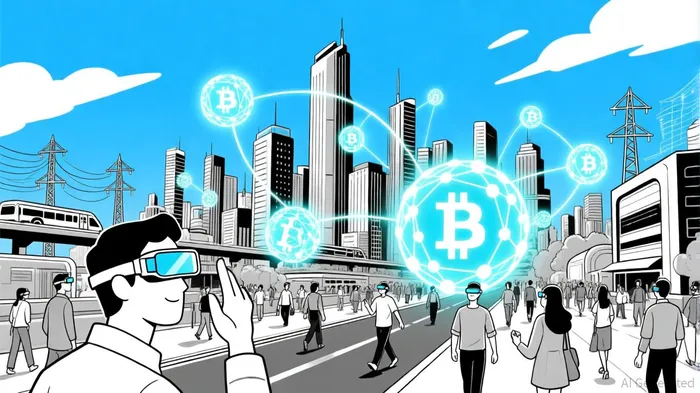
Key Sectors for Blockchain-Driven Smart City Innovation
Decentralized Energy Grids
Blockchain-enabled peer-to-peer (P2P) energy trading platforms are revolutionizing urban energy management. Projects like the Brooklyn Microgrid in New York allow residents to trade excess solar energy directly with neighbors, reducing reliance on centralized utilities and promoting renewable adoption [1]. Similarly, blockchain-based smart contracts automate energy distribution and settlement, ensuring real-time transparency. In 2025, South Korea's national smart-city policy has prioritized such platforms, with startups like Eswin Computing-which raised $1 billion for semiconductor infrastructure-supporting IoT-enabled energy systems [5].Transportation and Mobility
Blockchain is streamlining public transit logistics and payment systems. Dubai's blockchain-based vehicle registration system, for instance, ensures tamper-proof ownership tracking, reducing fraud and administrative costs [2]. Meanwhile, startups like Aptos Labs are enhancing scalability for decentralized mobility solutions. Their Zaptos upgrade achieved 20,000 transactions per second (TPS) with sub-second latency, enabling real-time fare settlements and ride-sharing coordination [3].Governance and Civic Engagement
Blockchain's immutable ledger capabilities are fostering trust in urban governance. Estonia's blockchain-based identity verification system allows citizens to securely access public services, while Dubai's blockchain voting platform is testing decentralized democratic processes [2]. Startups like Humanity Protocol are further advancing this space by using biometric palm scans to verify digital identities, raising $20 million in 2025 to combat bot-driven fraud [4].
Investment Landscape: Funding Trends and Regional Hubs
The blockchain infrastructure market has attracted over $52 billion in cumulative funding since 2016, with $2.06 billion raised in 2025 alone [5]. The U.S. leads in investment volume, with companies like Consensys and Alchemy securing substantial capital. However, the Asia-Pacific region is emerging as a growth engine, projected to grow at a 27.9% CAGR through 2034, driven by government-backed initiatives in South Korea and Singapore [5].
Notable early-stage startups include:
- Utila (Israel): Raised $22 million in a 2025 Series A to develop blockchain-powered infrastructure for smart cities.
- Epoch Protocol (Singapore): Secured $1.2 million in a Pre-Seed round for decentralized urban data management.
- 1Self.World (South Korea): A $1.43 million-funded project leveraging blockchain for digital identity in private city models [5].
Challenges and Opportunities
While blockchain's potential is vast, scalability and regulatory hurdles remain. For example, integrating blockchain with legacy systems and 5G/6G networks is critical to overcoming latency issues in real-time applications [2]. However, these challenges also represent investment opportunities. Startups like Fuel Labs, which raised $81.5 million, are addressing scalability through rollup technologies, enabling Ethereum-based smart city apps to achieve Web2-level performance [4].
Regulatory uncertainty is another barrier, but early adopters in Dubai and Estonia demonstrate that clear frameworks can accelerate adoption. As governments prioritize carbon neutrality and digital resilience, blockchain's role in transparent energy trading and secure data management will become increasingly indispensable.
The Future: AI and Blockchain Convergence
The next frontier lies in combining blockchain with AI for predictive urban analytics. AI-driven energy grids, for instance, can optimize consumption patterns, while blockchain ensures data integrity. This synergy is already evident in projects like GenX AI, which uses blockchain to unify data from traffic, utilities, and waste management systems into a single, tamper-proof ledger [1]. Such integrations will drive the next wave of smart city innovation, creating value for early-stage investors.
Conclusion
Blockchain is no longer a speculative technology-it is a critical infrastructure layer for smart cities. From decentralized energy grids to AI-enhanced governance, the opportunities for early-stage investment are vast. As urbanization accelerates and sustainability becomes a global priority, blockchain startups that solve scalability, interoperability, and regulatory challenges will lead the next industrial revolution. For investors, the time to act is now.






Comentarios
Aún no hay comentarios