
Unlocking Value in China's AI Infrastructure: Identifying Undervalued Players in the Cost-Efficiency Revolution
The global AI infrastructure market is undergoing a seismic shift, with China emerging as a pivotal player in redefining cost efficiency in AI training. While the U.S. dominates private investment and cutting-edge research, China's strategic focus on scalable deployment, government-backed funding, and innovative cost-cutting measures has positioned it to outpace Western rivals in practical AI adoption. However, this rapid expansion has also led to overbuilding and underutilization of AI data centers, creating a paradox: a market flooded with infrastructure but starved of demand. For investors, this volatility masks a critical opportunity—undervalued Chinese AI infrastructure companies that are pioneering cost-efficient solutions to navigate the sector's turbulence.
The Overbuilding Crisis and Its Consequences
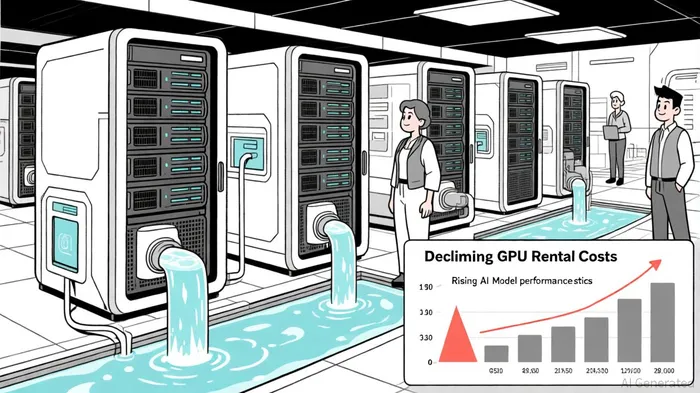
China's AI infrastructure boom between 2023 and 2024 saw over 500 new data center projects announced, with at least 150 completed by year-end [1]. Yet, up to 80% of these facilities remain underutilized, a result of speculative investments by local governments and corporations lacking technical expertise [2]. The oversupply has driven GPU rental prices down by 58% year-over-year, with an NvidiaNVDA-- H100 server now costing ¥75,000 monthly compared to ¥180,000 in 2024 [3]. This collapse in pricing reflects a broader industry shift: the rise of cost-effective reasoning models like DeepSeek's R1, which require less compute-intensive training and favor inference-specific hardware [4].
The crisis has exposed systemic weaknesses. Many data centers were built without viable business models, relying on government subsidies and land deals rather than market demand [5]. As a result, operators are offloading assets at distressed prices, with industry insiders noting, “Everyone is selling, but few are buying” [6]. Yet, this turmoil is not a death knell for China's AI ambitions. Instead, it is accelerating a transition toward cost-efficient innovation, with companies leveraging open-source models, heterogeneous computing, and localized data strategies to reduce dependency on expensive U.S. chips [7].
Strategic Cost-Efficiency: The New Competitive Edge
Chinese AI startups and tech giants are redefining efficiency in three key ways:
1. Open-Source Model Development: DeepSeek, a Hangzhou-based startup, trained its V3 large language model for just $5.6 million—1/100th the cost of U.S. counterparts—by using a Mixture-of-Experts (MoE) architecture and reinforcement learning [8]. This approach activates only a fraction of model parameters per task, slashing computational demand.
2. Heterogeneous Computing Clusters: Companies like Infinigence AI are integrating chips from AMDAMD--, Huawei, and Nvidia to optimize performance while circumventing U.S. export restrictions. This strategy reduces training costs by 30% and mitigates supply chain risks [9].
3. Localized Data Optimization: By scraping WeChat articles and Chinese books for training data, firms avoid the high costs of international data licensing. This method also improves model relevance for domestic users, enhancing monetization potential [10].
Undervalued Players: AlibabaBABA--, Tencent, and the New Guard
Despite the sector's challenges, several Chinese companies are trading at significant discounts relative to their AI-driven growth potential:
- Alibaba Group (NYSE: BABA)
- Investment: Committed CNY380 billion ($52.4 billion) over three years to AI and cloud infrastructure, making it one of China's largest private-sector bets [11].
- Cost-Efficiency: Its Qwen3 AI models are optimized for Apple's MLX framework, aligning with global hardware trends. A forward P/E of 10 suggests undervaluation given its cloud growth and strategic partnerships [12].
Government Synergy: Benefits from the $47.5 billion semiconductor fund, which supports domestic chip production and reduces reliance on U.S. technology [13].
Tencent Holdings (OTCPK: TCEHY)
- Expansion: Boosted 2025 capital expenditure to strengthen AI capabilities across cloud, gaming, and messaging. Its Hunyuan AI model is being deployed in Europe, tapping into a market where U.S. dominance is weaker [14].
Monetization: A $98 billion AI infrastructure investment surge in China in 2025 positions Tencent to capitalize on enterprise AI adoption [15].
DeepSeek and the Startup Ecosystem
- Disruption: DeepSeek's API pricing ($0.55 per million input tokens) forces competitors like ByteDance and Tencent to lower costs, accelerating industry-wide efficiency [16].
- Government Backing: The third phase of China's semiconductor fund prioritizes AI-specific chips, directly benefiting startups like DeepSeek that require specialized hardware [17].
The Path Forward: Government Intervention and Market Realignment
The Chinese government is expected to step in to manage distressed data center assets, potentially transferring them to more capable operators like Alibaba and Tencent [18]. This intervention, combined with the sector's pivot to cost efficiency, could catalyze a consolidation phase where well-positioned firms outperform. For investors, the key is to focus on companies that align with national strategic goals—such as semiconductors, cloud computing, and localized AI deployment—while demonstrating financial discipline amid overcapacity.
Conclusion
China's AI infrastructure sector is at a crossroads. While the overbuilding crisis has created short-term pain, it is also driving innovation in cost efficiency and self-reliance. For undervalued players like Alibaba, Tencent, and DeepSeek, this environment presents a unique opportunity to capture market share through strategic investments and frugal innovation. As the global AI infrastructure market is projected to grow at a 17.71% CAGR from 2025 to 2030 [19], these companies are well-positioned to emerge as leaders—provided investors act before the sector's fundamentals realign.





Comentarios
Aún no hay comentarios