
Unlocking Asia's $20T Credit Market via Tokenization: The Mu Digital Opportunity
The $20T Credit Market: A Catalyst for Tokenization
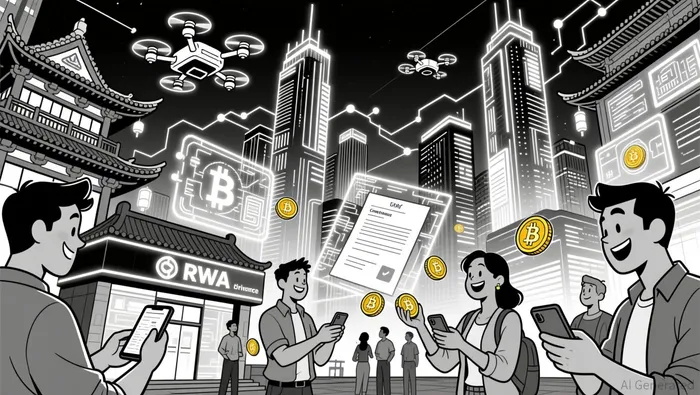 Asia's credit market, while vast, has long been constrained by inefficiencies such as fragmented infrastructure, limited liquidity, and high transaction costs. However, the advent of tokenization is addressing these challenges by digitizing real-world assets (RWAs) and integrating them into decentralized systems. As of 2025, the global RWA tokenization market has surged to $24 billion, with Asia-Pacific accounting for 20% of this growth. Private credit, which constitutes 61% of tokenized assets in the region, is a key driver, enabling fractional ownership and 24/7 trading of traditionally illiquid instruments according to Invesco's analysis.
The potential scale of this transformation is staggering. Projections suggest the RWA market could expand to $30 trillion by 2034 according to Antier Solutions, with Asia's $20T credit market serving as a critical foundation. Tokenization is notNOT-- merely digitizing assets but reimagining how they are traded, collateralized, and leveraged. For instance, platforms like Bullish Inc have reported a 72% year-over-year revenue surge in Q3 2025, driven by tokenization services and expanding institutional demand as revealed in their earnings call. This underscores the market's readiness to adopt blockchain-based solutions.
RWA-Driven DeFi: Yield Innovation in Emerging Markets
The integration of RWAs into DeFi is unlocking unprecedented yield opportunities, particularly in emerging markets where traditional financial systems are less developed. Tokenized assets such as U.S. Treasuries, private credit, and real estate are now programmable financial primitives, enabling 24/7 liquidity and dynamic risk management according to Tiger Research. Platforms like Ondo Finance and Maple FinanceSYRUP-- are pioneering this space, offering institutional-grade yields (5–12% APY) through tokenized treasuries and crypto-collateralized credit facilities.
Emerging markets are uniquely positioned to benefit from this innovation. For example, Singapore's regulatory clarity and Singapore's Project Guardian have standardized tokenization in fixed income and fund management, while Hong Kong's Digital Bond Grant Scheme is attracting private tokenized deals according to crypto analysts. In the UAE, Dubai's first licensed tokenized real estate offering under the Virtual Assets Regulatory Authority (VARA) has enabled primary issuance and secondary trading. These initiatives are not isolated experiments but part of a broader trend where RWAs are becoming the backbone of DeFi ecosystems.
Regulatory Frameworks: Enabling Mass Adoption
Regulatory advancements are accelerating the adoption of tokenization in Asia's credit markets. Singapore, Hong Kong, and Dubai have emerged as hubs for compliant innovation, with frameworks that treat RWA tokens as securities under existing laws according to Tiger Research. For instance, Singapore's stablecoin regulations and tokenized bill trials are fostering trust in digital assets, while Hong Kong's multi-currency digital bond issuances are expanding access to global capital as reported by BeInCrypto.
The U.S. and Hong Kong's new stablecoin frameworks, such as the GENIUS and CLARITY Acts, further underscore the importance of RWAs in bridging traditional and decentralized finance according to Tiger Research. These policies are not only legitimizing tokenized assets but also creating infrastructure for cross-border transactions. As a result, stablecoins like USDTUSDT-- and USDCUSDC-- are facilitating RWA accessibility, with transaction volumes rising by 15% in November 2025.
Future Outlook: From Experiments to Infrastructure
The Asia-Pacific region is poised to lead the transition of tokenization from experimental pilots to foundational infrastructure. By 2030, tokenized real estate alone could reach $3 trillion in value according to CoinLaw, driven by fractional ownership and global liquidity. Institutional players like BlackRockBLK--, JPMorgan, and Franklin Templeton are already tokenizing billions in assets, signaling a shift of Wall Street onto blockchain infrastructure as reported by Tiger Research.
For investors, the opportunities are manifold. Hybrid permissioned-permissionless markets, tokenized equity exchanges, and on-chain IPOs are redefining capital formation according to BeInCrypto. Moreover, innovations in ESG investing and carbon credit tokenization are aligning financial returns with sustainability goals according to GrowthTurbine. As cross-chain interoperability and AI-powered compliance tools mature, the barriers to entry for institutional and retail investors will continue to erode according to Antier Solutions.
Conclusion: The Mu Digital Opportunity
Asia's $20T credit market is no longer a distant opportunity-it is a reality being reshaped by tokenization and RWA-driven DeFi. Emerging markets, with their regulatory agility and technological ambition, are leading this charge. For investors, the key lies in identifying platforms and jurisdictions that combine innovation with compliance. As the RWA market grows from $24 billion to $30 trillion by 2034 according to Antier Solutions, the Mu Digital Opportunity-unlocking value through tokenization-will define the next decade of financial innovation.





Comentarios
Aún no hay comentarios