
Unlocking the AI Semiconductor Gold Rush: Talent, Partnerships, and Investment Opportunities in 2025
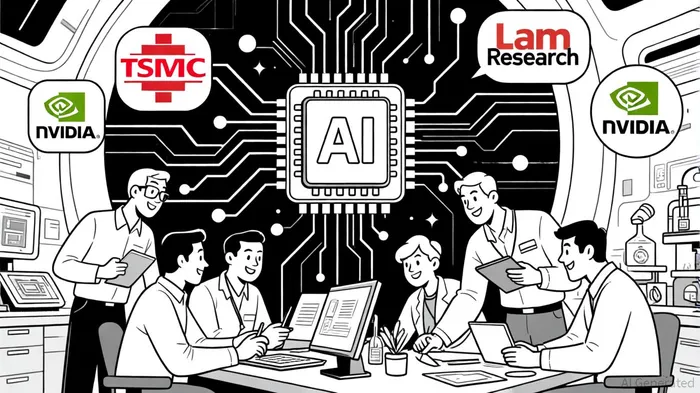
The semiconductor industry is undergoing a seismic shift driven by generative AI, with cross-industry partnerships and talent reallocation reshaping the landscape of hardware innovation. For investors, this transformation presents a unique window to capitalize on companies at the intersection of AI-driven design, manufacturing, and workforce evolution.
AI as the Catalyst for Semiconductor Disruption
According to a report by McKinsey, AI-powered Electronic Design Automation (EDA) tools are reducing 5nm chip design cycles from months to weeks, with Synopsys' DSO.ai exemplifying this efficiency leap. NVIDIA's Blackwell architecture and TSMC's AI-optimized digital twin simulations further underscore the sector's pivot toward AI-first hardware. These advancements are not just incremental—they represent a fundamental reengineering of the semiconductor value chain, from design to yield optimization.
Investors should prioritize firms integrating AI into core operations. TSMC's use of AI for EUV lithography and yield management, Intel's neuromorphic chips like Loihi, and NVIDIA's A100/H100 GPUs for generative AI workloads are prime examples. The latter's Blackwell architecture, designed for exascale computing, is already attracting partnerships with cloud providers and AI startups, signaling a $50 billion+ market for AI-optimized semiconductors by 2027.
Strategic Partnerships: The New Currency of Innovation
Collaborative ecosystems are accelerating AI adoption in manufacturing. A landmark 2025 partnership between Lam ResearchLRCX-- and JSR/Inpria Corporation highlights this trend, combining dry resist technology for EUV lithography with next-gen materials for atomic layer etching. Such alliances are critical for scaling AI-driven processes, as they reduce R&D costs and accelerate time-to-market for cutting-edge nodes.
For investors, the key is to identify companies with robust partnership networks. TSMC's collaboration with ASMLASML-- on high-NA EUV tools and Intel's joint ventures with IBMIBM-- on 3D chip stacking illustrate how cross-industry alliances mitigate technical risks while capturing first-mover advantages. Startups leveraging open-source AI frameworks, such as RISC-V-based accelerators, also warrant attention, as they benefit from lower IP barriers and agile development cycles.
Talent Wars: AI-Driven Recruitment and Workforce Reskilling
The semiconductor industry faces a critical talent shortage, exacerbated by the complexity of AI-driven workflows. The U.S. CHIPS and Science Act of 2022 aims to address this by funding 10,000+ new technical roles, but private-sector solutions are equally vital. Companies like Tignis are deploying AI-powered process control systems to automate repetitive tasks, enabling workers to focus on strategic innovation.
Investors should monitor firms investing in AI-driven talent pipelines. Deloitte's 2025 analysis reveals that AI-powered recruitment tools are reducing hiring cycles by 40% for niche roles like RTL design and formal verification. Semiconductor leaders are also leveraging LinkedIn campaigns and GitHub outreach to attract top-tier engineers, with roles in AI accelerators and RISC-V development commanding premium salaries.
Emerging Investment Opportunities
- EDA and AI-Optimized Chip Design: SynopsysSNPS--, CadenceCADE--, and ANSYS are leading the charge in AI-driven EDA tools, with their platforms enabling faster design iterations and lower costs.
- Materials and Manufacturing Innovators: Lam Research, ASML, and JSR Corporation are pivotal in advancing EUV lithography and next-gen materials, essential for AI-driven node scaling.
- Talent-Reskilling Platforms: Startups like Tignis and established players like NVIDIANVDA-- (via its AI training programs) are addressing the skills gap, ensuring a workforce ready for AI's demands.
- AI-First Semiconductor Foundries: TSMCTSM-- and Intel's foundry services are attracting AI startups and cloud providers seeking to customize chips for generative AI workloads.
Conclusion
The AI semiconductor revolution is no longer a distant horizon—it is here, driven by cross-industry collaboration, AI-native design tools, and a reimagined talent strategy. For investors, the path forward lies in backing companies that are not just adapting to this shift but defining it. Those who act now will position themselves at the forefront of a $1.2 trillion semiconductor market by 2030.





Comentarios
Aún no hay comentarios