
Unlocking the AI Semiconductor Boom: Strategic Growth Opportunities in AI Infrastructure Providers
The AI semiconductor market is undergoing a seismic transformation, driven by insatiable demand for compute power to fuel next-generation artificial intelligence applications. With global AI semiconductor revenue projected to surge from $56.42 billion in 2024 to $232.85 billion by 2034, according to a Precedence Research forecast, investors are increasingly turning their attention to infrastructure providers at the forefront of this revolution. This analysis explores the strategic growth opportunities within AI-driven semiconductor demand, focusing on the competitive dynamics, technological innovations, and macroeconomic forces shaping the industry.
Market Growth: A Multi-Decade Trajectory
The AI semiconductor market is expanding at an unprecedented pace. According to an SNS Insider report, the market was valued at $48.96 billion in 2023 and is expected to reach $174.48 billion by 2032, with a compound annual growth rate (CAGR) of 15.2%. More recent data from Coherent Market Insights suggests an even steeper trajectory, projecting a 27.5% CAGR through 2032, with the market size ballooning to $459 billion. This divergence in forecasts underscores the sector's volatility but also highlights its immense potential.
The growth is being fueled by three key drivers:
1. Data Center Demand: AI training and inference workloads are pushing data centers to adopt high-performance GPUs and accelerators. NVIDIA's data center revenue, for instance, surged 112% year-over-year in Q2 2026, driven by its H100 and Blackwell architectures, according to a Pune News piece.
2. Edge Computing: As AI moves closer to the endpoint, demand for specialized chips in edge devices-such as AMD's Ryzen AI and Intel's Gaudi 2-is accelerating.
3. Industry Adoption: Sectors like healthcare, automotive, and manufacturing are integrating AI for diagnostics, autonomous systems, and predictive maintenance, further diversifying demand, as SNS Insider notes.
Key Players: Innovation and Market Share Dynamics
NVIDIA has cemented its dominance in the AI chip space, with its Blackwell and Rubin architectures poised to redefine performance benchmarks. The company's GB300 NVL72 system, for example, offers a 10x improvement in energy efficiency over its Hopper series, solidifying its leadership in data center AI, according to Data Center Frontier. Analysts project NVIDIA's AI accelerator Total Addressable Market (TAM) to reach $563 billion by 2028, with the company maintaining over 85% market share, per industry analysis.
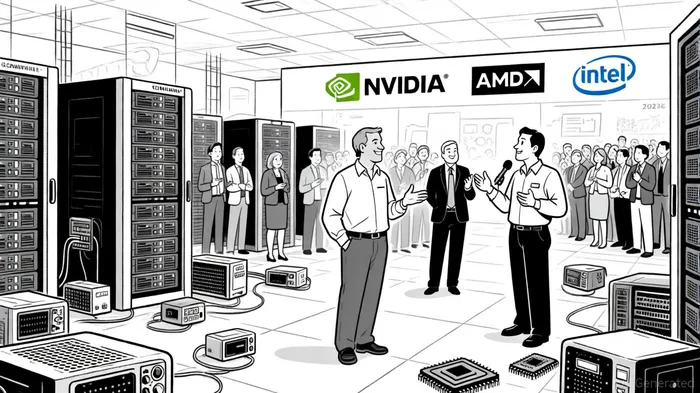
AMD and IntelINTC-- are mounting aggressive counterattacks. AMD's Instinct MI300 series, coupled with its $25,000 MI350 AI chip, is gaining traction in inference workloads, with sales projected to hit $15.1 billion in 2026. Intel, meanwhile, is leveraging its x86 expertise to develop Gaudi 2 processors for large-scale AI training, though it faces an uphill battle to reclaim lost ground. Strategic partnerships are amplifying these efforts: NVIDIA's collaboration with Intel to co-develop AI infrastructure and personal computing products, and AMD's deal with OpenAI-granting the latter a warrant for up to 10% of AMDAMD-- shares-highlight the sector's collaborative yet competitive nature, as reported by Forbes.
Strategic Collaborations: The New Normal
The AI semiconductor landscape is increasingly defined by cross-industry alliances. Microsoft, for instance, has committed $80 billion to AI infrastructure in 2025, leveraging its Azure AI platform to capture enterprise AI demand, according to a LinkedIn post. Similarly, AWS's Bedrock ecosystem, bolstered by its partnership with Anthropic, is expected to generate over $5 billion in revenue within three years, a point also highlighted in that LinkedIn post. These collaborations are not just about hardware; they reflect a broader shift toward integrated AI ecosystems where infrastructure providers, cloud platforms, and software developers co-create value.
However, geopolitical tensions pose a wildcard. U.S. export restrictions on advanced AI chips to China have impacted NVIDIANVDA-- and AMD, though cloud providers like Google and Microsoft are lobbying for exemptions to expand their AI footprints in restricted regions, according to the Futunn report. This regulatory uncertainty adds complexity to long-term investment strategies but also creates opportunities for nimble players to navigate policy shifts.
Future Outlook: Navigating Risks and Rewards
While the AI semiconductor market's growth trajectory is compelling, investors must weigh several risks:
- Technological Obsolescence: Rapid innovation cycles mean today's leaders could be disrupted by breakthroughs in neuromorphic computing or quantum AI.
- Supply Chain Volatility: Geopolitical tensions and raw material constraints could disrupt production.
- Market Saturation: As AI adoption matures, competition for market share may intensify, compressing margins.
Despite these challenges, the sector's fundamentals remain robust. Gartner predicts AI semiconductor revenue will hit $198 billion by 2028, driven by both data center and edge AI applications. For investors, the key is to focus on companies with strong R&D pipelines, diversified customer bases, and strategic partnerships. NVIDIA's Blackwell roadmap, AMD's OpenAI alliance, and Intel's x86-CPU integration with NVIDIA's silicon are particularly noteworthy.
Conclusion: A High-Stakes Bet on the Future
The AI semiconductor market represents one of the most dynamic investment opportunities of the decade. With demand for AI infrastructure growing at a breakneck pace, infrastructure providers are uniquely positioned to capitalize on this wave. However, success will require not just technological prowess but also geopolitical agility and strategic foresight. For investors willing to navigate these complexities, the rewards could be transformative.





Comentarios
Aún no hay comentarios