
Unlocking the AI Infrastructure Gold Rush: Undervalued Beneficiaries of the Nvidia-Tesla Partnership
The global AI infrastructure market is undergoing a seismic shift, driven by the strategic alliance between TeslaTSLA-- and NvidiaNVDA--. As autonomous systems and AI-driven robotics accelerate toward mainstream adoption, the supply chains underpinning these technologies are revealing a trove of undervalued opportunities. This analysis identifies key beneficiaries of the Nvidia-Tesla collaboration, focusing on lesser-known infrastructure providers whose roles are critical yet overlooked by mainstream investors.
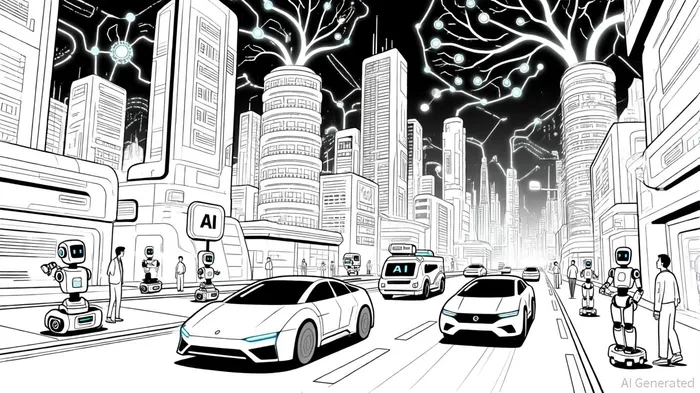
The Nvidia-Tesla Synergy: A New Era of AI Hardware
Tesla's renewed partnership with Nvidia in 2025 marks a pivotal moment in the race for full autonomy. By integrating Nvidia's Blackwell B200 architecture into its Full Self-Driving (FSD) program, Tesla is leveraging the GPU giant's computational prowess to refine its neural networks, according to an OpenTools report. This collaboration is not merely technical but financial: Tesla has secured a $16.5 billion contract with Samsung Foundry to produce its AI6 chips, while TSMCTSM-- handles AI5 production, as detailed in an Accounting Insights piece. These arrangements underscore Tesla's strategy to diversify its supply chain while ensuring access to cutting-edge hardware.
Nvidia, meanwhile, is expanding its infrastructure dominance with a $500 billion global manufacturing plan, including a Blackwell AI chip facility in Arizona, per Supply Chain Dive. Its CUDA software ecosystem further cements its monopoly, as clients like OpenAI and Meta rely on its platforms for large-scale AI operations, as noted in a Techovedas analysis. The symbiosis between Tesla's vision-based autonomous systems and Nvidia's hardware is creating a flywheel effect, driving demand for specialized components and infrastructure.
Aligned Data Centers and CoreWeave: The Hidden Engines of AI Scalability
The AI boom requires unprecedented compute capacity, and two infrastructure players are emerging as critical enablers. Aligned Data Centers, recently acquired by a $40 billion consortium led by BlackRock, Microsoft, and Nvidia, is poised to dominate the hyperscale data center market, according to a Business Wire release. With 50 campuses and 5 gigawatts of capacity, Aligned's expansion into AI-ready infrastructure aligns perfectly with Tesla's and Nvidia's ambitions. The consortium's investment ensures Aligned can meet surging demand for energy-efficient, high-performance computing.
CoreWeave, another key player, has become Nvidia's top GPU cloud partner, deploying Blackwell-powered clusters and securing a $11.9 billion contract with OpenAI, per a CoreWeave announcement. Its $12 billion capital raise and $35 billion IPO valuation target reflect investor confidence in its ability to scale AI infrastructure, according to a Yahoo Finance report. CoreWeave's partnership with Dell Technologies and its edge AI initiatives further position it as a linchpin in the AI ecosystem.
Undervalued Suppliers: The "Silent Partners" of Autonomy
While Aligned and CoreWeave dominate headlines, lesser-known suppliers are equally vital. onsemi (often referenced as "S.A.V." in niche analyses) provides imaging sensors critical for Tesla's vision-based autonomous systems, according to a Glarity analysis. Its recent 4x-range sensor innovation has made it a key player in the "manifested AI" revolution, supplying Tesla, Volkswagen, and Hyundai, as noted in a StockGumshoe article. Despite its strategic importance, onsemi remains underfollowed by Wall Street, with only two analysts recommending it as a "buy."
Similarly, Detease-a term linked to AI 2.0 initiatives-highlights the potential of companies like Ambarella and Symbotic, which supply vision processors and warehouse automation systems for Tesla's Optimus robot, according to Stocksleuther picks. These firms benefit from Tesla's $3–4 billion annual Nvidia hardware spend, yet their valuations lag behind the AI hype.
Financial Metrics and Growth Projections
The financials of these beneficiaries tell a compelling story. Aligned's $12 billion capital raise and CoreWeave's $1.1 billion funding round at a $19 billion valuation signal robust investor appetite, per an Aligned press release. onsemi's revenue growth, driven by its 4x-range sensors, is projected to outpace the broader semiconductor industry. Meanwhile, Tesla's AI-related expenditures-expected to reach $4 billion in 2024-underscore the scale of demand for infrastructure partners, according to an Investopedia article.
Risks and Regulatory Considerations
Investors must remain cautious. The AI infrastructure boom faces challenges, including energy consumption, geopolitical supply chain risks, and regulatory scrutiny. The EU AI Act, for instance, may impose compliance costs on firms like CoreWeave and Aligned, according to a Dentons report. Additionally, the sustainability of private capital inflows into AI infrastructure remains untested, with 44% of IT leaders citing infrastructure limitations as a barrier to AI expansion, per the Flexential report.
Conclusion: A Strategic Play for the AI Decade
The Nvidia-Tesla partnership is catalyzing a paradigm shift in AI infrastructure. While giants like Nvidia and Tesla dominate headlines, the real alpha lies in the underappreciated suppliers and infrastructure providers enabling their ambitions. Aligned Data Centers, CoreWeave, onsemi, and Ambarella represent a diversified portfolio of undervalued beneficiaries, offering exposure to the AI-driven future without the volatility of speculative tech stocks. As the AI infrastructure market surges toward $200 billion by 2028, according to an IDC forecast, these companies are poised to deliver outsized returns for investors who act now.





Comentarios
Aún no hay comentarios