
Unlocking £25.5 Billion in Opportunities: UK-India FTA and Starmer's Strategic Visit
The UK-India Free Trade Agreement (FTA), finalized in April 2025, marks a historic shift in bilateral economic relations, with Prime Minister Keir Starmer’s upcoming visit to India set to cement this transformative partnership. The deal, which aims to boost annual trade by £25.5 billion by 2040, promises to reshape industriesRSLS--, spur investment, and position both nations as key players in a post-Brexit, post-pandemic global economy.
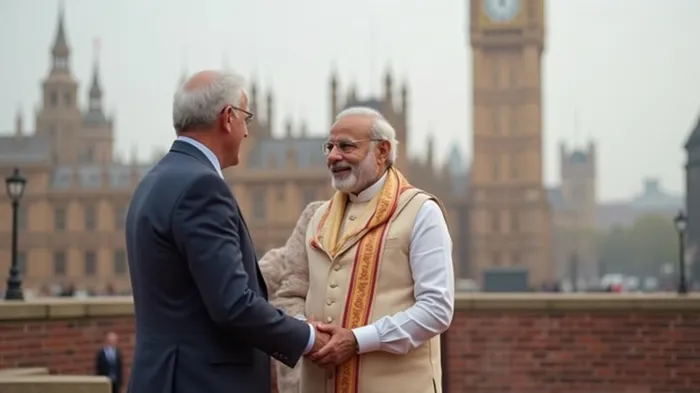
Key Provisions of the FTA
The FTA’s core provisions include:
- Tariff Reductions: Scotch whisky tariffs to drop from 150% to 75% immediately, then to 40% by 2035.
- Automotive Sector: Tariffs on car parts slashed from over 100% to 10% under a quota system.
- Trade in Services: 99% of Indian goods, including textiles and agricultural products, gain duty-free access to the UK.
- Labor Mobility: A Double Contribution Convention to ease social security rules for Indian professionals in the UK and vice versa.
Sectoral Impact: Where the Opportunities Lie
1. Whisky Industry: A £1 Billion Boost
The Scotch Whisky Association estimates exports to India could surge by £1 billion over five years, driven by the immediate 40% tariff cut. This benefits firms like Diageo (DGE.L), the world’s largest spirits company, which owns Johnnie Walker and other premium brands.
2. Automotive and Manufacturing: A Quota-Driven Expansion
The automotive sector, a cornerstone of the UK’s manufacturing economy, stands to gain. Jaguar Land Rover (part of Tata Motors, TTM), for instance, could see reduced costs for exporting components to India, where demand for electric vehicles (EVs) is booming.
3. Healthcare and Medical Devices: A Growing Market
India’s healthcare sector, projected to reach $445 billion by 2026, offers UK firms like AstraZeneca (AZN) and GlaxoSmithKline (GSK) new opportunities. Reduced tariffs on medical devices and streamlined regulations could accelerate joint ventures in drug manufacturing and R&D.
4. Technology and Green Energy: A Strategic Partnership
The FTA’s emphasis on clean energy aligns with India’s goal to achieve 500 GW of renewable capacity by 2030. UK firms such as Rolls-Royce (RR.) and BP (BP.) are already eyeing partnerships in solar, wind, and hydrogen projects, leveraging reduced tariffs on critical minerals and machinery.
Investment Opportunities: Where to Look Now
- Equity Plays: Invest in UK firms exposed to Indian markets, such as Diageo, Rolls-Royce, or IT services giants like Capita (UKC).
- Sovereign Bonds: The FTA’s long-term stability could make Indian government bonds (e.g., 10-year G-Sec yields) attractive for yield-seeking investors.
- Infrastructure Funds: The UK-India Infrastructure Fund, backed by both governments, targets sectors like green energy and transportation.
Challenges and Risks
Despite the optimism, hurdles remain:
- Carbon Border Tax (CBAM) Disparities: Indian exports to the EU could face CBAM levies, potentially undermining competitiveness.
- Immigration Concerns: UK opposition parties have criticized the FTA’s visa provisions, which may face political pushback.
- Implementation Delays: Ratification timelines and regulatory alignment (e.g., customs clearance) could slow initial gains.
Data-Driven Outlook
The FTA’s success hinges on its ability to deliver tangible growth. Current projections show:
- Trade Volume Growth: UK-India trade to double from £20 billion to £40 billion within a decade.
- GDP Impact: The UK economy could gain £4.8 billion annually by 2030, with wages rising by £2.2 billion.
Conclusion
Starmer’s visit to India is not just a diplomatic gesture—it’s the culmination of years of negotiation with profound investment implications. The FTA’s long-term potential lies in its ability to leverage sectors like whisky, automotive, and green energy, where UK firms can capitalize on India’s growing consumer base and infrastructure needs.
While challenges like CBAM and political headwinds persist, the agreement’s structure—phased tariff reductions, labor mobility provisions, and focus on innovation—positions it as a blueprint for 21st-century trade. For investors, this is a rare opportunity to align with two of the world’s fastest-growing economies, backed by a projected £25.5 billion annual boost to trade. As Starmer and Modi formalize the deal, the stage is set for a new era of bilateral prosperity.
The FTA’s full impact will be measured in decades, but its first test lies in the coming months: swift ratification, implementation, and the resolve to address asymmetries like CBAM. For now, the data—and the handshake—point to a promising future.







Comentarios
Aún no hay comentarios