
Unity's 0.14% Decline and 23.6% Volume Drop Land 451st in U.S. Liquidity Amid Insider Sale Filing
Market Snapshot
On November 17, 2025, UnityU-- Software Inc. (U) closed with a 0.14% decline, marking a modest but notable drag in its performance. The stock’s trading volume totaled $0.25 billion, a 23.6% drop from the previous day, and ranked 451st among U.S. equities by daily liquidity. This sharp decline in volume, coupled with the slight price depreciation, suggests reduced short-term investor activity, potentially signaling caution or strategic reallocation ahead of broader market developments.
Key Drivers
The filing of a Form 144 by Unity Officer Barrysmith Mark on November 17 emerged as a pivotal catalyst for investor sentiment. The document, submitted to the SEC, outlined plans to sell 817 restricted shares via Charles Schwab & Co. Inc. under a prearranged 10b5-1 trading plan. Such filings typically precede insider sales and often trigger market skepticism, as they may signal a lack of confidence in near-term stock performance or liquidity needs. While the transaction itself is routine and permitted within 90 days of filing, the timing coincided with Unity’s volume contraction, amplifying perceptions of potential downward pressure.
Additionally, Unity insiders collectively hold 2.7% of the company’s shares, valued at approximately $432 million as of the latest trading price. This level of insider ownership, while relatively stable, underscores the significance of individual actions by executives or major stakeholders. The recent Form 144 filing by Barrysmith, though small in absolute terms (817 shares), could be interpreted as part of a broader pattern of liquidity management. However, no further sales by Barrysmith or other insiders were explicitly reported in the provided data, leaving the immediate impact speculative.
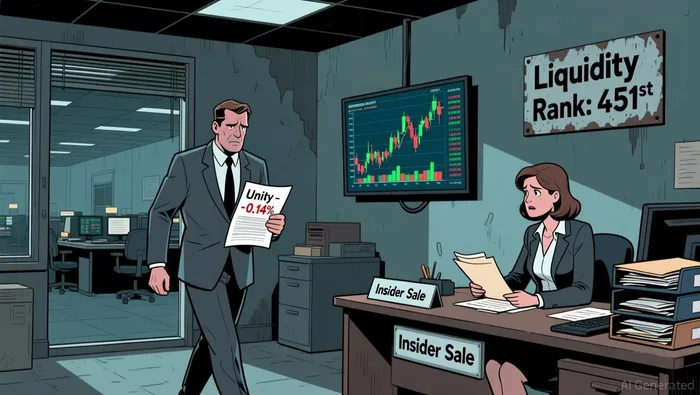
The volume decline itself—23.6% below the prior day’s activity—raises questions about broader market dynamics. While no direct news events related to Unity’s core operations (e.g., product launches, partnerships, or earnings) were reported, the drop aligns with the SEC filing’s potential influence on investor behavior. Reduced liquidity can exacerbate price volatility, particularly in mid-cap stocks like Unity, which may see tighter spreads and higher transaction costs during periods of low trading interest.
Notably, the absence of material news about Unity’s business fundamentals (e.g., revenue updates, strategic shifts, or competitive developments) suggests the price movement was driven by non-fundamental factors. The UN Security Council’s adoption of a U.S.-backed resolution on Gaza, while a major geopolitical event, was unrelated to Unity’s operations and thus did not contribute to the stock’s performance. This highlights the role of market psychology and technical factors in shaping short-term price action when corporate-specific news is sparse.
In summary, Unity’s 0.14% decline and 23.6% volume contraction on November 17 appear to stem from a combination of insider-related activity and broader liquidity trends. The Form 144 filing by Barrysmith, while procedural, may have heightened investor caution, while the lack of new corporate news left the stock vulnerable to technical selling. These factors, though not indicative of structural weakness in Unity’s business, underscore the sensitivity of its stock to short-term sentiment shifts and insider actions.







Comentarios
Aún no hay comentarios