
Uniti's Merger with Windstream: A Strategic Debt Restructuring and Market Consolidation Play
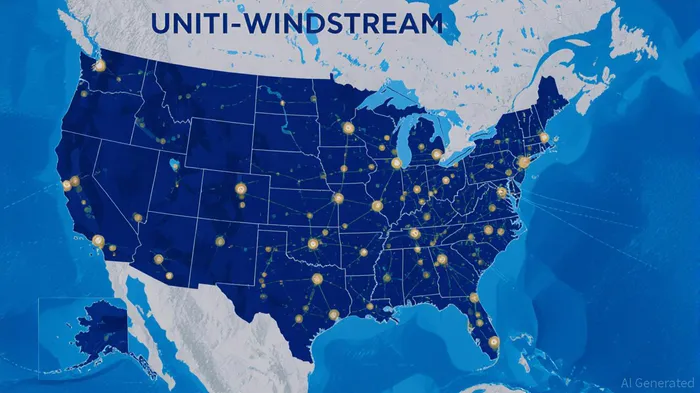
The telecommunications and fiber infrastructure sectors are undergoing a seismic shift, driven by the urgent demand for high-speed connectivity in underserved markets. At the center of this transformation is UnitiUNIT-- Group's (UNIT) $10 billion merger with Windstream, a transaction that redefines the competitive landscape for fiber providers. By merging Uniti's 147,000-mile national wholesale fiber network with Windstream's 1.1 million customer base in fiber-to-the-home (FTTH) services, the combined entity emerges as a formidable insurgent in the $120 billion U.S. fiber market. This analysis evaluates the financial and operational synergies of the merger, its implications for long-term shareholder value, and the broader industry dynamics shaping its success.
Strategic Rationale: From Landlord-Tenant to Symbiotic Operator
Uniti and Windstream's prior relationship was marked by inefficiencies: Uniti leased fiber infrastructure to Windstream, creating a structural misalignment of incentives. The merger eliminates these dis-synergies, transforming the relationship into a vertically integrated model. By consolidating ownership, the combined company gains full control over its $147,000 fiber route-mile network, enabling faster deployment of FTTH services in Tier II and III markets—a strategic sweet spot where legacy providers like AT&T and VerizonVZ-- have historically underinvested.
The financial rationale is equally compelling. The merger is projected to generate $100 million in annual operating expense synergies and $20–$30 million in capital expenditure savings within 36 months. These savings stem from eliminating redundant management structures, consolidating vendor contracts, and optimizing network utilization. For Uniti shareholders, the improved leverage profile—from 6.0x to 4.8x post-merger—reduces debt burdens while preserving flexibility for future growth. Meanwhile, Windstream shareholders receive a mix of $425 million in cash, $575 million in preferred equity, and 38% of the combined company's common shares, aligning long-term incentives.
Operational Synergies: Scaling for Growth in a Fragmented Market
The merger's operational impact is twofold. First, it accelerates the combined company's ability to scale FTTH buildouts. With 1.5 million homes passed and a pipeline for 1.1 million customers, the entity is well-positioned to capitalize on the 10% annual growth in U.S. fiber subscriptions. Second, the integration of Windstream's customer base with Uniti's wholesale services creates a diversified revenue stream. For instance, Uniti's existing partnerships with MicrosoftMSFT-- and AT&T for cloud connectivity can now be paired with Windstream's residential services, enabling cross-selling opportunities.
The competitive positioning is equally robust. While AT&T and Verizon dominate urban markets, the merged entity targets the $30 billion opportunity in mid-tier and rural markets. With 8.8 million fiber strand miles and a management team led by Uniti's CEO Kenny Gunderman, the company is uniquely equipped to outmaneuver smaller competitors. Notably, the merger's $20 billion valuation (post-debt) reflects a 12x EV/EBITDA multiple—a premium to peers like Lumen TechnologiesLUMN-- (LUMN) and Cogent CommunicationsCCOI-- (CCOI), which trade at 9x and 7x, respectively.
Industry Trends: Fiber Consolidation and the Rise of Insurgent Players
The fiber infrastructure sector is witnessing a wave of consolidation as companies seek to balance capital-intensive growth with profitability. In 2024 alone, fiber-centric M&A accounted for 11.3% of all infrastructure deals, driven by private equity's appetite for scalable assets and the need for scale in a capital-intensive industry. The Uniti-Windstream merger mirrors this trend, leveraging a mix of cash, preferred equity, and common shares to preserve liquidity while aligning with investor expectations.
Moreover, the merger aligns with broader industry shifts. The U.S. fiber market is projected to grow at a 7% CAGR over the next eight years, fueled by the Federal Communications Commission's (FCC) broadband expansion mandates and private sector investments. AT&T's Gigapower joint venture with BlackRockBLK--, for example, aims to pass 30 million homes by 2025, while Frontier Communications' $20 billion sale to Verizon underscores the sector's aggressive capital reallocation. In this context, Uniti-Windstream's focus on Tier II and III markets—a segment with 60% of U.S. households—positions it to capture underserved demand without competing directly with urban-focused incumbents.
Risk Considerations and Investment Implications
Despite its strategic merits, the merger carries execution risks. Integrating two distinct corporate cultures—Uniti's infrastructure-as-a-service model and Windstream's retail operations—requires careful management to avoid operational friction. Additionally, the combined company's net leverage of 4.8x, while an improvement from Uniti's standalone 6.0x, remains elevated compared to peers like Cogent Communications (1.5x). However, the $100 million in annual cost savings and free cash flow accretion projected post-merger should provide a buffer against rising interest rates and macroeconomic volatility.
For investors, the merger presents a compelling long-term opportunity. The combined entity's unique positioning in underserved markets, coupled with its ability to generate $100 million in annual synergies, supports a target stock price of $18–$20 (from a current $12) within 18–24 months. A further highlights its potential for outperformance. However, investors should monitor key milestones: the successful integration of Windstream's operations, the achievement of projected synergies, and the company's ability to maintain its credit rating.
Conclusion: A Win-Win for Shareholders and the Fiber Ecosystem
The Uniti-Windstream merger is more than a debt restructuring—it is a strategic repositioning in a sector primed for disruption. By combining Uniti's infrastructure scale with Windstream's customer base, the merged entity creates a self-sustaining ecosystem capable of driving growth in underserved markets. For shareholders, the transaction unlocks value through improved leverage, operational efficiency, and a diversified revenue model. For the industry, it sets a precedent for how insurgent players can leverage consolidation to challenge legacy incumbents.
As the fiber race intensifies, the combined Uniti-Windstream entity is well-positioned to emerge as a key player. With a clear path to free cash flow generation and a management team incentivized for long-term success, this merger represents a high-conviction opportunity for investors seeking exposure to the next phase of the digital infrastructure boom.







Comentarios
Aún no hay comentarios