
Uniti Group's Upsized $1.4 Billion Senior Notes Offering: A Strategic Move in Capital Structure Optimization
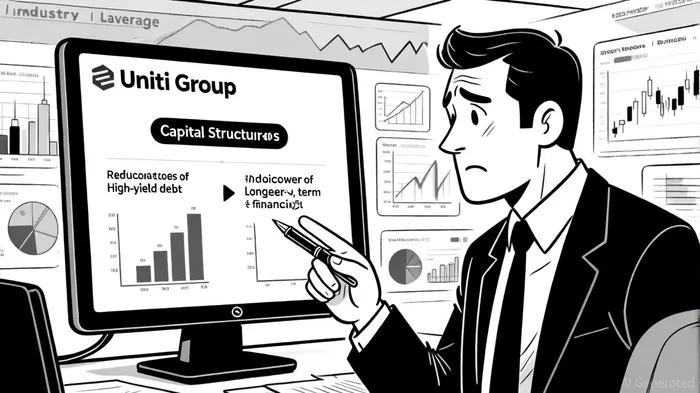
Uniti Group Inc.'s recent $1.4 billion senior notes offering—upsized from an initial $900 million—represents a pivotal step in its capital structure optimization strategy. By issuing 7.50% senior secured notes due 2033 at par value, the company aims to redeem its costly 10.50% senior secured notes due 2028, reducing annual interest expenses by approximately $35 million[1]. This refinancing, combined with a planned $1.0 billion incremental term loan at Term SOFR + 4.00%, underscores Uniti's focus on extending debt maturities and lowering near-term financial pressure[2].
Capital Structure Optimization: A Sector-Wide Imperative
The communications infrastructure sector is grappling with stagnant revenue growth and capital-intensive demands, particularly as companies invest in fiber expansion and AI-driven infrastructure[3]. Uniti's leverage ratio of 5.75x (as of Q2 2025) exceeds the industry average of 2.54x[4], highlighting the urgency of its debt management efforts. By swapping high-yield, short-term obligations for lower-cost, longer-term financing, UnitiUNIT-- aligns with broader industry trends. For example, Deloitte notes that telecoms are increasingly leveraging refinancing to “free up capital for strategic investments” in 5G and AI[5].
The company's prior actions—such as its $600 million 8.625% senior unsecured notes offering in June 2025—demonstrate a disciplined approach to reducing leverage. These moves have already improved Uniti's balance sheet, with unrestricted cash rising to $740.7 million by Q2 2025[6]. The latest offering further cements this strategy, with proceeds earmarked to eliminate $1.25 billion in high-cost debt and fund general corporate purposes[1].
Market Signaling: Stability and Strategic Commitment
Debt refinancing is not merely a financial exercise but a signaling mechanism. By securing favorable terms for its 2033 notes—despite a challenging interest rate environment—Uniti conveys confidence in its operational resilience. This is critical in a sector where investor caution is heightened by macroeconomic headwinds, including rising rates and geopolitical uncertainties[7].
The offering also supports Uniti's post-merger integration with Windstream, a transaction expected to close in Q3 2025. The combined entity, with $11.3 billion in assets and $8.48 billion in debt[8], will require robust liquidity to fund synergies and fiber deployment. By proactively addressing its capital structure, Uniti signals to stakeholders that it is prepared to navigate the complexities of integration while maintaining financial flexibility[9].
Investor Perceptions and Strategic Risks
While Uniti's strategy has been met with cautious optimism, its $4.2 billion debt burden remains a constraint[10]. However, the company's strong fiber infrastructure and long-term customer contracts—key strengths identified in Q3 2025 analyses—provide a stable cash flow foundation[11]. Additionally, Uniti's 2025 guidance for $966–$986 million in adjusted EBITDA[12] suggests confidence in its ability to service debt while investing in growth.
Investors are also watching how Uniti navigates the broader “refinancing wall” facing U.S. corporations, as maturing debt in the coming years could strain liquidity[13]. Yet, the company's proactive approach—refinancing $2.4 billion in obligations ahead of schedule—positions it to avoid potential disruptions[1].
Conclusion: A Calculated Path Forward
Uniti's upsized notes offering exemplifies a strategic, if aggressive, approach to capital structure optimization. By reducing interest costs, extending maturities, and aligning with sector trends, the company is positioning itself to withstand macroeconomic pressures while funding its transformation into a leading communications infrastructure provider. For investors, the offering signals both the challenges and opportunities inherent in a sector poised for technological reinvention.





Comentarios
Aún no hay comentarios